The key facts
- Geopolitical instability, government bond rates and the AI boom dominated the IMF meetings in Bangkok
- The IMF praised the UK's fiscal plans; Chancellor John Healey called 2026 economic growth strong
- The 'second China shock' — the rapid rise of Chinese dominance in electric vehicles — has prompted the EU to rethink trade policy
The tug-of-war of the global economy
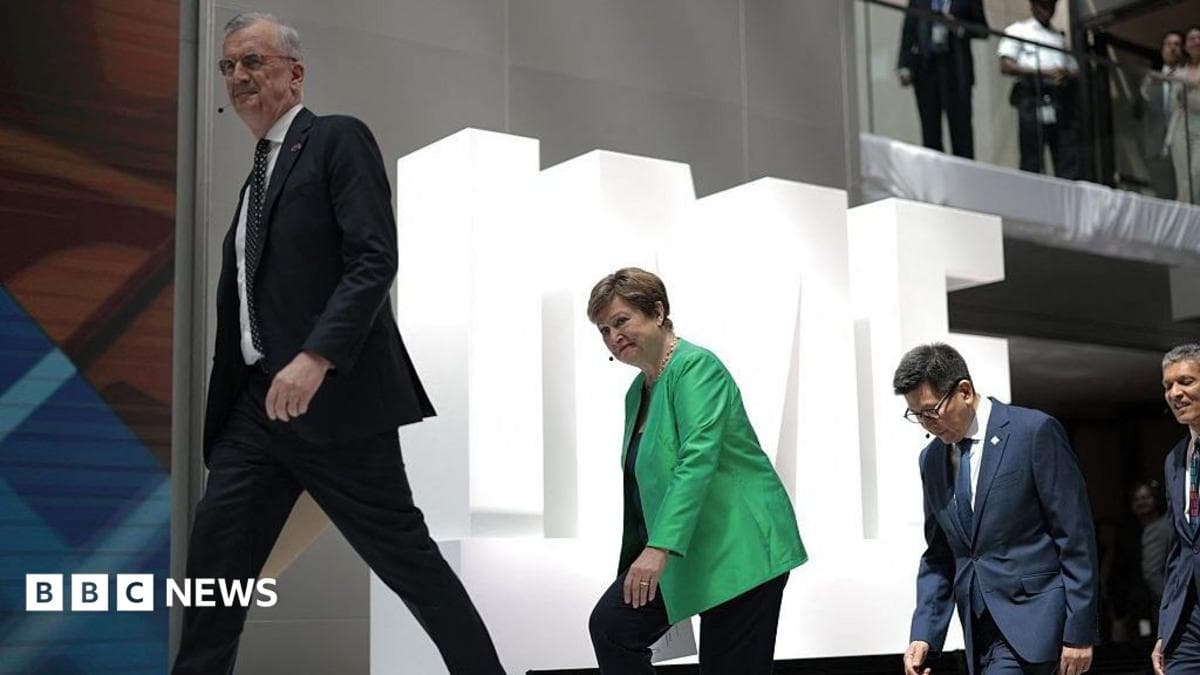
BBC economics editor Faisal Islam, back from the annual IMF meetings in Bangkok, describes the state of the global economy as a 'tug-of-war'. Familiar crises hold back growth — the energy shock, trade conflicts and real wars, most vividly reflected in the rapidly rising debt servicing costs of advanced economies. Pulling in the opposite direction are massive AI spending and, according to the author, remarkable resilience, especially of small economies that have built new trade routes out of necessity, including oil and gas. These themes, Islam notes, recurred at the meetings even at the highest level, but even the 'top table' participants do not know where it will all go.
Bond markets: the US, France and the 'model pupil' UK
In the author's phrase, bond market attention is a kind of sporting bet, and it is currently fixed on the US and France. French finance minister Roland Lescure nevertheless said he has no problems selling debt, although borrowing costs more, and that his budget is in order. He also said he helped save the 'G7', which a year ago risked falling apart amid tensions caused by Donald Trump. Islam notes that the absence of a global recession or a debt crisis in a major emerging economy can be considered something of a miracle: the Thai finance minister, he says, boasted about how little his borrowing had grown compared with the US. The UK was a surprise too: it was taken off the bond markets' 'punishment steps', and the IMF called it a 'model pupil', taking the government's fiscal plans on trust — which, the author remarks, is not the case for the rest of the G7. This gave Chancellor John Healey the chance to stress that the UK's hard growth data continues to exceed expectations and may be described as strong in 2026. Healey told Islam that he sees in these figures the first sign that AI and technology investment is beginning to accelerate UK economic growth; bond financiers at the meetings, the author observed, are once again taking a close look at the UK after years of crises.
The 'second China shock' and electric vehicles
The third big challenge, alongside geopolitical instability and bond market uncertainty, is visible even on the streets of Bangkok. Thailand, sometimes called the 'Detroit of Asia' for its own automotive history, has experienced a boom in Chinese electric vehicle sales: now almost a third of all car sales are Chinese electric cars. This, in the author's formulation, is the most vivid example of the so-called 'second China shock' — the rapid dominance of the PRC in advanced manufacturing, whereas the first shock hit basic manufacturing in the 2000s. This wave has in recent months led to a reassessment of how global trade functions and how it will be governed, especially in the EU, which is urgently rethinking what now feels like 'one-way traffic' in China's trade with Europe. The 'Made in Europe' protection measures being prepared by Brussels will also affect the UK: if it ends up outside the new rules, China could redirect excess car production to the UK, where tariffs are still lower and subsidies exist; or the EU could invite Britain inside, but ask it to raise tariffs in line with its own.
'Divorced — and dating again': the UK-EU theme
The UK's relations with the EU, according to the author, came up in Bangkok more often than one might have expected, and even added a bit of entertainment. IMF Managing Director Kristalina Georgieva joked, laughing, that 'the Brexit-divorced are starting to date again'. The Finnish finance minister told Islam that the UK is 'flirting' with the EU, and major banks published reports on the prospects of 'Breturn' — Britain's return.
AI: springboard or threat
It is the AI boom, the author writes, that is being counted on as the springboard to push the global economy out of an era of multiple simultaneous crises, many of which are linked to President Trump's decisions. But here too everything is ambiguous: in one hall finance ministers extol AI's transformative economic effect, while in the next, central bank governors worry about its ability to hack the cybersecurity of much of the banking system. The financial boom around AI cannot last forever, Islam notes, and the 'masters of the financial universe' are merely grateful that it is continuing for now.
 Image source, AFP via Getty Images


