The key facts
- Of the 54.5 GW coal pipeline (2014), only the Afşin-Elbistan projects (under appeal) and a new Cenal unit remain
- Wind and solar account for a third of installed capacity; the target is 120 GW by 2035
- Fuel import savings of $21.5 billion over 2015–2025 (energy ministry estimate)
Coal plans have nearly vanished, renewables are growing
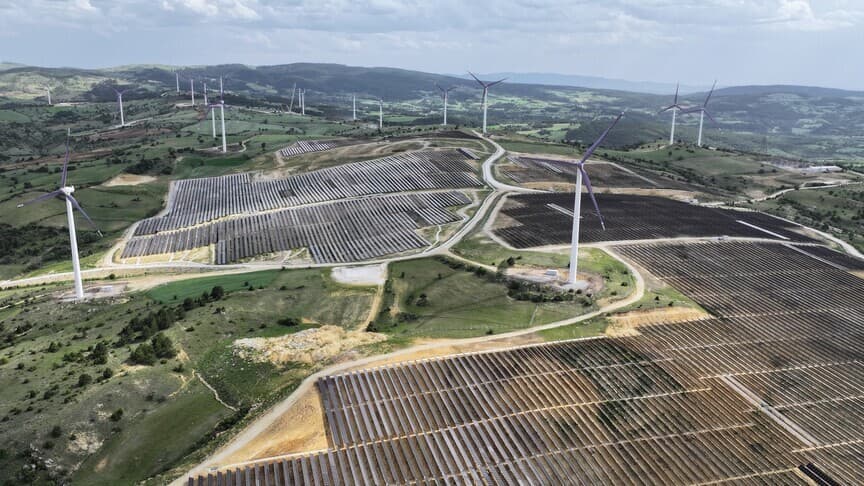
Turkey's power system has changed noticeably over the past decade, write Global Energy Monitor analysts Christine Shearer and Zhanaiym Kozybay in a column for Anadolu. In 2014, the country's coal pipeline stood at 54.5 GW — only China and India had more. According to GEM, almost all of these projects have since been delayed or cancelled; only a few proposals remain, including the expansion of the Afşin-Elbistan plant (under appeal) and a new unit at the Cenal plant in Çanakkale. At the same time, wind and solar grew rapidly: they now account for a third of installed capacity, and the government plans to triple their combined capacity to 120 GW by 2035.
Savings and energy security
According to Turkey's Ministry of Energy and Natural Resources, the growth of wind and solar generation in 2015–2025 displaced fossil fuel imports equivalent to $21.5 billion. Wind and solar are the most cost-competitive options for new generation and the fastest-growing additions to the power system. Turkey is also among the world leaders in planned battery storage paired with renewables. The authors note that expanding renewables beyond current plans could yield additional savings, especially as electrification grows. Recent disruptions in global energy markets due to the war with Iran, in their view, have underscored the advantage of renewables, which do not depend on rising international fuel prices, including coal.
Problems with domestic coal
Domestic coal has traditionally been seen as an energy security tool, but, as the energy ministry points out, 93% of Turkey's coal resources are low-grade lignite and asphaltite, which require burning more fuel and produce more pollution. An Ember analysis showed that due to frequent outages, only about half of the 10.4 GW of domestic coal power plant capacity is available at any given time; their downtime is five times higher than that of plants running on imported coal. At the same time, domestic coal remains an important source of employment in several regions, and a Greenpeace analysis suggests that renewable energy investments could create thousands of new jobs in the Afşin-Elbistan region alone.
The European market and CBAM
An additional incentive comes from changing trade standards: the EU's Carbon Border Adjustment Mechanism (CBAM) officially entered into force in January 2026, introducing a carbon price on the embodied emissions of imports — steel, aluminium, cement and electricity. In early 2026, Turkey was among the leading suppliers of goods covered by CBAM, which creates an economic incentive to reduce the carbon intensity of industry and power generation. The European Commission is also examining indirect emissions from electricity used in producing imported goods, including accounting for power purchase agreements. The authors conclude that Turkey's energy transition is linked not only to climate commitments but also to industrial competitiveness and trade with Europe. The article is an opinion piece and does not necessarily reflect Anadolu's editorial position.


