The key facts
- Zelensky requested an additional €70 billion from the EU for 2026; leaders tasked the European Commission with preparing a proposal
- The Irish presidency's negotiation document cutting the budget by €141 billion was declared dead; António Costa is preparing a new compromise for the 26 November summit
- Leaders condemned Trump's diesel deal with Putin; Bulgaria supported it
Unity around Ukraine amid the conflict with Trump
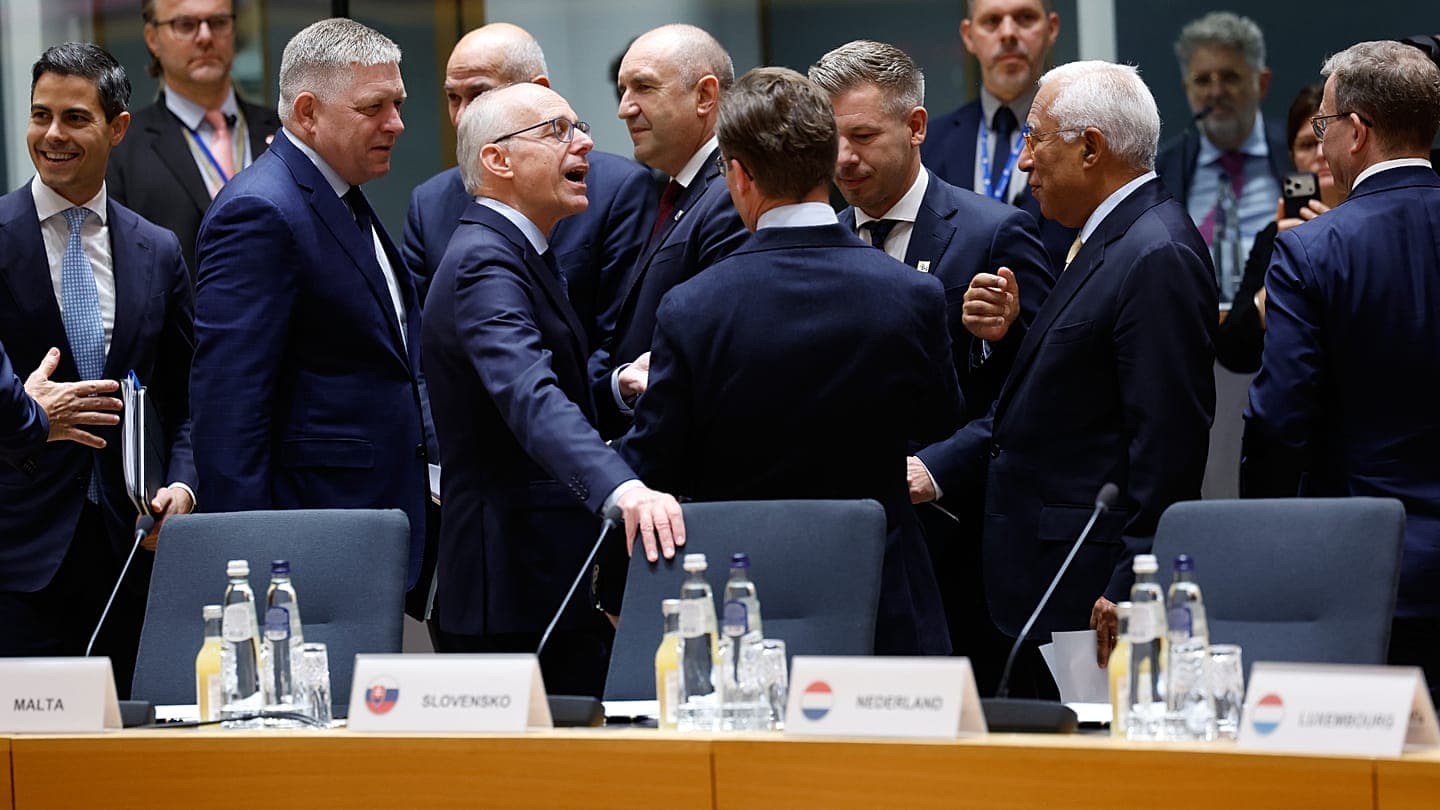
EU leaders gathered in Brussels on Thursday and Friday with an agenda that included the long-term budget, support for Ukraine, migration, energy and relations with China. The main topic of the second day was the conflict between Ukrainian President Volodymyr Zelensky and US President Donald Trump. EU leaders demonstrated unity around Zelensky and pledged to maintain sanctions as long as Russia continues its full-scale invasion. They condemned the diesel deal concluded by Trump with Vladimir Putin, although Bulgaria's prime minister broke ranks and supported the deal. Trump, meanwhile, said dealing with Zelensky was 'harder' than with Putin, demanded new elections in Ukraine and called Kyiv's strikes on Russian oil refineries a 'disgrace'. Zelensky responded: 'I am exclusively defending the interests of Ukraine and the Ukrainian people. We were attacked, we were occupied, our people were killed. It is logical that we have the right to self-defence.'
The €70 billion request and a difficult search for funding
In his address, Zelensky asked for an additional €70 billion in financial and military aid for the coming year to counter Russia's escalation. This request upends the union's previous plans, under which last year's €90 billion loan was supposed to cover the needs of 2026 and 2027. Leaders tasked the European Commission with preparing a proposal to close Kyiv's financial gap. According to Euronews' assessment, the task will not be easy: rising borrowing costs make joint debt unpopular, frozen Russian assets — which Zelensky once again urged to tap — remain politically contentious, and bilateral contributions risk shifting the burden onto a few wealthy countries.
EU budget: the compromise handed to Costa
Thursday's discussion of the next multiannual financial framework (MFF), as expected, barely moved forward: 'frugal' donor countries and 'friends of cohesion' from the south and east dug into their positions. The Irish presidency's negotiation document, which proposed cutting the budget by €141 billion, has officially been declared defunct. Negotiations will be led by European Council President António Costa, who in the coming weeks will present a new compromise — expected by the special summit on 26 November, a few days before Spain's elections. Costa is expected to work along three lines: minimising national contributions, reworking the package of pan-European taxes building on European Parliament proposals, and restoring the trimmed flexibility instruments. At the same time, leaders on both sides openly state they feel no need to reach a deal by the end of the year, which experienced negotiators consider risky: a failed deal in December would push negotiations past an electoral season capable of reshaping Europe's political map.
Migration: Rome and Madrid move closer amid hard rhetoric
Migration once again became one of the most contentious topics after June's spat between Pedro Sánchez, on one side, and Giorgia Meloni and Mette Frederiksen on the other. This time, Italy and Spain apparently took a first step towards resolving the border dispute that arose after a series of mutual checks amid the Ceuta crisis: Italy's temporary border controls, which were due to expire on Thursday evening, were extended by a week, synchronised with the Spanish deadline of 22 October, by which the interior ministers of the two countries must agree on replacement measures. Frederiksen, meanwhile, criticised Sánchez's plan to legalise the status of 600,000 migrants: 'I have asked the European Commission to look into what happens when one country does almost the exact opposite of what the rest of us are doing.' Meloni, Frederiksen and Dutch Prime Minister Rob Jetten held an informal breakfast with 17 other leaders to discuss 'innovative solutions'; support is growing for emergency measures allowing the suspension of asylum applications during crises. Italy, Denmark and Poland sought the inclusion in the conclusions of wording against 'measures creating incentives for illegal migration', but the final text contains only a call for the Commission to coordinate with member states action 'on all forms of instrumentalisation'.
China: demands for new trade instruments
On the question of 'macroeconomic imbalances' — a formulation that avoids naming China directly — leaders kept their course despite the European Commission's deal with Beijing to restrict hybrid car imports. Over Thursday's dinner, they demanded that the Commission prepare a set of trade defence instruments, including safeguard measures with quotas and tariffs, for the chemical and engineering industries, against the backdrop of the EU's trade deficit with China of around €360 billion. According to Chinese customs data, Chinese exports to the EU grew by 25% over the year. While car quotas were agreed with Beijing, leaders called for unilateral safeguard measures 'without delay'. German Chancellor Friedrich Merz said: 'Competition must be fair. We will create instruments against the use of overcapacity, against high subsidies, against undervalued currencies. This toolbox will become broader. It will be applied as needed.' Ursula von der Leyen said the Commission is starting work on such an instrument, but it is unclear whether it will be ready by the end of the year. Also being developed are a mechanism to diversify suppliers of strategic goods and a solidarity mechanism for countries affected by possible Chinese retaliatory measures.
Energy: a dispute over prices and the emissions trading system
On Thursday, leaders let the energy discussion drag on: the Visegrád Four (V4) and Italy demanded changes to the summit conclusions, calling on the Commission to propose measures against short-term electricity price spikes and to revise the proposed emissions trading system (ETS). The initiative by the V4, Italy and, to a lesser extent, Greece is attributed to some of the highest energy costs in Europe; other countries ultimately called for a coordinated pan-European response to the energy crisis. The attempt to revise the ETS met resistance from Finland, Denmark and Sweden — the system obliges companies to pay for emissions and incentivises investment in sustainable development. Czech Prime Minister Andrej Babiš, by contrast, criticised the carbon tax, accusing it of undermining Europe's competitiveness and raising energy prices for the benefit of market speculators. 'All day at leaders' level we dealt with edits on a technical issue. This does not lead to any new measures that would actually help member states,' one EU official lamented. According to Euronews, Rome and the V4 understand they lack a qualified majority to revise the carbon market rules, and the goal was to signal to a domestic audience that they are fighting rising prices.