The key facts
- Villages in Ayutthaya province have been flooded for the sixth year in a row: water rises above head level and stays for months
- Raising a house on stilts costs from 100,000 to a million baht (about €2,700–27,000); some families have done it twice
- The government is building a €700 million bypass canal designed for 1,200 cubic meters of water per second, with completion planned by 2030
Life in a flooded house
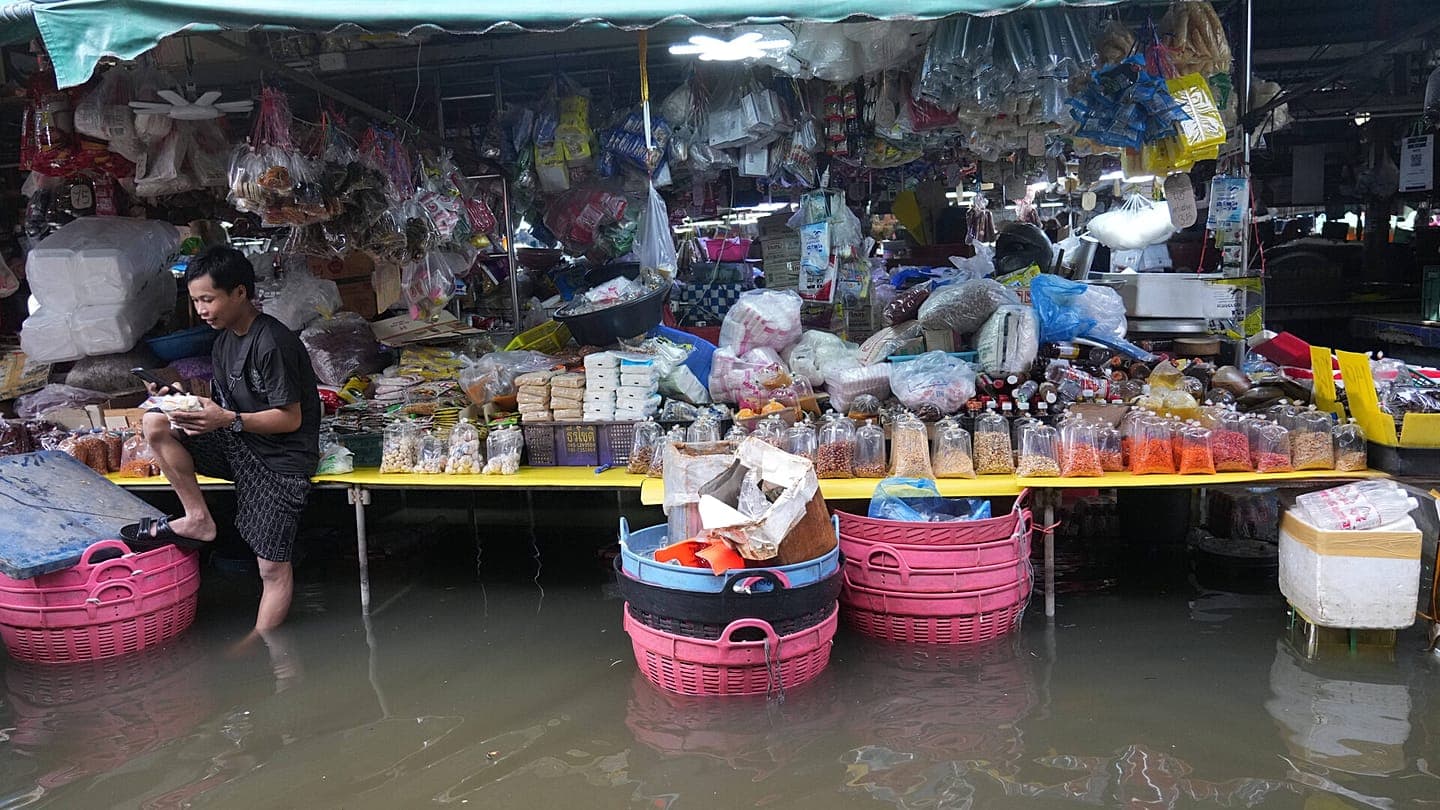
In the central Thai province of Ayutthaya, the family of 34-year-old Kamonchanok Sathaponamonwut lives in a house raised more than three meters above the ground: they sleep on temporary platforms, the toilet is flooded. Their village has been flooded for the sixth year in a row — some residents leave, others raise their houses even higher. 'Our district simply can no longer cope with this amount of water,' she says. According to her, the authorities primarily protect Bangkok and business centers, while 'they simply forget about our residential areas.' Kamonchanok has to commute to work by boat and lift household appliances above the water level. About 20 kilometers from the temple ruins of Ayutthaya, a UNESCO World Heritage Site, residents say that water that used to reach the knees now rises above head level in some places and stays for several months.
How the protection system was built
Floods in Thailand occur annually during the rainy season; scientists link the increasing frequency and intensity of downpours and floods to human-caused climate change. After the devastating floods of 2011, the government expanded dikes, spillways and other infrastructure to divert water away from Bangkok, historic Ayutthaya and industrial zones along the Chao Phraya River. The protective structures largely spared the commercial centers, but residents of other areas were left to face the disaster alone.
The 'cruel' price of protection
Thanet Somboon, a representative of Thailand's Royal Irrigation Department, explains the more severe floods downstream by climate change, low-lying terrain and recently built dikes that have altered the natural flow of the Chao Phraya: 'Even when water is released from the dam at the same rate as before, the consequences are now more noticeable.' When the irrigation canals fill up, he says, the authorities 'have no choice but to release the excess downstream.' At the same time, he admits that the infrastructure may have to be reconsidered. Environmentalist Sasin Chalermlarp believes the government handled flood management on the central plains 'very well,' but its actions turned out to be 'cruel' toward those who bore the brunt. According to him, whereas floodwaters used to spread across most of Ayutthaya, they are now concentrated on only 'five to ten percent' of the province's territory. This autumn, in the low-lying areas that serve as floodwater release zones, entire villages found themselves underwater: some houses are abandoned, others are flooded up to the roofs.
Rising costs for residents
Residents raise their houses on stilts at their own expense: according to them, it costs from 100,000 to a million baht (about €2,700–27,000) depending on the size and height. Kamonchanok's family raised the house twice in the 1990s, the second time by 1.5 meters, but the water still reached the house in 2011 and then for six years in a row. Some families raised their houses twice over several years, exhausting their savings and going into debt. Eighty-seven-year-old Sawong Raksri spent more than a million baht (about €27,000) on raising her house: 'In recent years it floods every season. What's the point of complaining?'
A 'flood-free living tax' and a bypass canal
Sasin Chalermlarp, who lives in the protected part of Ayutthaya, acknowledges that the low-lying terrain makes these places a natural path for floodwaters, but emphasizes: 'Villagers have no choice. They are forced to sacrifice themselves.' He proposed introducing a 'flood-free living tax' on those who benefit from the protective structures, in order to help affected families. Thanet Somboon said the idea deserves further study to understand 'how to support people who sacrifice their land to receive floodwaters.' The government's flagship project is a bypass canal costing €700 million, designed to carry 1,200 cubic meters of water per second (about half the volume of an Olympic swimming pool) around the section where the Chao Phraya narrows at Ayutthaya. Completion is planned by 2030. Until then, Kamonchanok says, the community is not even demanding an end to deliberate flooding, only limits on the water level and financial assistance for those whose homes lie below the flood line: 'All we ask for is the chance to live normally in our own homes. Why can't they give us that?'