The key facts
- For the first time since the start of the war with Iran in late February, delegations of conflicting Middle Eastern and Asian countries met in Baku at the seventh CICA summit on October 15, 2026.
- For the first time since the war with Iran began in late February, delegations from conflicting Middle Eastern and Asian countries met in Baku at the seventh CICA summit on October 15, 2026.
- During Israeli President Isaac Herzog's address, the delegations of Turkey, Iran, Kuwait and Pakistan left the hall; the Emir of Qatar and the delegations of the UAE and Bahrain stayed.
- The Baku Declaration was adopted, including CICA's first unified consensus on the balance of opportunities and risks of AI; Azerbaijan's chairmanship was extended for 2026–2028, and Laos was admitted as a full member.
- The Baku Declaration was adopted, including CICA's first unified consensus on balancing AI opportunities and risks; Azerbaijan's chairmanship extended for 2026–2028, and Laos admitted as a full member.
A Rare Platform for Conflicting Sides
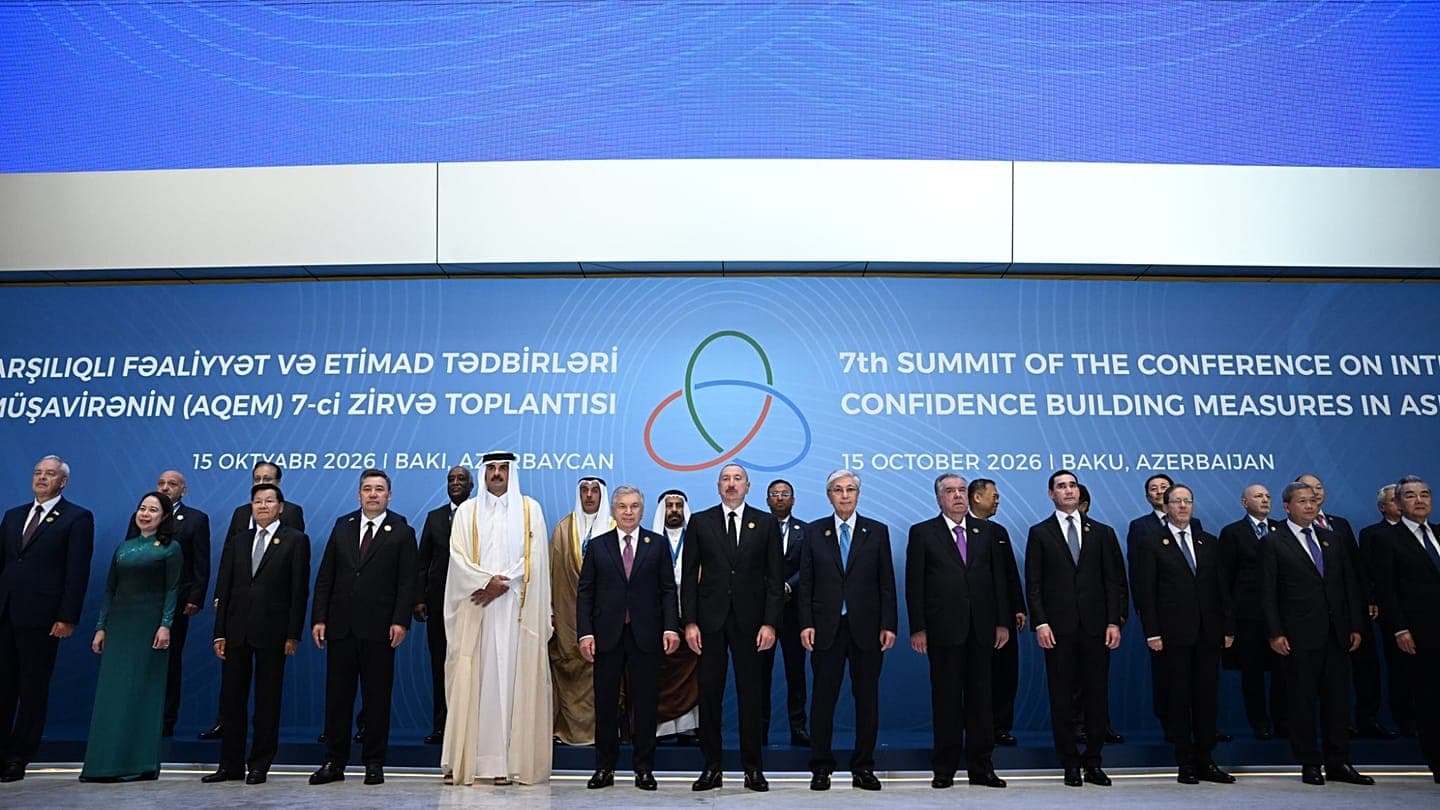
On October 15, 2026, the seventh summit of the Conference on Interaction and Confidence-Building Measures in Asia (CICA) was held in Baku, hosted by Azerbaijan. According to Euronews, for the first time since the start of the war with Iran in late February, high-level delegations of conflicting countries of the Middle East and Asia gathered together. President of Azerbaijan Ilham Aliyev brought together Israeli President Isaac Herzog, Iranian Deputy Foreign Minister Kazem Gharibabadi, Turkish Foreign Minister Hakan Fidan, Russian Foreign Minister Sergey Lavrov, Emir of Qatar Sheikh Tamim bin Hamad Al Thani, UAE Minister of State for Foreign Affairs Khalifa bin Shaheen Al Marar, and a Palestinian delegation led by Foreign Minister Varsen Aghabekian Shahin, as well as Chinese Foreign Minister Wang Yi. On the opening day, they were joined by the presidents of Uzbekistan, Kazakhstan, Kyrgyzstan and Tajikistan and the heads of state and government of China, Laos, Cambodia, Vietnam, India and Sri Lanka. The agenda included regional security, transport connectivity, digital interaction and sustainable growth.
Aliyev: Azerbaijan Is a Connecting Hub of Eurasia
In his opening speech, Aliyev stated that Azerbaijan, 'geographically located at the junction of Asia and Europe, is playing an increasingly important role as a connecting hub in the Eurasian space.' According to him, the country's bilateral and multilateral cooperation in political, economic, transport, energy and humanitarian spheres 'strengthens the security system in our region.' He also noted the importance of the fact that the participating states agreed to attend the summit side by side in troubled times. Later, Aliyev delivered a speech about the wars with Armenia over Karabakh, stating: 'we drove the occupiers out of our lands,' but 'did not seek revenge on them for 30 years of suffering, genocide and the destruction of our cities and villages.' He said that 'for a little over a year we have been living in peace,' calling this peace 'fragile,' one that 'needs to be protected and strengthened.' Aliyev also criticized 'double standards and selective approaches' in interstate relations and once again criticized the European Parliament and the Council of Europe, calling their policy toward Azerbaijan 'outdated.'
Herzog's Visit and Sideline Meetings
Israeli President Isaac Herzog arrived in Baku on Wednesday and held a meeting with Aliyev, whom he called a friend. In posts on X, he called Azerbaijan 'an important partner of Israel in the region' and said the visit was aimed at strengthening ties in security, energy and trade; his office announced plans to meet with the local Jewish community. Herzog praised the 'excellent' relations between the two countries, based, in his words, on mutual respect, shared interests and historical ties, and added that the sides discussed recent events in the region and a commitment to stability and security. Judging by photos and videos of the arrival, Herzog flew to Baku on a commercial Azerbaijan Airlines flight — likely to be able to fly through Turkish airspace. He also held, in his words, an 'excellent meeting' with Bahraini Foreign Minister Abdullatif bin Rashid Al Zayani, discussing the friendship between the two countries and the significance of the US-initiated Abraham Accords. Euronews notes that since the start of the war with Iran, Bahrain has been subjected to intense Iranian strikes, and relations between the two countries have long remained cold. Herzog also held talks with the President of Kazakhstan.
Tense Moments and Middle East Speeches
When Herzog began his address at the summit, the delegations of Turkey, Iran, Kuwait, Pakistan and other countries left the hall; however, the Emir of Qatar and the delegations of the UAE and Bahrain remained. Herzog stated that Israel 'is focused on practical cooperation and pursues common and mutual interests,' called the presence of representatives of Bahrain and other Arab countries 'noteworthy,' and reaffirmed commitment to cooperation in technology and water management, noting the upcoming visit of US Secretary of State Marco Rubio to Uzbekistan. Al Zayani, speaking as a non-permanent member of the UN Security Council, called for 'the full implementation of resolution 2317, co-sponsored by 136 states.' He stated that the disruption of shipping in the Strait of Hormuz and the dangers in the Bab el-Mandeb Strait threaten global supply chains: about 1,600 vessels are detained and more than 23,000 seafarers are deprived of their freedom. He also condemned this week's Houthi attacks on the airports of Riyadh, Abha, Jizan and Najran, calling them 'a serious violation of international law and the Chicago Convention.' Chinese Foreign Minister Wang Yi stated that Asia 'does not need a Cold War mentality' and 'does not welcome bloc confrontation,' called for a diplomatic settlement between the US and Iran, the preservation of unimpeded shipping in the Strait of Hormuz and the Red Sea, restraint in Yemen, and the earliest possible return of the Palestinian issue 'to the right path of a two-state solution.' Palestinian Foreign Minister Varsen Aghabekian Shahin addressed the humanitarian crisis in Gaza and the expansion of settlements, quoting recent Prime Minister Mahmoud Abbas's speech at the UN General Assembly that Palestinians will not accept displacement, and called for the swift implementation of UN Security Council resolution 2803 to guarantee a permanent ceasefire.
Transport, AI and Climate Initiatives
President of Kazakhstan Kassym-Jomart Tokayev proposed a CICA transport connectivity strategy, noting last year's signing of the document on strategic partnership between Kazakhstan, Azerbaijan and Uzbekistan and documents on creating the Caspian green energy corridor for supplies to the European market via the Black Sea, as well as the benefits through the Baku — Tbilisi — Ceyhan pipeline. Aliyev and Tokayev officially launched the trans-Caspian fiber-optic line along the bottom of the Caspian Sea, enhancing digital connectivity between Asia and Europe within the Middle Corridor. Tokayev also proposed adding artificial intelligence to the number of CICA's five key dimensions, as well as a partnership on water basins and a partnership on human capital with scholarships for all 28 member states, noting that Asia will account for 59% of global economic development this year, according to UN figures cited by President of Kyrgyzstan Sadyr Japarov. Turkmen President Serdar Berdimuhamedov proposed an International Code on Artificial Intelligence and Diplomacy; President of Tajikistan Emomali Rahmon announced that from 2027, August 31 will be officially celebrated in the country as National AI Professional Development Day. President of Uzbekistan Shavkat Mirziyoyev called for 'an infrastructure of trust in Asia' and warned: 'when dialogue weakens, the risk of wrong decisions grows.' He announced that Tashkent will host the 20th summit of the Non-Aligned Movement within two years. President of Laos Thongloun Sisoulith spoke about the country's transformation from a landlocked state into a transport hub thanks to the China — Laos railway, operational since 2021. Cambodian Prime Minister Hun Manet mentioned the Phnom Penh Declaration adopted following the conference on com
Kyrgyzstan's Focus on Regional Cooperation and Global Initiatives
The summit addressed the fight against online fraud involving 26 countries and seven international organizations. It was noted that delays in implementing the agreement on the border dispute with Thailand hinder the safe return of 20,000 Cambodians to their homes. President Sadyr Japarov pledged $10 million to a trust fund for protecting the glacier ecosystem of Lake Issyk-Kul and invited participants to the 'Bishkek +25' summit. Tajikistan highlighted the UN's decade-long peace initiative for 2027–2036 and the UN Water Conference scheduled for 2027–2028.
Baku Declaration and Summit Outcomes
Following the summit, member states adopted the Baku Declaration, outlining measures against military-political, economic, and environmental risks, as well as calls for inter-civilizational dialogue, tolerance, and educational innovation. The declaration established CICA's first unified multilateral consensus on balancing the economic opportunities and security risks associated with artificial intelligence. The summit concluded with a unanimous decision to extend Azerbaijan's chairmanship in CICA for the two-year period of 2026–2028 and to officially admit Laos as a new full member of the organization. Vietnamese Vice President Vo Thi Anh Xuan, noting CICA's more than 30-year history and Vietnam's 40 years of 'Doi Moi' reforms, outlined the country's goals to become a middle-income nation by 2030 and a high-income nation by 2045.