The key facts
- The Turkmen long-eared bat has been confirmed in the fauna of Uzbekistan for the first time — in South Ustyurt National Park, near the border with Turkmenistan.
- The species was described in 1988 as a subspecies of the grey long-eared bat and recognized as a separate species in 2006.
- According to the Berlin Museum of Natural History, the species may be threatened with extinction due to the drying of Central Asian deserts.
First find in Uzbekistan
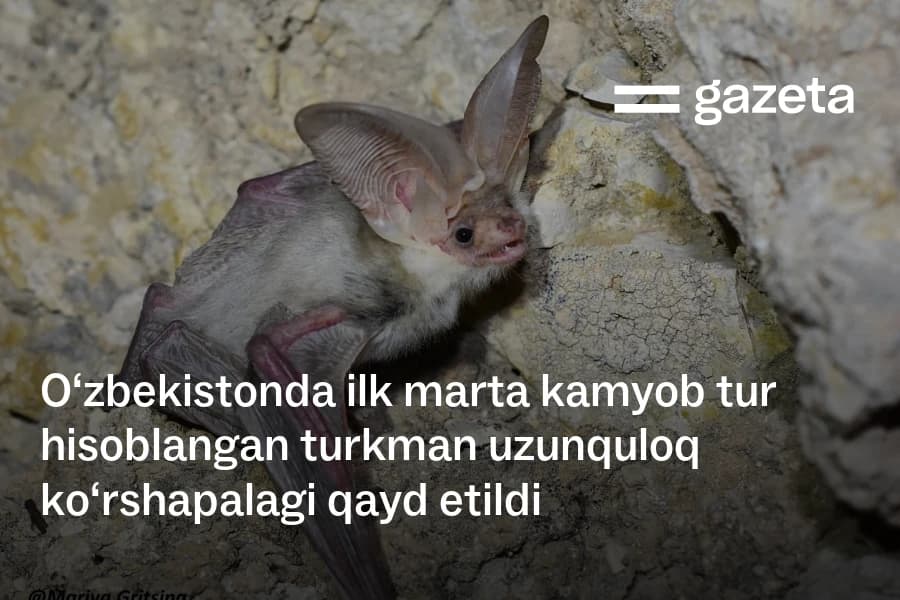
The Turkmen long-eared bat (Plecotus turkmenicus), a rare species of bats not previously confirmed in the fauna of Uzbekistan, has been discovered in the South Ustyurt National Nature Park. This was reported by the press service of the Academy of Sciences, citing scientists from the Institute of Zoology. The National Committee for Ecology and Climate Change specified that the animal was found in September near the border with Turkmenistan as part of an expedition under a project of the International Union for Conservation of Nature. According to the Academy of Sciences, over the past 55 years the species has been almost never encountered in the wild: before that, it was known from data collected before 1970 and from museum specimens.
History of the species
Maria Gritsyna, a senior researcher at the Institute of Zoology, said that information on the distribution and way of life of the Turkmen long-eared bat had until recently been extremely limited. In 1988, zoologist Pyotr Petrovich Strelkov described it as a subspecies of the grey long-eared bat (Plecotus austriacus), and in 2006 Friederike Spitzenberger and her co-authors, based on morphological and genetic studies, recognized the Turkmen long-eared bat as a separate species. Gritsyna emphasized that the find in Ustyurt became the first confirmation of the species' presence in the fauna of Uzbekistan and a new stage in the study of the country's biodiversity.
Previous find and threat to the species
In 2025, a group of researchers from Germany, Uzbekistan and Turkmenistan led by the Berlin Museum of Natural History worked in the Karakum Desert in Turkmenistan, where they recorded the Turkmen long-eared bat not far from the border with Uzbekistan; at that time it was assumed that the species also lived in the neighboring country. According to the museum, the Turkmen long-eared bat may be under threat of extinction due to climate change: due to the progressive drying of Central Asian deserts caused by rising temperatures, the natural vegetation cover is shrinking, and the species' already limited habitat is narrowing.
Conservation plans
According to the Berlin Museum of Natural History, the government of Turkmenistan plans to create a protected area of more than 50 thousand hectares in the desert area. It is expected that this will help protect not only bats but also other species, such as kulan and goitered gazelles.


