The key facts
- Greenhouse operators in Tashkent and the region proposed 'greenhouses' using gas, electricity, geothermal and solar energy, and waste heat from thermal power plants; if impossible, coal with certified boilers and filters is requested.
- Measurements on September 30 and October 8 revealed that a prototype filtration system based on Chinese technology failed to meet emission standards; the prototype will be improved.
- Subsidies and tax incentives are planned for those switching to clean technologies; the ban on greenhouses without environmentally safe heating in the capital region will remain in force.
Proposals from greenhouse operators
On October 12, the National Committee on Ecology and Climate Change of Uzbekistan reported on proposals from greenhouse operators in Tashkent and the Tashkent region regarding the transition to environmentally clean heating technologies. The possibility of maintaining their operations in the capital is being discussed, conditional on their transformation into 'greenhouses.' According to the committee, with the onset of cold weather and atmospheric inversion, complaints from residents about air pollution caused by emissions from coal-heated greenhouses have increased; appeals were received, in particular, from residents of the Yunusabad district, reporting deteriorating air quality and unpleasant odors. Specialists from environmental services responded to these appeals, conducted inspections, and collected air samples. The agency reminded that the main sources of air pollution in the capital are industrial enterprises, vehicles, and heating systems, and during the autumn-winter period, greenhouses near residential areas become an additional source.
Operating conditions and coal as a backup option
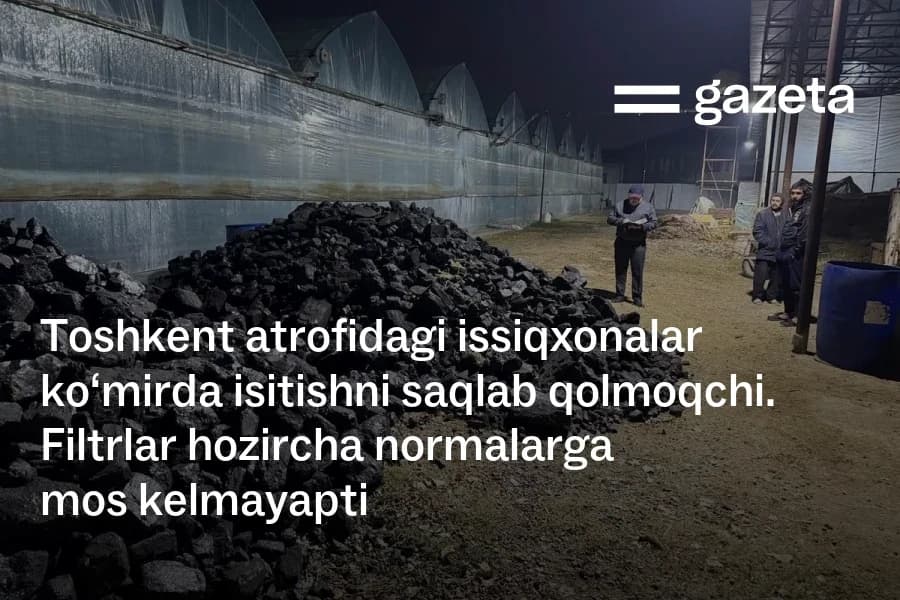
Representatives of greenhouse operators have repeatedly stated their readiness to modernize facilities, switch to energy-efficient heating systems, and reduce emissions to meet standards. The proposals include modern heating systems and real-time emission monitoring. Operators with existing heating systems and positive conclusions from state ecological expertise propose switching to natural and liquefied gas, electricity, geothermal and solar energy, as well as waste heat from thermal power plants. If these sources cannot be used, entrepreneurs request permission to use coal heating, provided that modern certified boilers with mandatory emission cleaning and filtration systems meeting environmental standards are applied, along with the installation of video surveillance systems transmitting data and video streams to the National Center for Ecological Monitoring.
Filter tests failed
The proposals were reviewed by a working group involving the National Committee on Ecology, the Ministries of Agriculture and Energy, and other bodies. Greenhouse operators presented a prototype of a comprehensive heating system consisting of boiler equipment and filters developed based on Chinese technology. Specialists from the National Center for Ecological Monitoring conducted several measurements using the approved methodology; the tests were carried out in the presence of representatives from the media and the Public Council under the committee. Measurements taken on September 30 and October 8 showed that the filtration system did not meet emission standards safe for public health. By agreement, the operators must improve the prototype, after which the working group will conduct repeat measurements. Additionally, a draft document establishing emission standards for filters of boiler equipment in greenhouses is being prepared.
Incentives and retention of the ban
For operators transitioning to clean technologies and transforming into 'greenhouses,' a package of subsidies and tax incentives is planned. Meanwhile, the ban on the operation of greenhouses not equipped with environmentally safe heating systems in the capital region will remain in force — the committee explains this by the harm emissions cause to public health.
Background
In November 2025, against the backdrop of deteriorating air quality in Tashkent, a decision was made to urgently convert all greenhouses in the capital and surrounding areas to gas heating. In June 2026, a special commission began dismantling greenhouses and disconnecting them from artificial heating systems in the Kibray, Tashkent, Zangiata, and Yangiyo'l districts of the Tashkent region; entrepreneurs were offered to relocate their operations to the 'Surkhon-Agro' free economic zone in the Sherabad district of the Surkhandarya region. Tashkent Mayor Shavkat Umurzakov, in an interview with 'Gazeta,' stated that for those wishing to continue operations in the capital region, the possibility of installing filters and using permitted fuel types with emission cleaning is being considered, for which financial support instruments are provided. Additionally, starting October 1, 2026, restrictions on the creation of new greenhouses in Tashkent and surrounding areas were planned.


