The key facts
- Prof. Axel R. Pries, president of the World Health Summit, calls the rise of a national approach to healthcare a 'political virus' spreading around the world.
- He believes Europe and Germany can become among the leaders of global health, but only in a multilateral format, ideally under the auspices of the WHO.
- He views bilateral data-for-aid agreements (the America First strategy) skeptically; the draft German Health Security Act will be discussed in early 2027.
'Political virus' of nationalism
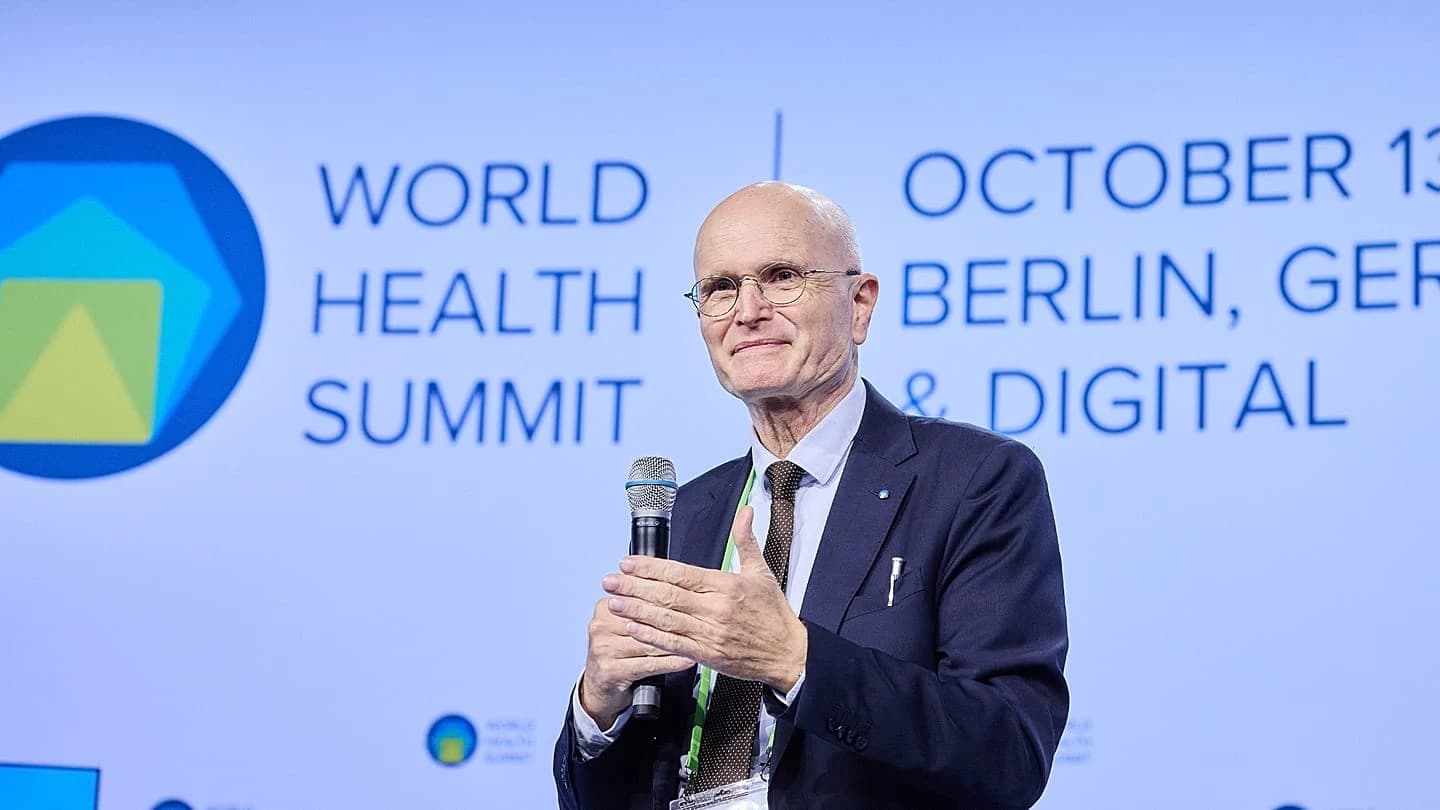
Professor Dr. Axel R. Pries, a physician and physiologist, formerly dean and member of the executive board of the Charité hospital, has headed the World Health Summit (WHS) in Berlin for six years now. In an interview with Euronews on the sidelines of the summit, he said that in recent years there have been more threats and crises in healthcare, and the focus should be on multilateral cooperation. At the WHS 2026 regional meeting in Nairobi in April, he said: 'We don't have a virus, but we have a political virus.' As he explained, many countries increasingly look at healthcare issues purely from a national, and sometimes nationalist, position, and this 'virus' is spreading around the world, blocking effective solutions. Local measures are necessary, but they must be coordinated at the global level: the COVID pandemic showed that problems — from infections to mental health and non-communicable diseases — cannot be solved only locally.
The role of Europe and Germany
Answering a question about the US withdrawal from global health policy, Pries said that Europe should not be the sole leader, but can and should be one of the leading centers. In his words, Europe is a strong platform for medical innovation: a few days ago, the Nobel Prize in Physiology or Medicine was awarded to scientists from Berlin and Würzburg for their work in optogenetics, and major companies operate in Europe — from medical technology to pharmaceuticals. Germany, as Europe's largest economy, is capable of setting the tone, but, Pries emphasized, only 'as part of the overall orchestra' — on equal footing with France, the United Kingdom and others. Speaking about dependencies on China, he noted that Europe finds it difficult to react quickly because of its diversity, but it also benefits from this richness; it is now important to prevent the emergence of strategic dependencies in healthcare.
Crisis preparedness law and bilateral deals
In Germany, a law on securing the healthcare system in crisis situations (Health Security Act) is being discussed, intended to close the gap in crisis preparedness; the draft is planned to be discussed in early 2027. Pries called this an important step within pandemic preparedness, but reminded that if every country, as was partly the case during COVID, holds critically important goods for itself, the whole chain collapses. Today, no country can fully produce medicines or vaccines on its own. Commenting on bilateral agreements exchanging medical data for development aid — a key element of the America First Global Health Strategy — he stated that the very name of the strategy points to its flaw, and such deals usually cement an imbalance of power. A fair exchange of 'data — resources or vaccines,' in his view, is possible only on a multilateral basis, through a supranational framework concept implemented by the WHO.
WHO reform and 'team play'
Pries advocates for the most multilateral global health system possible under the auspices of the UN and the WHO, while noting that WHO mechanisms need constant updating: reform would not hurt, but it must not take place under the influence of the 'virus' of abandoning multilateralism. He compared global health to football: for a team game, you need a referee and organization. Acknowledging that reaching agreement is not easy, he expressed hope that humanity will be able to develop multilateral cooperation not under the impact of a new catastrophe — as with the UN reform after World War II — but out of an understanding of necessity, for which energy and optimism will be required.


