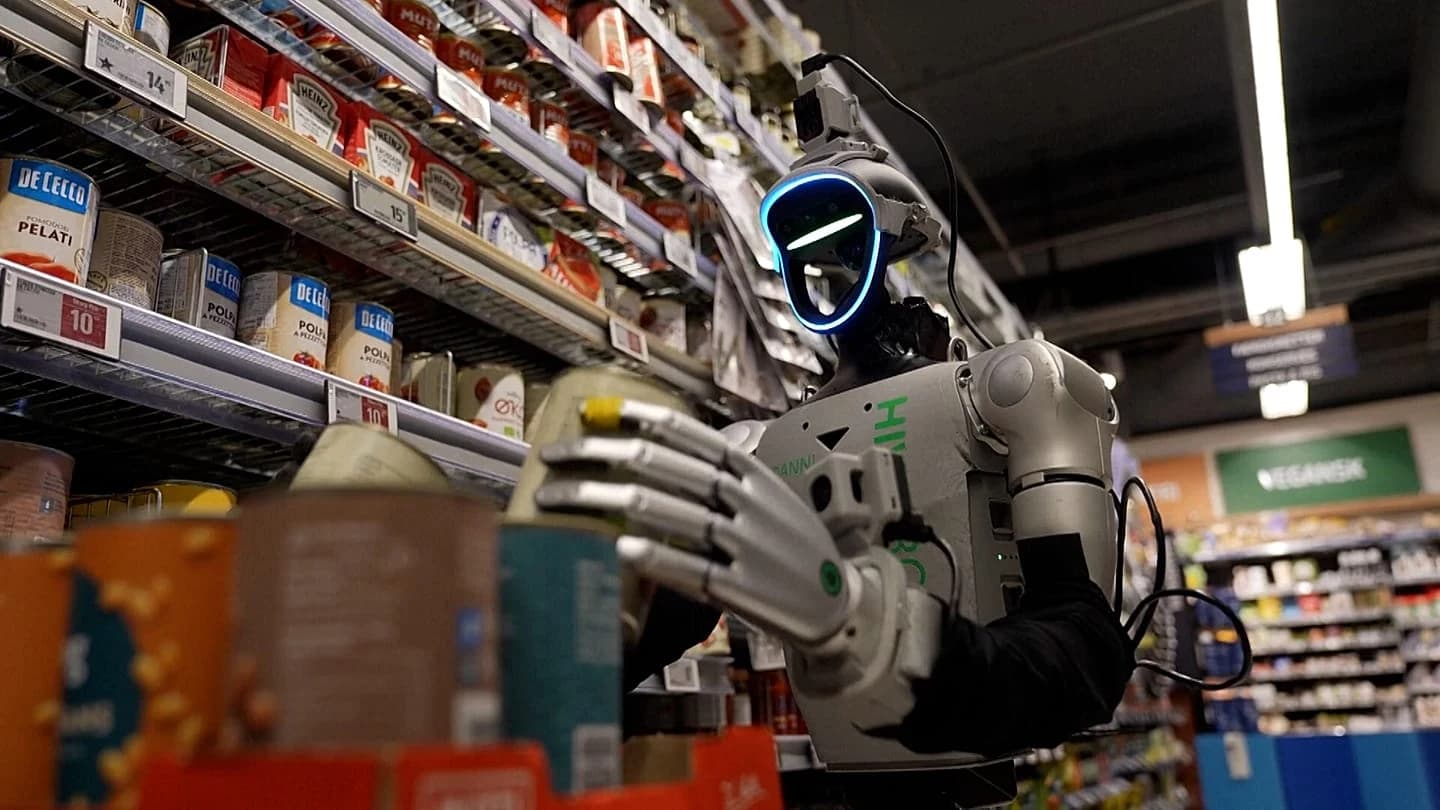
The key facts
- Since June, humanoid robots have been trained in shelf stocking at the Føtex chain in Lyngby; software by Hive Robots, manufacturing by Unitree
- The goal is autonomous night-time stocking of individual items by early 2027, paid by the hour
- Føtex estimates that stocking takes up 40–50% of staff working time; rollout to all stores could take up to five years
Robot Trainees in a Danish Supermarket
In the Danish town of Lyngby, north of Copenhagen, humanoid robots are learning to stock shelves after the supermarket closes. This is part of a multi-year experiment whose goal is to delegate routine operations to machines and free up employees to work with customers. According to the Danish startup Hive Robots, thanks to arms, legs and fingers, the robots can work in spaces designed for humans, and stores do not need to change their layout. For now, the robots are slower than supermarket workers, but the startup expects that advances in AI will improve their speed and accuracy.
How the Training Works
To work in real conditions, the robots are trained on data collected at the workplace. An operator wearing virtual reality goggles and holding handheld controllers guides the robot, which picks up packs of pasta and places them on shelves; these demonstrations serve as data for autonomous task execution. “There are many little things that we humans don't even think about, but that we absolutely have to teach the robot,” said Hive Robots robot operator Roger Sala. The training began in June at the Føtex chain, owned by Denmark's largest retailer Salling Group, which operates more than 2,100 stores in Denmark, Germany, Poland, Latvia, Estonia and Lithuania. Hive Robots develops the software and trains the machines, while they are manufactured by the Chinese company Unitree.
Plans and Timeline
Hive Robots hopes that by early 2027 the robots will be able to autonomously restock individual items at night, with stores paying for the service by the hour. Føtex chief operating officer Simon Kudsk believes that rolling out the robots across all stores in the chain could take up to five years. In the future, they may also be tasked with finding missing or misplaced items, removing empty cardboard boxes and checking expiration dates. “Our current goal, our dream, is for one or two humanoid robots to work in every Føtex store, helping our employees by making work more efficient and freeing up time for truly important, customer-focused activities,” said Kudsk.
What It Means for Workers
The arrival of humanoid robots in the workplace is fueling the debate over whether AI will solve the labor shortage or reduce demand for workers. According to a 2024 International Monetary Fund report, AI could change how work is done on roughly 60% of jobs in the EU, assisting employees in some tasks and replacing them in others; the report notes both productivity gains and the risk of worker displacement. Salling Group emphasizes that the goal of the pilot is to help employees, not to replace them. According to Føtex estimates, stocking and replenishing goods accounts for 40 to 50% of staff working time, and according to Hive Robots, the chain also struggles to find young employees for this work.


