The key facts
- Head of SAMA Sohibjon Murodov announced on October 8 the revocation of Saneg's licenses for oil fields due to failure to meet license conditions.
- The number of revoked licenses and the affected fields were not specified; Saneg's website previously indicated rights to 103 fields.
- The transfer of the fields in 2019 is an episode in the criminal case against former head of Uzbekneftegaz Bakhodirzhon Sidikov, who denies guilt.
License revocation
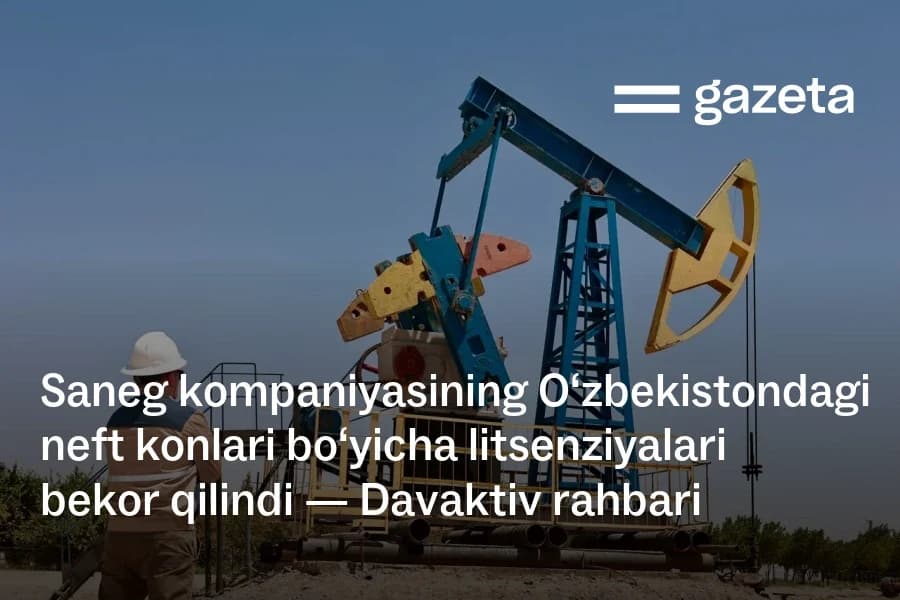
Licenses for the right to use oil fields previously issued to the company Sanoat Energetika Guruhi (Saneg) have been revoked due to failure to meet the established conditions. This was announced by the director of the State Assets Management Agency (SAMA), Sohibjon Murodov, at a press conference on October 8. The statement came in response to a question about the grounds on which the fields were transferred to a private company without open auctions or tenders.
Explanation of the license issuance mechanism
Murodov emphasized that the fields themselves were not transferred into private ownership: natural resources are not privatized, but the right to use the subsoil is granted in the form of a license. He referred to Cabinet of Ministers Resolution No. 133 of March 25, 2022, which regulates the procedure for issuing such permits. According to him, previously the license was granted to the first applicant after payment of a fee, the amount of which was determined based on the characteristics of the plot. Later, gradually in 2023–2024, the issuance of hydrocarbon licenses was moved to auctions.
Status of the fields
Answering a question about the current status of the fields, Murodov said that, to his knowledge, they had not been put into operation and the license conditions were not met, so the licenses were revoked. The Ministry of Geology, he said, is developing measures for their effective use. However, the head of SAMA did not specify how many licenses were revoked, which fields are in question, when the decisions were made, and how many plots remain with Saneg. The company's official website previously stated that it holds subsoil use rights to 103 oil and gas fields with licenses for geological study and extraction.
Background of the field transfer
In 2019, more than 100 oil and gas fields were transferred from Uzbekneftegaz to the company Jizzakh Petroleum (now Saneg) under a closed government resolution as part of the program to increase oil production for 2020–2030, which envisaged investments of $2.68 billion, drilling of 800 new wells, and major repairs of another 500. A working group created in 2019 on the initiative of the president warned about the risk of failing to achieve the targets due to hard-to-recover reserves. According to Saneg, in 2022 production amounted to 545.4 thousand tons against a planned 614.7 thousand tons. In April 2026, chief geologist of Uzbekneftegaz Nodir Mukhiddinov reported that production first increased after the transfer and then began to decline again, and a special commission was created to examine the situation.
Criminal case and Sidikov's position
The transfer of the fields became one of the episodes in the criminal case against the former chairman of the board of Uzbekneftegaz, Bakhodirzhon Sidikov, and other defendants. According to the prosecution, 106 fields were initially transferred for temporary use without final execution of contracts, and then their sale with a 10-year installment plan was provided for; the investigation believes that the value of the assets was understated by approximately 90 billion sums, and due to untimely re-registration of rights, Uzbekneftegaz paid land taxes for Saneg of approximately 10.4 billion sums in 2023–2025. Sidikov rejected the charges, stating that the transfer was provided for by a Cabinet of Ministers resolution adopted before his appointment, the discrepancies in value were due to a change in the VAT rate, and the installment terms were determined by a government decision taking into account Uzbekneftegaz's obligations to international creditors.
Sale of the group's assets
In January, the government of Uzbekistan decided to sell the non-core assets of the group of companies Enter Engineering, Eriell Group and Sanoat Energetika Guruhi (Saneg), associated with the entrepreneur Bakhtiyor Fazilov, in order to repay debts to employees, the budget, and banks.


