The key facts
- Rubio said in Samarkand that the Trump administration is calling for repeal of the Jackson-Vanik amendment
- The amendment applies to four of the five Central Asian countries, including Uzbekistan
- Uzbekistan already enjoys a conditional normal trade relations regime, reviewed annually
Rubio's statement in Samarkand
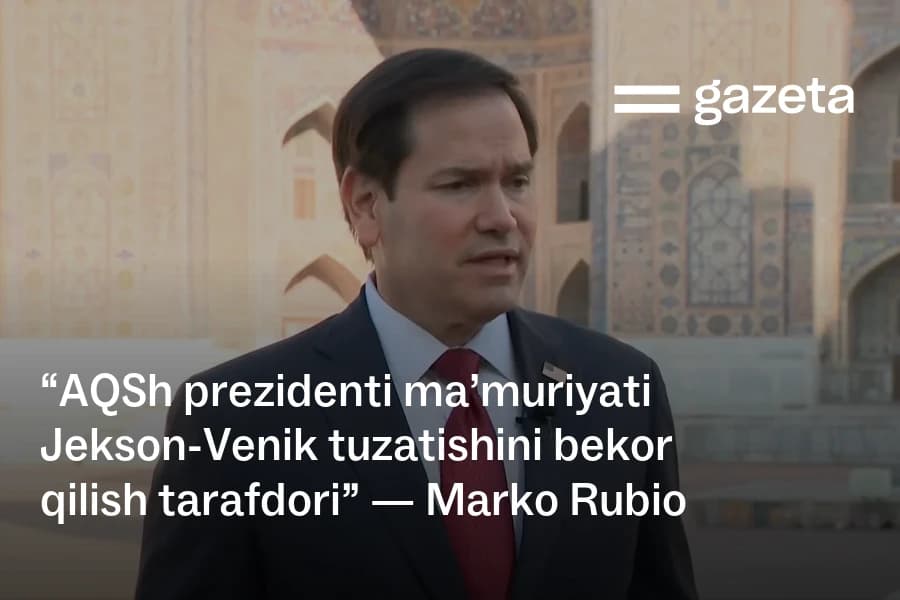
US Secretary of State Marco Rubio, on October 19, while visiting the Registan Square in Samarkand, told journalists that the administration of the US president supports repealing the Jackson-Vanik amendment. He arrived in Uzbekistan the day before to take part in the C5+1 ministerial meeting and the second session of the US-Uzbekistan Business and Investment Council.
Quote from the Secretary of State
“We support its repeal. There are many influential supporters of such a decision in the US Congress. I was asked about this during the hearings on the confirmation of my nomination in the Senate, and I answered that I support repeal. The administration [of US President Donald Trump] is also calling for it. Congress simply has not gotten to this issue yet, but we hope it will happen,” Rubio said.
The amendment's effect
The Jackson-Vanik amendment continues to apply to four of the five Central Asian countries, including Uzbekistan. Javlon Vakhabov, director of the International Institute for Central Asia, previously told Gazeta that administrations of both parties in the US had supported revising it, but a final decision requires the consent of both chambers of Congress.
Impact on trade
According to Vakhabov, the amendment does not block trade: Uzbekistan already enjoys normal trade relations with the US, but this regime remains conditional and is reviewed annually. Making it permanent would reduce administrative procedures and increase the predictability of conditions for trade and long-term investment.
Bills and obstacles
Vakhabov noted that lawmakers from both parties have introduced bills in the Senate and the House of Representatives to terminate the application of the amendment and establish permanent normal trade relations. He named the gap between political support and passage of a law as the main obstacle: this requires a broad coalition of lawmakers and priority consideration of the issue in Congress.