The key facts
- The CJP movement emerged after Chief Justice Surya Kant called unemployed youth 'cockroaches'; in late July Education Minister Dharmendra Pradhan stepped down
- Protesters now demand the resignation of Election Commission chief Gyanesh Kumar after more than 130 million names were removed from draft electoral rolls
- Women and queer activists, including AISA leader Neha Bora, face threats, detentions and sexualized pressure, but reject the role of victims
From a wedding to protests
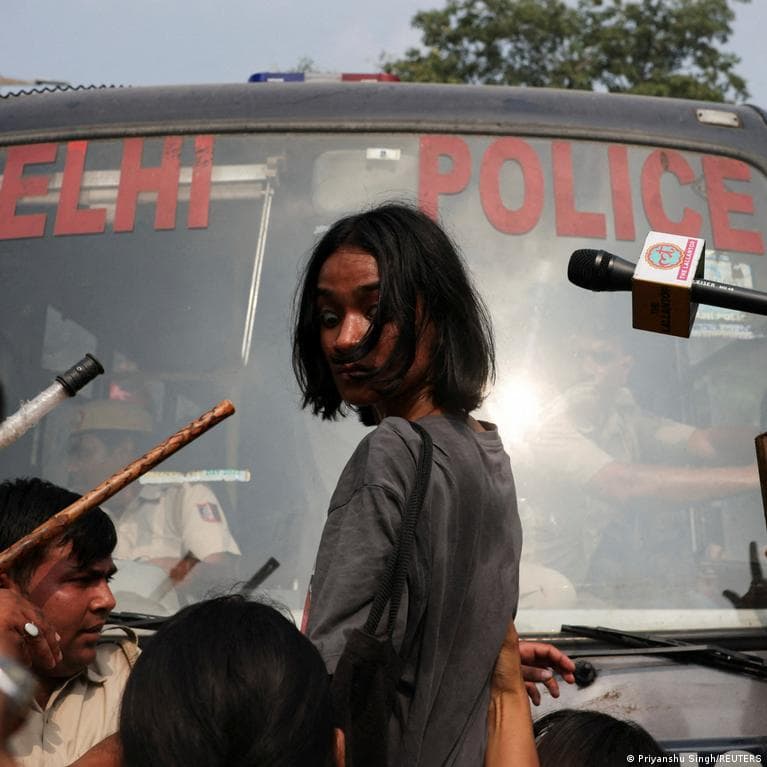
On July 20, activist Navkiran Natt and her partner came to a magistrate's office in New Delhi to get married, but found a tense situation: police were being deployed to disperse a youth march on parliament, and the witnesses to their wedding were delayed by barricades. The march was called by the Cockroach Janta Party (CJP) movement, which demanded the resignation of the then education minister Dharmendra Pradhan. Protesters were met with batons, tear gas and shotguns firing rubber bullets — there were injuries and mass detentions. Less than three months later, on October 10, Natt spent the whole day searching the cordoned-off capital for a protest she could join. 'The success of a protest is not about how many people reach Jantar Mantar,' she told DW. 'It's about the fact that after all the barricades and state violence, people still come out of their homes.'
Origins and demands of the movement
CJP began as a satirical online movement after Chief Justice of India Surya Kant, in an offhand remark, called unemployed youth 'cockroaches.' The name is an ironic reference to the ruling Bharatiya Janata Party (BJP) of Prime Minister Narendra Modi. Having secured Pradhan's resignation in late July, the movement now demands the removal of Election Commission chief Gyanesh Kumar after more than 130 million names were removed from draft electoral rolls across the country. While the CJP leadership is under judicial arrest or under threat of detention, student leader Neha Bora (who prefers they/them pronouns) has become the symbol of the protests — president of the All India Students' Association (AISA), the student wing of the communist party CPI-ML. Bora has run from police, climbed over barricades, shouted slogans from police vans and spoken at press conferences. 'In extremely depressing, frightening, tyrannical times, people look for hope wherever they can… If these people are fighting, then so can we,' Bora told DW.
Women on the streets and the context of violence
The protests coincided with demands by women and the LGBTQ+ community for greater autonomy following the recent gang rape of a 17-year-old girl in New Delhi. According to the National Crime Records Bureau, 441,534 crimes against women were registered in 2024 — an average of 1,210 per day; experts consider these figures incomplete. Despite sexualized attacks from police and online mobs, women and genderqueer activists reject the role of victims. 'The slogan of
Protest as everyday life and the price of visibility
29-year-old Gurmeher Kaur, author of the book 'The Young and the Restless: Youth and Politics in India,' joined the youth wing of the opposition Indian National Congress this year; her day often ends with lawyers securing the release of youth wing members from police detention. She says that 'resistance cannot be a separate event' and considers it her duty 'to show up and put my body on the line.' Visibility, however, comes at a price: according to Kaur, for men a photo in the media is a source of pride, while for her 'attention equals death and rape threats, humiliation and insults.' Natt, known for the 2020–2021 farmers' protests, adds: 'If a protest is led by a woman, the first blow is aimed at her sexuality.' Images of women with torn clothing after clashes with police circulated on social media. Delhi officials deny any physical violence, claiming that women protesters were treated 'with dignity'; Bora refutes this, pointing to the shortage of female police officers and recounting how protesters shielded her from detention. A case has been opened under the law protecting registered castes and tribes against a journalist who accused a senior Delhi police officer of sexual harassment; authorities say her allegations are being investigated. The internet has also been flooded with AI-generated sexualized images of women protesters, embedded into photos from the demonstrations.
The tactics are not working
Protesters keep taking to the streets even the day after detentions. 'They don't know who they are dealing with,' Krishnan said of the authorities. According to her, the authorities expect sexual humiliation to deter women, but 'this is not a generation that considers sexual violence shameful.' She took part in the protests after the 2012 'Nirbhaya' gang rape, but, in her words, the current anger 'will not be expressed in masculine displays of honor' — it is about 'dignity and freedom.' Krishnan also links the youth protests to a global wave of 'civilizational, cultural nationalism' that uses rhetoric about protecting daughters, families and traditions against minorities, migrants and transgender people, mentioning Donald Trump, Viktor Orbán and Germany's AfD. Young Indians, she says, are 'fighting for a language of the future, a language that holds hope.'