The key facts
- Vietnam and EFTA (Iceland, Liechtenstein, Norway, Switzerland) signed a free trade agreement in Hanoi on October 18
- The deal eliminates or reduces tariffs, including on industrial, fishery and agricultural goods; about half of Norwegian exports to Vietnam will become duty-free
- Trade turnover between EFTA and Vietnam last year was €4.8 billion ($5.4 billion)
Signing in Hanoi
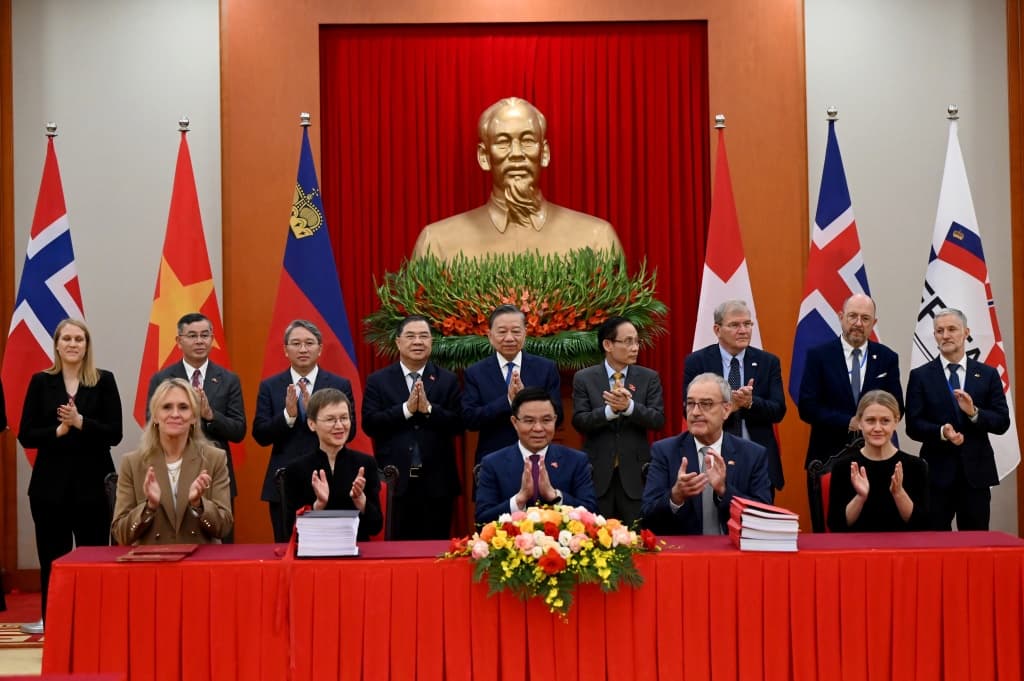
Vietnam and four European countries outside the EU signed a free trade agreement in Hanoi on Sunday, October 18. The deal was concluded with the European Free Trade Association (EFTA), which comprises Iceland, Liechtenstein, Norway and Switzerland. The ceremony took place in the presence of Vietnam's top leader To Lam and representatives of the EFTA governments. The signing was announced by the governments of Vietnam and Norway; Vietnam's ministry of trade confirmed the signing with EFTA.
Terms of the agreement
The agreement eliminates or reduces customs tariffs, including on imports of industrial, fishery and agricultural goods. According to the Norwegian government, about half of Norwegian exports to Vietnam will become duty-free, and more than 98% within seven years. The agreement covers trade in goods and services, intellectual property rights, trade defence measures and sustainable development, both sides report.
A long road of negotiations
Official negotiations between Vietnam and EFTA began in 2012 but were interrupted in 2018 and resumed only in September last year. The parties concluded the negotiations in July of this year.
The context of US tariffs
The signing took place against the backdrop of the US tariff policy under President Donald Trump that disrupts global trade: Vietnam continues negotiations with Washington, which maintains high tariffs on its exports to the US. The Vietnamese government stated that the agreement demonstrates the parties' determination to 'strengthen the rules-based trading system amid continued volatility of the global economy' and will help the country 'diversify import and export markets' and 'integrate more deeply into global value chains'.
Expert assessments
Experts note that the deal reflects a general desire to diversify trade ties and reduce dependence on the largest partners. 'As the US increasingly exerts trade pressure on European countries, the agreement is a joint attempt to turn economic integration into greater strategic autonomy and develop alternative trade relations rather than relying exclusively on the largest partners,' historian and political scientist Do Dinh Lam Khang told AFP. According to him, for Vietnam, closer ties with the EFTA economies could support ambitions to move toward higher value-added activities.
Trade figures
Trade turnover between EFTA and Vietnam last year amounted to €4.8 billion ($5.4 billion), according to the association. The main exports of EFTA countries to Vietnam are electrical and mechanical engineering equipment, fish and pharmaceutical products; Vietnam exported mainly machinery, footwear and clothing to EFTA. EFTA was created as a counterweight to the European Economic Community — the predecessor of the EU — to which the four member states are close but do not belong.