The key facts
- 21 traffic lights synchronized on a 10 km section of the MKAD — from Beruni Street ('Orzu') to Katta Darkhon Street (Pilaf Museum)
- Travel time outside rush hour decreased from 26 to 20 minutes (−23%), saving 6 minutes per trip
- Including the September corridor, the continuous 'green wave' on the MKAD reached 15 km
Launch of the longest 'green corridor'
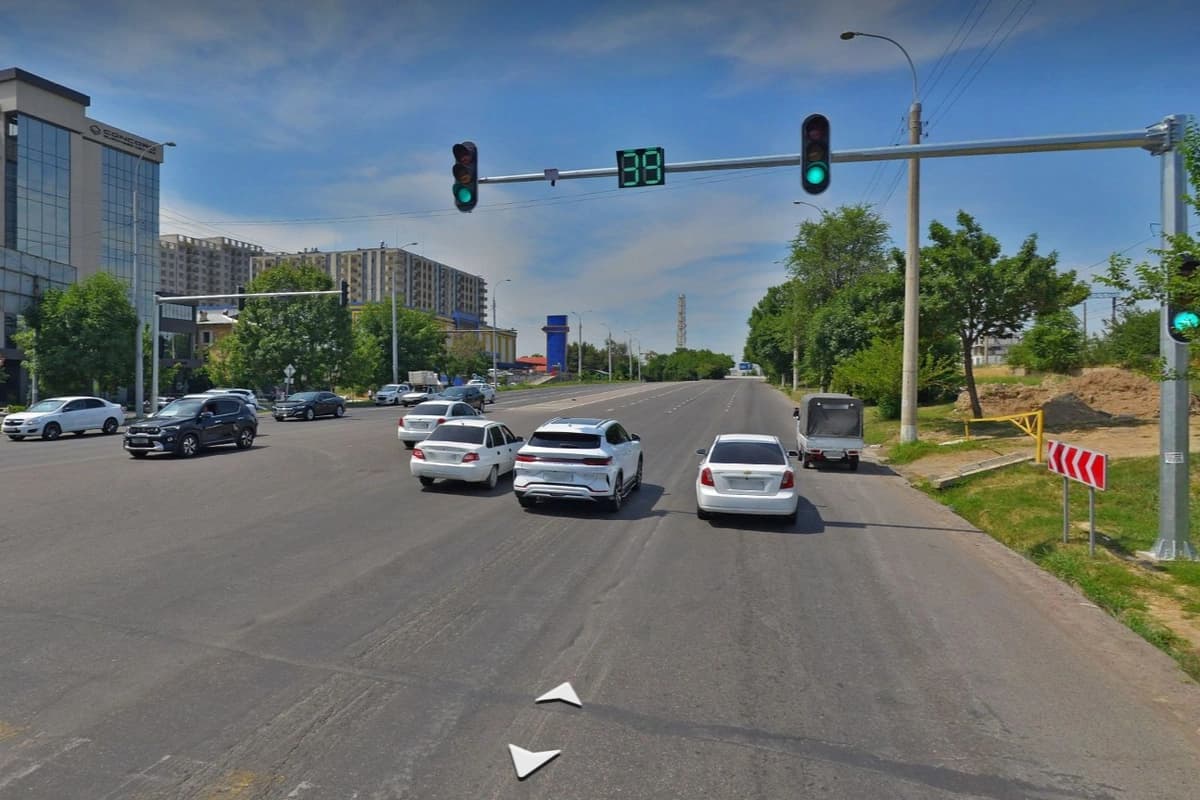
The Tashkent Center for Traffic Organization (TCO) announced the launch of a 'Green Wave' system on a 10-kilometer section of the Small Ring Road. According to the TCO, this is the longest 'green corridor' in the capital. It covers 21 traffic light complexes on the section from the intersection with Beruni Street ('Orzu') in the Almazar district to Katta Darkhon Street (Pilaf Museum, former excavator plant) in the Mirzo-Ulugbek district.
Results of the optimization
Specialists from the center studied traffic flows and reconfigured the traffic light operation modes: they coordinated the sequence of signal switching and adjusted the duration of traffic light cycles taking into account traffic intensity and the specifics of intersections. According to control measurements by the TCO, travel time on the section outside rush hour decreased from 26 to 20 minutes — by 23%, meaning a saving of 6 minutes per trip. Measurements were taken during off-peak hours: before the adjustment — September 25 at 12:00, after — October 8 at 12:40. The center noted that during morning and evening hours, travel time may differ depending on traffic intensity and the road situation.
Continuous 'green wave' on the MKAD — 15 km
Including the 'corridor' launched in September on the section from the building of the Uzbekistan State University of World Languages, the total length of the continuous 'green wave' on the MKAD reached 15 km. According to the TCO, synchronization improved the coordination of traffic flows: the new settings should reduce the number of unnecessary stops, decrease waiting time at traffic lights, and ensure more uniform vehicle movement.
Other 'green corridors' of Tashkent
Over the past months, several 'green corridors' have been launched in Tashkent. The first one started operating at the end of July on Buyuk Ipak Yuli Street — from the 'Tura Buva' mosque to Salom Street; in the morning, priority is given to the flow toward the center, in the evening — in the opposite direction. The second appeared on a 1.7-kilometer section of the MKAD from Bogibuston Street to the Chilanzar metro station: the TCO synchronized traffic lights in five places, and at a speed of 40–60 km/h, a non-stop trip takes about 2 minutes 45 seconds — 45% faster than before the reconfiguration. In mid-August, a 'green wave' appeared on Amir Temur Square, where cars on the street of the same name can pass through the square in both directions without stopping, and then — along Shota Rustaveli Street. In September, three corridors were launched: on Makhtumkuli Street between Amir Temur Square and the Tashkent Highway (former Tashkent Aviation Production Association), on a 5 km section of the MKAD in the west and northwest of the capital, and along the northern part of Babur Street. The Uzbek-language version of the Spot.uz material additionally mentions the reconfiguration of traffic lights at the intersection of Fitrat and Heydar Aliyev streets near the airport, where the green signal time for the busiest direction was increased almost twofold, as well as the previously launched 'green wave' on Fargona Yuli Street.