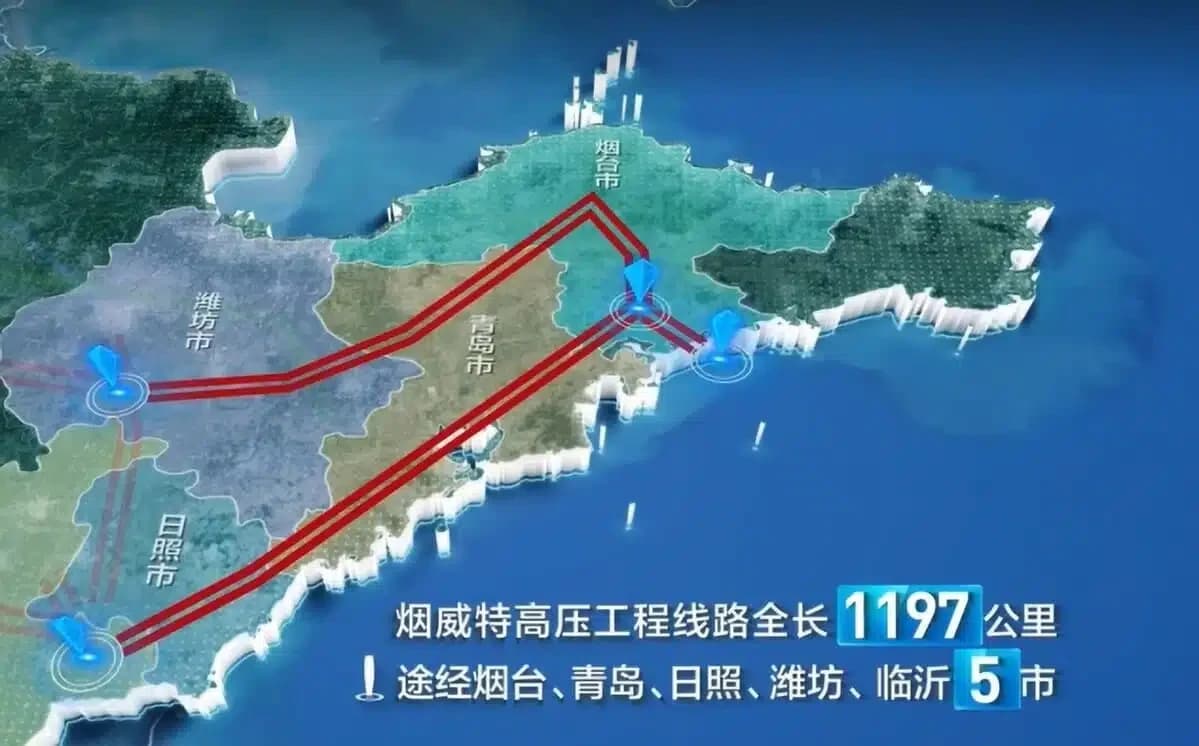
The key facts
- A 1000 kV (1 million volt) line 1197 km long has been launched through Yantai, Qingdao, Jizhao, Weifang and Linyi
- A new 1000 kV substation was built, two existing ones were expanded, and 2124 towers were installed, including 822 in mountainous terrain and 17 in a marine water area
- The line forms China's first regional ultra-high-voltage network of two rings; active construction took 12 months
A New Line for Transmitting Nuclear Energy
A major ultra-high-voltage power transmission line intended to carry electricity, including power generated by nuclear plants, has been commissioned in China. As Naked Science reports, citing a publication, the new line is designed to deliver electricity produced in the Yantai and Weihai areas of Shandong province to other regions. The line's equivalent length in single-circuit terms is 1197 kilometers, and it runs through the cities of Yantai, Qingdao, Jizhao, Weifang and Linyi.
The Scale of the Project
As part of the project, a new 1000 kilovolt (one million volt) distribution substation was built and two existing substations of the same category were expanded. A total of 2124 transmission towers were installed: 822 of them are located in hilly and mountainous terrain, and another 17 in a marine water area. The project is notable as the first ultra-high-voltage line in China built simultaneously across a mountainous area and a marine water area. The active construction period was 12 months, which, according to the publication, is the shortest time for AC transmission projects of this category and scale in the country.
The Context of Shandong's Power Industry
Shandong is one of China's most energy-consuming provinces. As of the end of September 2026, the installed capacity of energy facilities not using fossil fuels there reached 147 million kilowatts. Wind and solar power account for 132 million kilowatts — more than half of the province's total installed power plant capacity. Most of Shandong's nuclear energy is concentrated on the Yantai–Weihai peninsula: the region, which previously received electricity from outside, is turning into a major center supplying it to other areas.
The 'Figure-8' Scheme and Plans
The new line, connected to the existing grid, has formed a system of two rings resembling the figure '8'. This is the first regional ultra-high-voltage network of such configuration in China. The rings can serve as backups for each other, which expands electricity transmission capabilities and increases grid resilience in the event of failures. The Haiyang–Xi distribution substation was built on the 'two stations on one site' principle; in the future, 12 outgoing 1000 kilovolt lines are planned to be organized from it.


