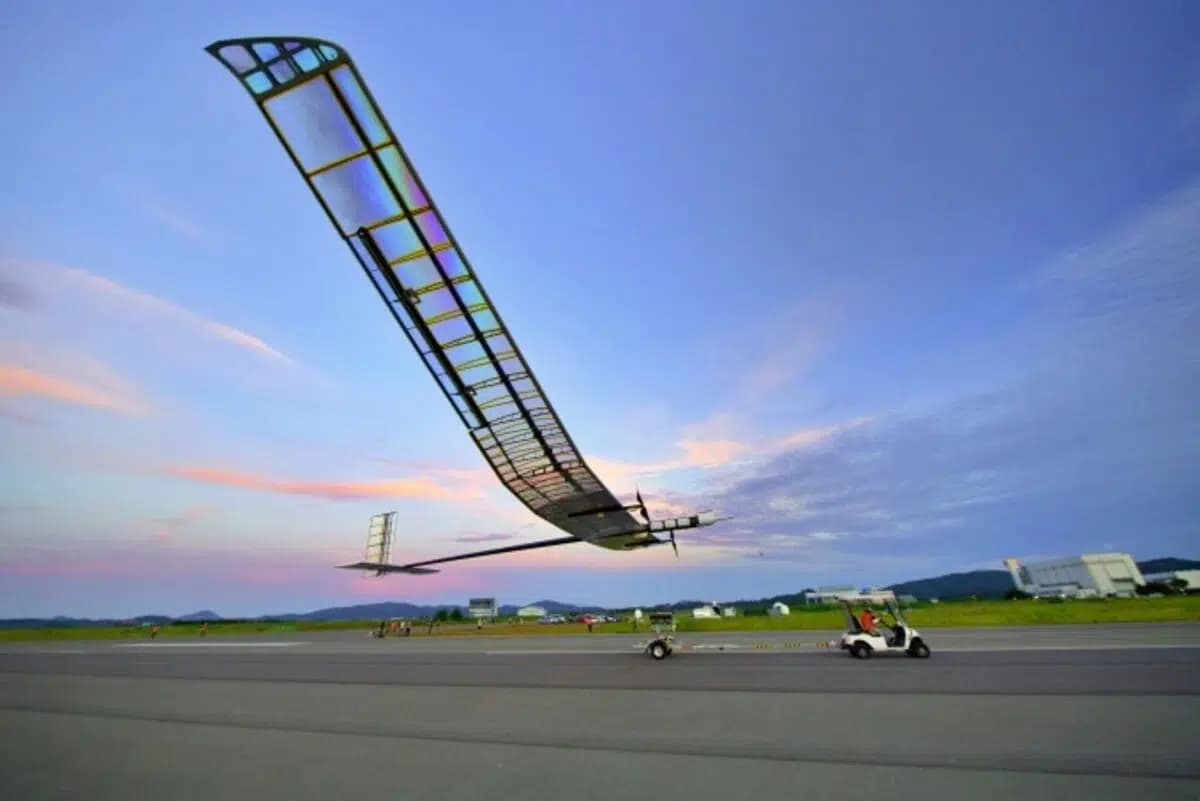
The key facts
- EAV-4 stayed aloft for 170 hours 5 minutes — more than triple the previous EAV-3 record (53 hours, 2020)
- Wingspan of about 30 m, maximum takeoff weight 150 kg, payload capacity up to 20 kg
- During wildfire detection tests, the drone spotted a fire from an altitude of 14.4 km within seconds
A Record-Breaking Solar-Powered Flight
The South Korean stratospheric drone EAV-4, powered by solar energy, completed a continuous flight lasting 170 hours and 5 minutes at an altitude of about 20 kilometers. According to the Korea AeroSpace Administration (KASA), the new result is more than three times the national record set in 2020 by the previous aircraft, the EAV-3, which flew for 53 hours. In terms of flight duration, the South Korean development ranks second in the world, second only to the Zephyr drone of the European company Airbus.
How the Aircraft Is Built
The EAV-4 was developed by the Korea Aerospace Research Institute (KARI). The aircraft has a wingspan of about 30 meters and a maximum takeoff weight of 150 kilograms, and it can carry up to 20 kilograms of payload to carry out assigned tasks. During the day, solar panels on the wings generate electricity, with the surplus stored in batteries — this allows the aircraft to continue flying at night, when the panels produce no energy.
Fire Detection Tests
In addition to demonstrating flight endurance, the aircraft carried out observation tasks needed for practical use in disaster response. During wildfire detection tests, the EAV-4, using an electro-optical and an infrared camera, detected a fire from an altitude of 14.4 kilometers in just a few seconds, and also demonstrated the ability to observe and predict the direction of smoke spread and the movement of the fire front.
How Stratospheric Drones Differ from Satellites
According to KASA, unlike artificial satellites in low Earth orbit, stratospheric aircraft can be directed straight to the required area. Compared with conventional drones, they are capable of continuously monitoring far larger territories, and in emergencies they can establish direct communication with ground-based mobile phones.