The key facts
- About 50 pilot whales stranded among the rocks on the Ngawi coast near Cape Palliser overnight into Thursday
- By Thursday evening the last four survivors had died, including two refloated during high tide
- The Department of Conservation confirmed around 20 animals, while residents counted nearly 50; some carcasses were swept out to sea
Mass stranding on the Ngawi coast
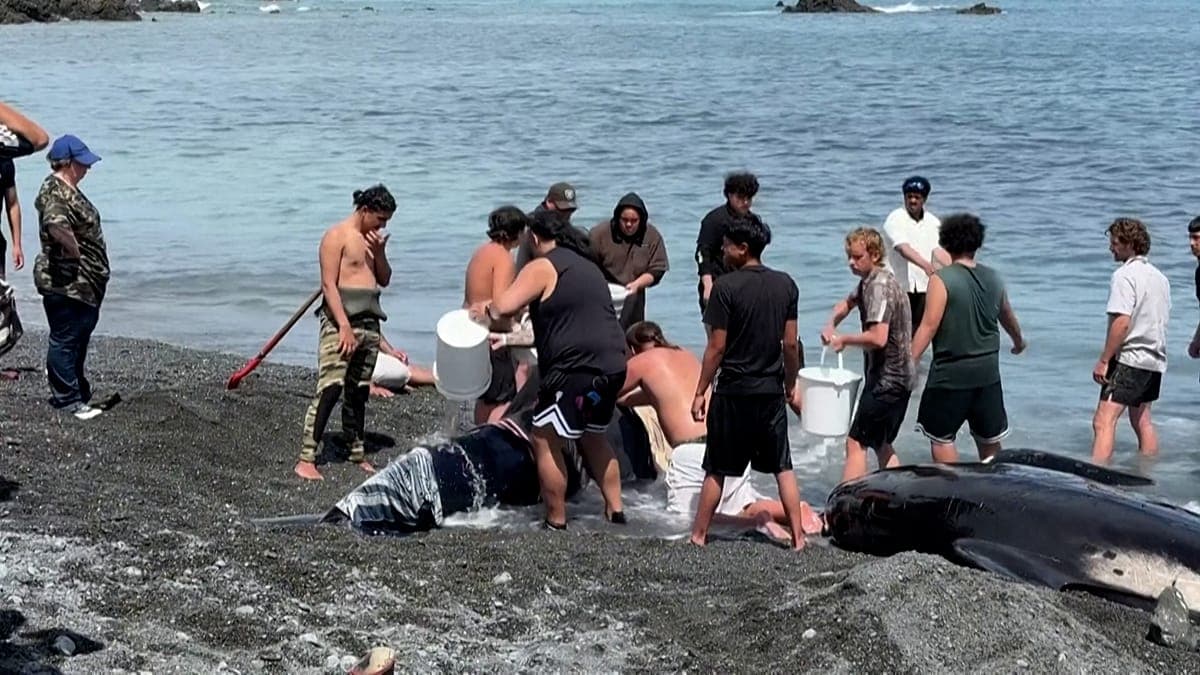
On the night of Thursday, about 50 pilot whales stranded themselves on the rocky coast of Ngawi near Cape Palliser, at the southern tip of New Zealand's North Island. Local residents counted nearly 50 animals, while the Department of Conservation (DOC) initially confirmed around 20 — some of the carcasses had already been swept out to sea by the waves, and the search area stretched for several kilometres of rocky shoreline, making counting difficult. This was reported by Euronews, citing DOC data and eyewitnesses.
The rescue operation and its outcome
Rescuers and marine medics from Project Jonah, DOC staff, the local iwi and volunteers from Ngawi joined the effort: they poured water over the animals and protected them from overheating. According to Anadolu , citing Radio New Zealand, two whales were successfully refloated, while Project Jonah assessed the animals' condition and mobilised medics in coordination with DOC and local residents. Fisherman Andrew Syme said rescuers were trying to keep several survivors alive but believed that 'most of the pod had died from their injuries'; Ngawi resident Rob Barh described the situation as tragic: 'It's horrible. Those that are alive are breathing their last breath' — according to him, the living animals were on their last legs.
Outcome of the operation and the unknown cause
Despite the efforts, most of the pod died during the day, and by Thursday evening the last four survivors had also died — including two that had earlier been returned to the sea during high tide. The exact death toll is difficult to establish because of carcasses swept out into the ocean. The cause of the stranding has not been determined. Pilot whales are known for their highly social behaviour and move in large groups, so if several animals enter shallow water, the whole pod may follow. According to DOC, strandings of this scale have not been recorded in this area since the 1990s. Radio New Zealand also reported that DOC staff and the local community planned to give the whales names and perform a karakia — a traditional Māori prayer.