The key facts
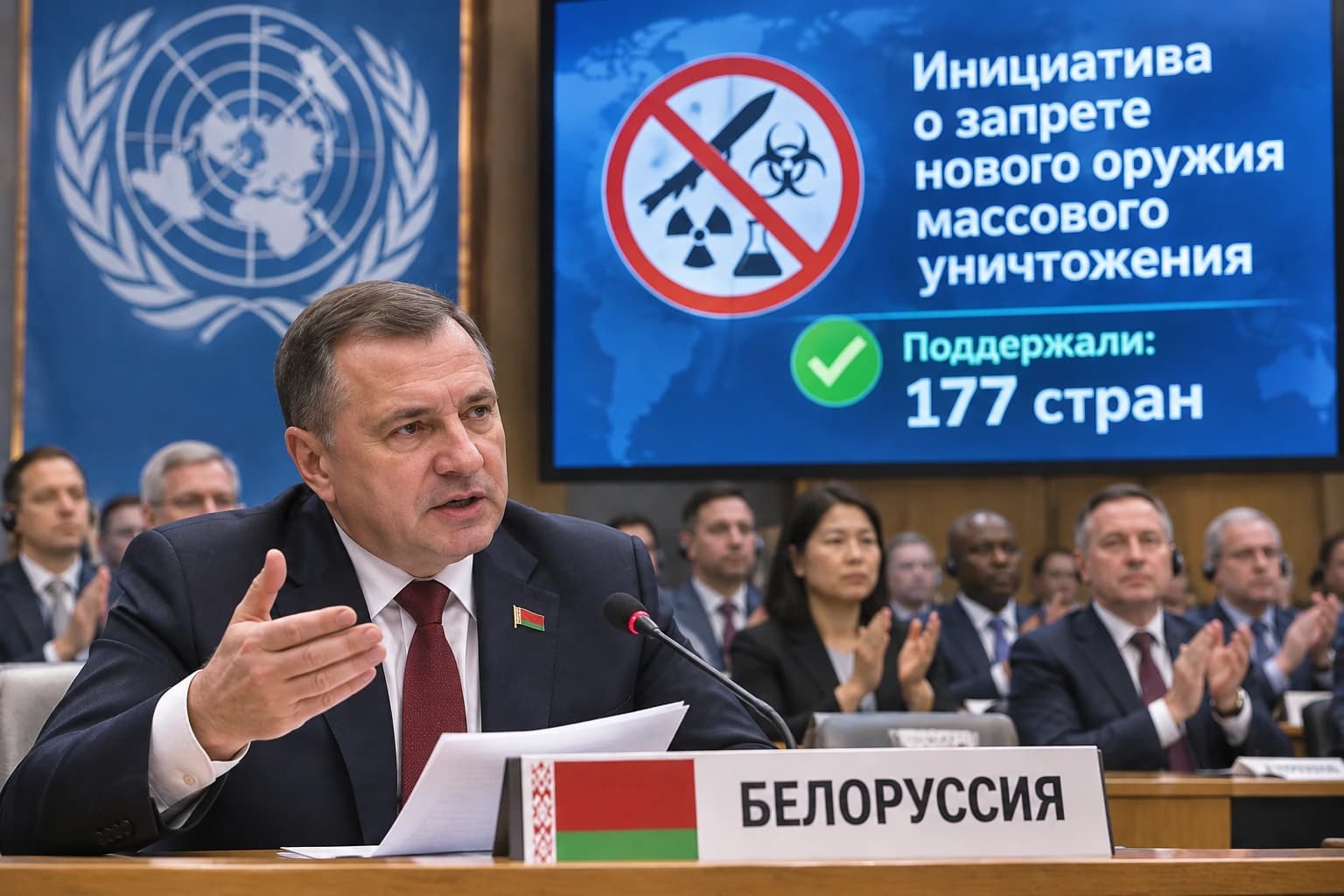
- The resolution 'Prohibition of the development and production of new types of weapons of mass destruction and new systems of such weapons: report of the Conference on Disarmament' was approved by the UN General Assembly First Committee
- The document was voted for by 177 UN member states
- Co-sponsors — 20 countries, including Russia, China, Kazakhstan and Pakistan
UN First Committee approves Belarusian initiative
The First Committee of the UN General Assembly approved a resolution proposed by Belarus aimed at preventing the development and production of new types of weapons of mass destruction. The document was voted for by 177 UN member states, the republic's foreign ministry reported (according to Life.ru). The resolution in question is titled 'Prohibition of the development and production of new types of weapons of mass destruction and new systems of such weapons: report of the Conference on Disarmament.'
Who supported the document
The resolution's co-sponsors were 20 states, including Russia, China, Kazakhstan and Pakistan, as well as countries from Asia, Africa and Latin America. The Belarusian Foreign Ministry said that such broad support 'testifies to its relevance and significance for international efforts to strengthen the disarmament and non-proliferation regime' and reflects countries' readiness to jointly counter the emergence of new types of weapons of mass destruction. Minsk also stated its intention to continue advocating for the strengthening of international security, the development of dialogue between states and the improvement of disarmament mechanisms.
Context: Russia's participation in an ICJ proceeding
At the same time, Life.ru recalls another recent step by Moscow within UN structures: Russia has decided for the first time in history to join a proceeding of the International Court of Justice as a third party. This concerns a dispute between Lithuania and Belarus in a case about the alleged organization of illegal migration. The Russian Foreign Ministry explained that Moscow intends to facilitate the correct interpretation of international treaties without becoming a direct party to the dispute. This is a separate event, unrelated to the vote on the resolution.