The key facts
- DIA published an image of the Chinese spaceplane in its report on global threats in space
- The image was taken by a satellite of the company Vantor (formerly Maxar Technologies) from approximately 90 km
- The vehicle resembles the X-37B but has a noticeably larger wingspan; which model was photographed has not been established
The image in the intelligence report
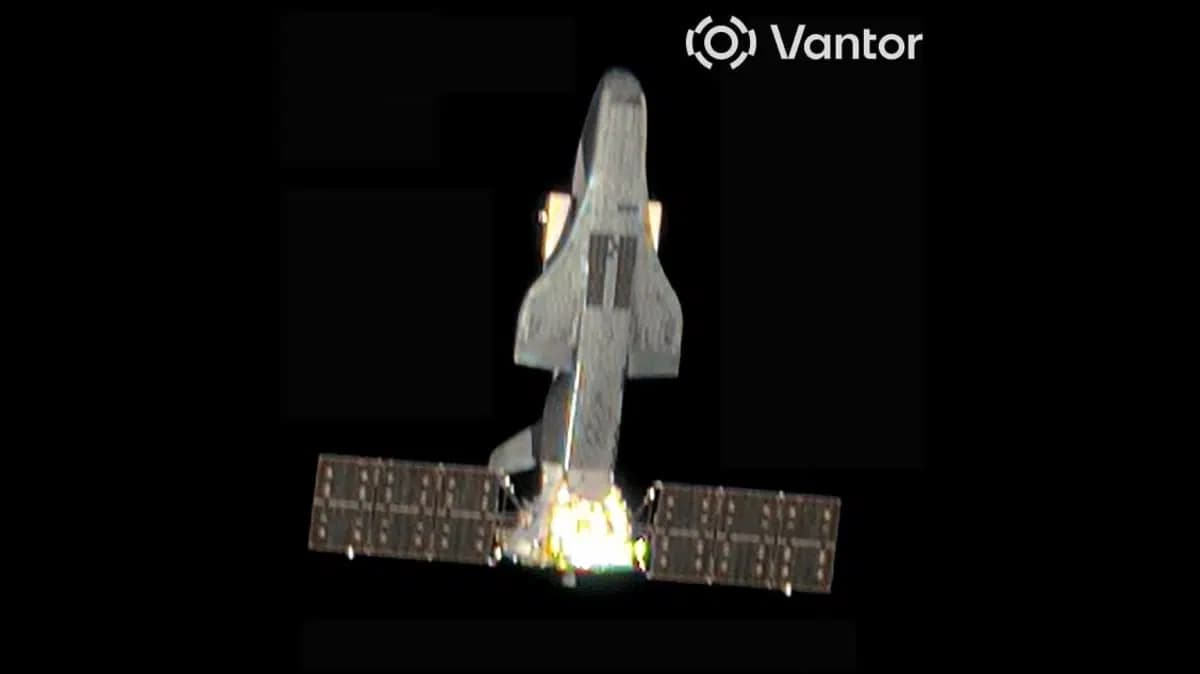
The Defense Intelligence Agency of the US Department of Defense (DIA) has included in its new open report on global threats in space an image of a secret Chinese spaceplane, taken in orbit from a distance of about 90 kilometers. This was reported by Kun.uz citing a TWZ publication. The image was captured by a satellite belonging to the company Vantor, formerly known as Maxar Technologies.
What is visible in the photograph
The image shows the vehicle's small wings and two vertical fins, as well as upward-opening doors above the central cargo bay. In the tail section, a protruding module is visible, with solar panels deployed on either side of it. In the lower part of the fuselage there are two side bays which, according to the report's authors, may be intended for the main struts of a tricycle landing gear. A higher-resolution version of the image allows the design to be examined in more detail.
Similarities to the X-37B and differences
In appearance, the vehicle resembles the miniature space shuttle X-37B used by the US Space Force: the American craft also has tricycle landing gear and the ability to install an additional cargo module in the tail section. The main noticeable difference is the wing shape: the chord of the Chinese vehicle's wing (the distance from the leading edge to the trailing edge) is noticeably longer than that of the X-37B.
Which model was photographed is unknown
The DIA report mentions two main models of Chinese spaceplanes — the 'Shenlong' and the 'Tengyun' — but it does not specify which one is captured in the image. The name 'Shenlong' is usually associated with the spaceplane China has been testing in recent years. Thus, the image confirms the vehicle's very presence in orbit and its design features, but its exact attribution to a specific program has not yet been determined.