The key facts
- A bird from the Late Jurassic (150–148 million years ago) has been found in Fujian province with teeth and a grasping claw characteristic of predatory dinosaurs
- Short forelimbs indicate a ground-dwelling lifestyle; the authors call it the oldest known flightless bird
- The study is published in the journal Nature
An unusual find in Fujian
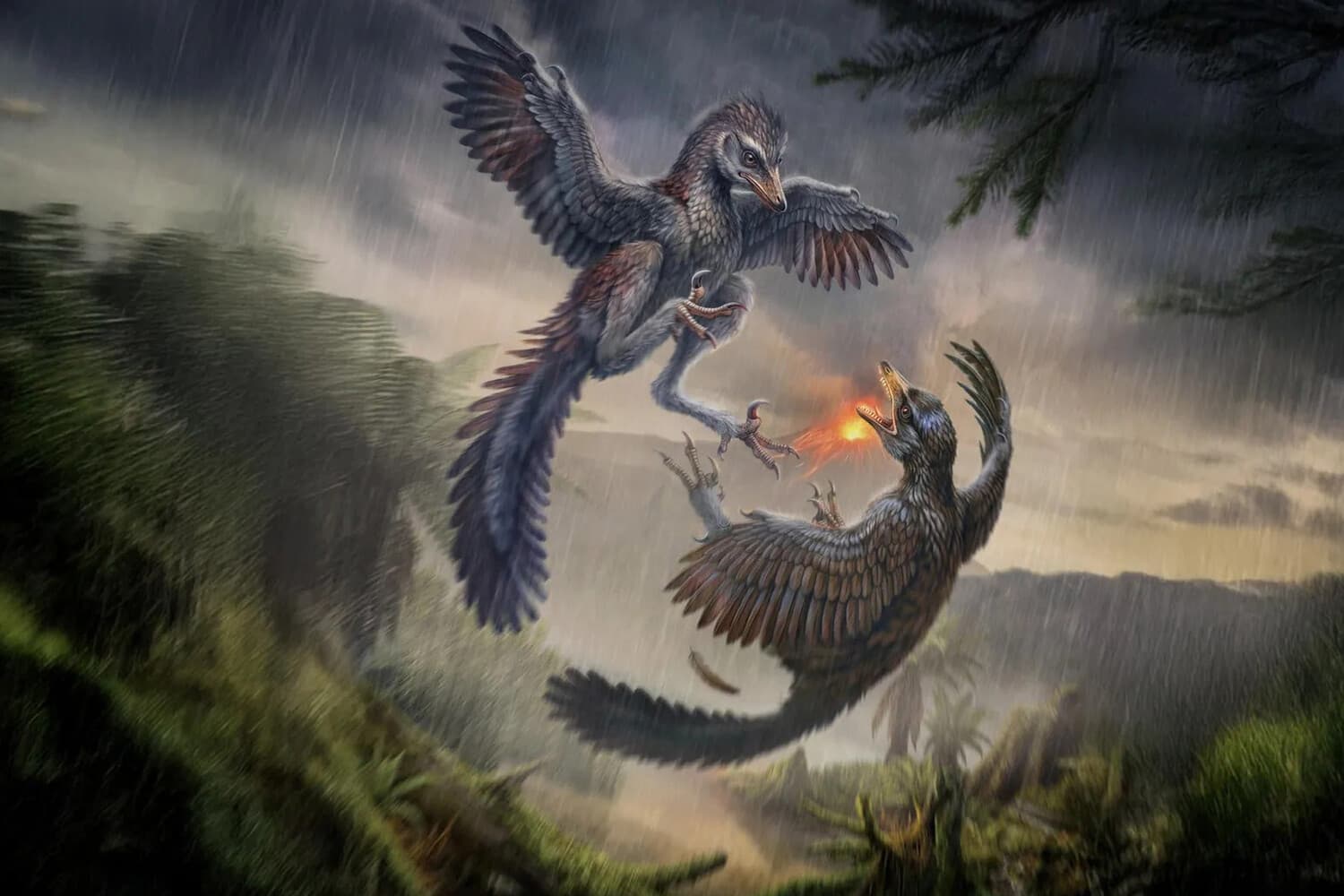
In China's Fujian province, an ancient bird was discovered that combined features of birds and predatory dinosaurs: it had serrated teeth and a grasping claw on the second toe, reminiscent of the weaponry of small predatory dinosaurs. Gazeta.Ru reports this, citing a study published in the journal Nature. The species lived in the Late Jurassic, roughly 150–148 million years ago. The work was carried out by specialists from the Institute of Vertebrate Paleontology and Paleoanthropology of the Chinese Academy of Sciences together with geologists from Fujian.
A mix of features and its place on the evolutionary tree
The structure of the pelvis and hind limbs brought the animal close to early birds, but jaws with tightly packed teeth and a second toe that bent upward with a curved sickle-shaped claw are characteristic of some predatory dinosaurs. This combination of features complicated determining its relationships, but according to the authors, different methods of reconstructing the evolutionary tree consistently placed the find among early representatives of the bird lineage, alongside another ancient species from the same region.
A ground-dwelling lifestyle and significance for science
A comparison of skeletal proportions with the anatomy of other birds and closely related dinosaurs showed that the forelimbs were very short, and the overall appearance better matches ground movement than flight. The authors consider the find the oldest known flightless bird. In their view, this is important for ideas about the origin of the bird body: early bird evolution, it seems, did not consist solely of the continuous improvement of flight abilities, and already in the Jurassic period different lineages were mastering different ecological roles, including life and hunting on the ground. At the same time, the conclusions about the inability to fly are based on the fossil's anatomy, not on direct observation. Earlier, scientists described the 'hell chicken' that crushed fruit like parrots.
Why this matters
The find expands our understanding of the diversity of early birds: already 150–148 million years ago there existed flightless lineages adapted to ground hunting, which is confirmed by the skeletal anatomy described in Nature. For science, this means that the origin of birds cannot be reduced to a single trajectory of 'improving flight,' and paleontologists will have to revise the criteria by which fossil remains are assigned to birds. In practical terms, this affects the interpretation of future finds in the region: another ancient representative of the bird lineage has already been discovered near the new species, pointing to Fujian as a key area for studying early bird evolution.