The key facts
- A second Ebola patient has died in Kenya — a 65-year-old woman, a close relative of the first victim
- Seven people continue treatment; the health ministry says there is a single cluster with no community transmission
- Nigeria reported genetic similarity between its first case and the Kenyan Bundibugyo virus strain
Second death in Kenya's first Ebola outbreak
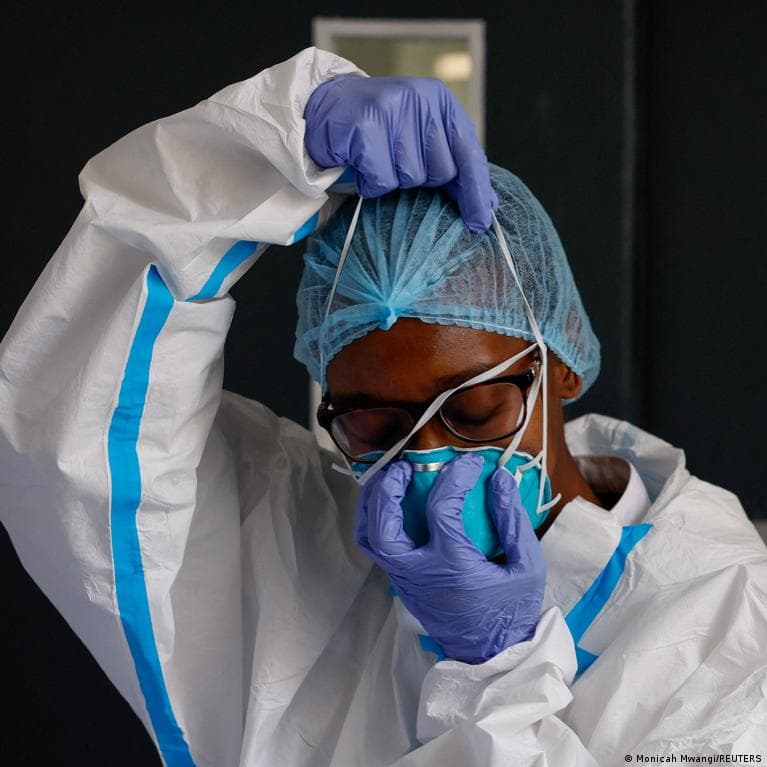
Kenya has announced a second death from Ebola, the country's health ministry said on Friday, Deutsche Welle reports. The patient was a 65-year-old woman — a close relative of the Kenyan who became the disease's first victim earlier this month. According to the health ministry, her symptoms appeared 10 days ago, while she was already in quarantine; she then received supportive care in an infectious diseases ward in Nairobi. «Unfortunately, she died of the disease early this evening,» the ministry said, adding that medics «did everything possible to save her life» and that the family would be provided with a safe and dignified burial. Seven people continue to receive treatment, Deutsche Welle reports. BBC News specifies that the patients are in two isolation units, and among them are three other relatives of the first victim, three healthcare workers, and a hospital cleaner.
How the outbreak developed
The first case of Ebola in Kenya was announced on October 6. The virus was detected in a 40-year-old Kenyan who had lived in the DR Congo and arrived in the country on October 3 via Uganda; on October 5 his test came back positive, and he died the same day. Of roughly 135 identified contacts, 118 have been placed in quarantine, and eight tested positive — four healthcare workers and four family members. The health ministry stresses that the remaining cases belong to «a single cluster with no signs of community transmission.» According to BBC News, the second victim developed symptoms on October 13 while in quarantine, while the first victim had fallen ill back in September and was treated in several hospitals in the DR Congo before arriving in Nairobi. This is the first Ebola outbreak in Kenya's history, the BBC notes.
Link to the case in Nigeria and measures to curb the spread
Genomic tests announced by Nigeria's health minister Muhammad Ali Pate showed that the virus in the Kenyan «index patient» resembles the strain from Nigeria's first case: «the viruses appear to be linked,» and the case is «highly similar to the Kenyan one,» Deutsche Welle quotes him as saying. In Nigeria, the infection was detected in the wife of an employee of the Swiss embassy in Abuja, who returned from Uganda on October 3. Africa's Centres for Disease Control and Prevention had suggested that she might have crossed paths with the first Kenyan patient at the airport — both flew out of Uganda on the same day. On Friday, the Swiss Foreign Ministry denied reports by Ugandan authorities that the patient had visited the DR Congo. African health authorities are trying to establish the source of the infection. Uganda, according to the BBC, has banned transit through its territory since Friday for people who have visited the DR Congo. Kenya has introduced enhanced screening for arrivals from the DR Congo and nine other countries, a digital monitoring form with a QR code before boarding, and additional inspection of aircraft; the United States has warned its citizens against travel to Kenya. The Bundibugyo outbreak, for which there is no approved vaccine or specific treatment, flared up in the DR Congo in May and spread to Uganda, Kenya, and Nigeria. According to WHO data as of October 20, confirmed cases have exceeded 9,700, with 4,690 deaths; the BBC calls it the second deadliest outbreak in the history of the disease.
Why it matters
The outbreak has for the first time affected Kenya — a major transport hub of the region — and both deaths occurred within a single contact cluster, which, according to the health ministry's assessment, has so far limited the spread. For travelers and residents of the region, this means continued enhanced border screening, mandatory digital forms, and quarantine measures, while for the health systems of Kenya, Nigeria, and Uganda it means ongoing contact tracing and the search for the source of infection. At the same time, the Bundibugyo species, with no approved vaccine or treatment, makes early detection and isolation the main available containment tool, as confirmed by the measures the countries are taking.