The key facts
- On October 22, 2026, an exhibition and conference on Central Asia’s heritage took place at the Palace of Nations in Geneva
- The event continues the dialogue launched on October 7 at UNESCO headquarters in Paris
- An agreement was reached on cooperation between the libraries of the Center and the UN office in Geneva
Event at the Palace of Nations
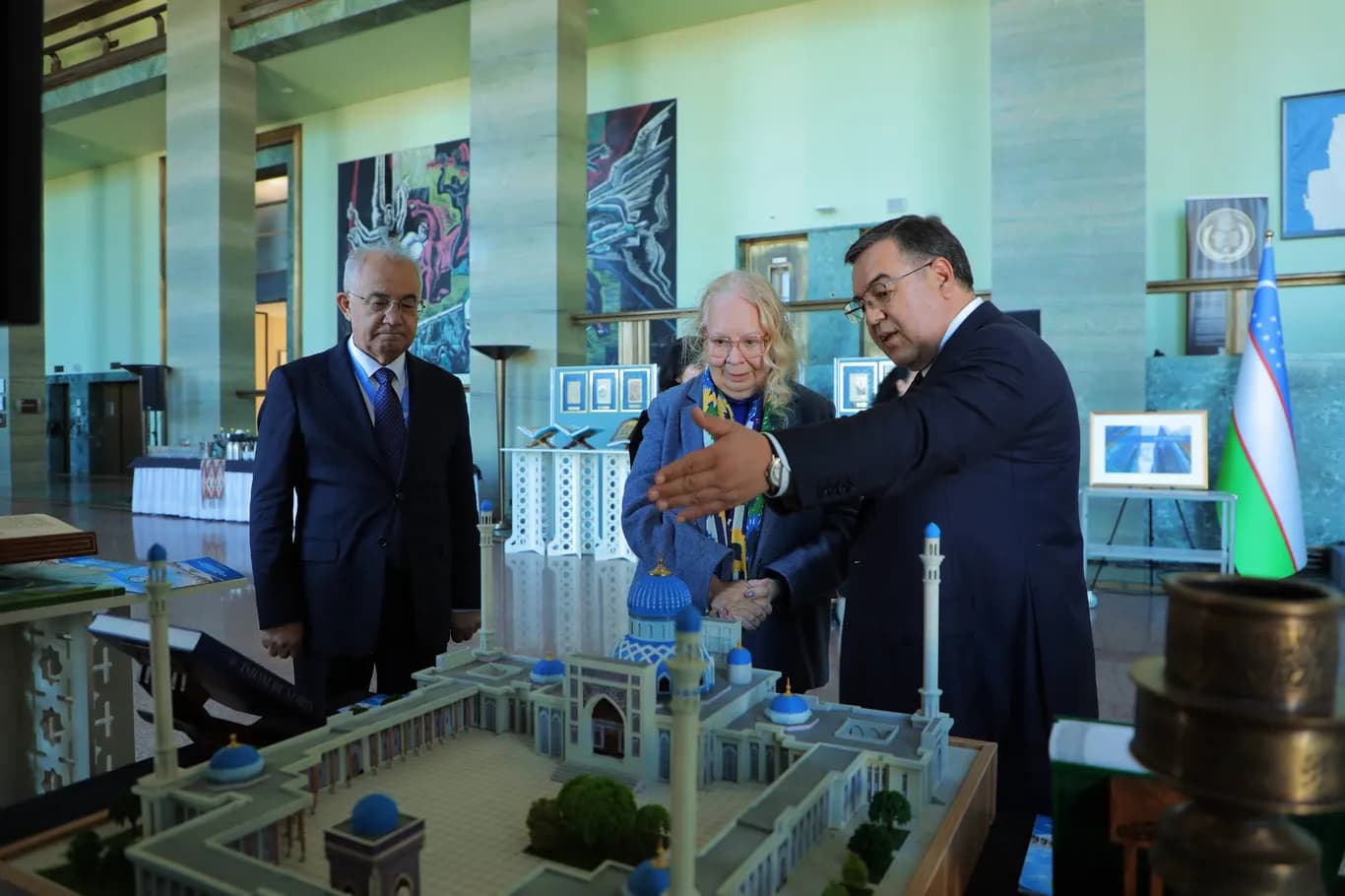
On October 22, 2026 the Center of Islamic Civilization in Uzbekistan presented at the UN office in Geneva the scientific and spiritual heritage of Central Asia, as well as modern projects for its study, preservation and popularization. The Palace of Nations hosted the exhibition “Civilizations, Personalities, Discoveries” and an international scholarly conference on the theme “Islamic Civilization: The Great Spiritual and Scientific Heritage of Maverannahr and the Horizons of Enlightenment.” The conference discussed the contribution of the scholarly traditions of Bukhara, Samarkand and Termez to the development of world civilization and the significance of this heritage for modern society.
Context of the initiative
The event continued the international dialogue launched on October 7 at UNESCO headquarters in Paris. Both meetings were organized within the framework of the initiative of the President of Uzbekistan, Shavkat Mirziyoyev, put forward on September 23, 2025 at the 80th session of the UN General Assembly, on the in-depth study of the legacy of Imam Bukhari, Imam Termezi and Imam Maturidi and its broad presentation to the world community. According to the publication, the Center’s director Firdavs Abdukhalikov stated that the initiative is finding expression in practical results.
Exhibition and participants
The program began with the exhibition “Civilizations, Personalities, Discoveries”: books, scholarly and illustrated editions, miniatures, and materials on the lives and discoveries of Central Asian thinkers were presented. Welcoming remarks were delivered by Director-General of the UN office in Geneva Tatiana Valovaya and the Permanent Representative of Uzbekistan to the UN office in Geneva, Elyor Toshmatov. Valovaya emphasized the conference’s importance for the dialogue of civilizations and highly praised the Center’s educational mission. Also speaking were the director of the National Center for Human Rights Akmal Saidov, Vice-President of the Academy of Sciences Bahrom Abdukhalimov, First Deputy Chairman of the Committee on Religious Affairs Davronbek Makhstudov, the directors of the international research centers of Imam Maturidi and Imam Bukhari, as well as foreign speakers — president of the Geneva diplomatic circle Robert Blum, director of Cultur-Cooperation International Kathleen Gübel, and a representative of Latter-day Saint Charities, Craig Taylor.
Practical agreements
The parties reported on an agreement reached on cooperation between the libraries of the Center and the UN office in Geneva. The Center’s director also announced an agreement with the leadership of the UN office on creating opportunities for using the UN library and archives; it is expected that this will open access to previously unknown materials on the history of Central Asia, in particular Uzbekistan. All books presented at the exhibition were donated by the Center to the library of the UN office in Geneva. The conference concluded with a discussion of prospects for joint projects in the scholarly and cultural-educational spheres, followed by a reception featuring Uzbek national cuisine at the Palace of Nations. The organizers were the Center of Islamic Civilization, the Ministry of Foreign Affairs of Uzbekistan, the Permanent Mission to the UN office in Geneva, the Committee on Religious Affairs, three international research centers, the International Islamic Academy of Uzbekistan, the ACDF foundation, the Muslim Board of Uzbekistan, and WOSCU.
Significance of the event
The event is important as a practical continuation of the initiative announced by Uzbekistan from the UN rostrum in September 2025: it was followed by concrete steps — presentations in Paris and Geneva and the donation of books to the UN library. For researchers, the most tangible result is the agreement on access to the UN library and archives, which, according to the Center’s director, may reveal previously unknown materials on the history of the region. It remains unclear which specific documents will become available and when the library cooperation will begin to operate.