The key facts
- A judge in New Mexico fined Meta $25 billion — the largest fine for the company; jurors counted more than 43 million violations
- The lawsuit is tied to the 2016 Cambridge Analytica scandal and the company's claims about protecting users' data
- Meta called the ruling an obstacle to doing business and intends to appeal it; under the law the fine goes to the state's education fund
The Court Ruling
Judge Francis Mathew in New Mexico on Wednesday, October 21, 2026, ordered Meta to pay $25 billion (about £18.6 billion or €22.5 billion) because the company misled the public for years about how it handled Facebook users' data. According to the BBC, the calculated fine for thousands of violations of state law amounted to $219 billion, but the judge reduced it to $25 billion — a sum roughly equal to the company's quarterly profit. This is the largest fine in Meta's history.
The Position of the Jury and the Court
In September, jurors found Meta guilty of more than 43 million violations of the state's consumer protection law; each violation, according to TechCrunch citing The New York Times, carried a fine of $5,000. Judge Mathew wrote that Facebook's promises that users control their data were false, and that correspondence among top executives, including Mark Zuckerberg, was 'aimed at misleading the public.' He characterized the violations as intentional and spanning more than 11 years — from 2010 to 2021. According to the BBC, the judge noted that 'the lies go beyond Facebook's data practices' and touch 'the very core of the company's key business practices.'
Origins of the Case
The lawsuit is tied to the Cambridge Analytica scandal: in 2016, a third-party app collected data from about 87 million Facebook profiles, which were passed to a British political consulting firm that worked, among other things, on Donald Trump's campaign. According to TechCrunch citing The Wall Street Journal, part of the case concerned the company's handling of the app linked to the leak, while other parts concerned its privacy policy and fight against disinformation. State attorneys argued that Meta executives' claims that users' data was not shared with third parties without permission were untrue, and that the company's actions harmed the state's entire population — about 2.1 million people (the BBC cites about 2 million). In 2019, the US Federal Trade Commission had already fined the company $5 billion for data privacy practices.
The Parties' Positions
New Mexico prosecutors sought between $35 billion and $40 billion (the BBC cites up to $40 billion), while Meta's lawyers argued that any amount above $3.4–3.45 billion was unconstitutional, and claimed the state had not proven actual harm to users. State Attorney General Raul Torres called the ruling an 'unambiguous message' to Silicon Valley and said that 'no corporation is too powerful to be held accountable.' State attorney Randy McGinn said during the trial that the court should speak to Meta 'in the only language it understands — money.'
Meta's Reaction and the Appeal
Meta announced its intention to appeal the ruling. The company's chief legal officer, C.J. Mahoney, said the ruling makes doing business in New Mexico 'practically impossible,' called the lawsuit an attempt to 'impose a tax on free speech,' and expressed confidence that the appeal would succeed. According to Torres, the funds will likely be frozen during the appeals, but under the law the fine must go to the state's education fund: 'We may have paid for the construction of schools for the next 100 years.'
Context of Other Cases
The ruling became another in a series of Meta's legal troubles in 2026. In August, nearly all US states agreed to a global settlement of $18 billion that included release from future Cambridge Analytica liability — New Mexico declined to join and filed its own lawsuit. Earlier this year, New Mexico also fined Meta nearly $1 billion (according to DW, $567 million under a separate August verdict) for misleading the public about the safety of platforms for children; the judge in that case compared the company to an industrial polluter whose form of pollution is 'psychological harm and the sexual exploitation of children.' California and a number of other states settled a similar child safety lawsuit without a fine or admission of liability, a few days after the start of the expected multi-week trial.
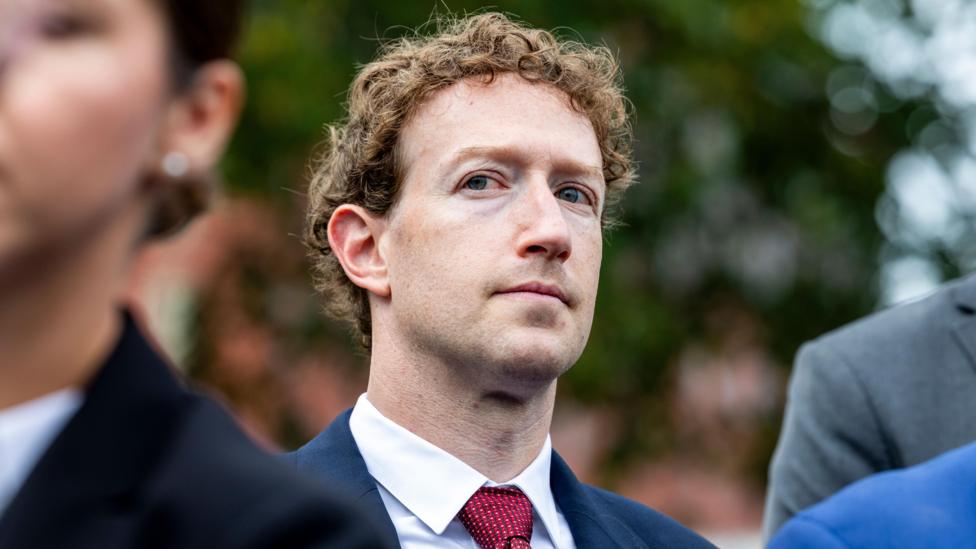 Image source, EPA
Meta has been hit with numerous legal fines this year