The key facts
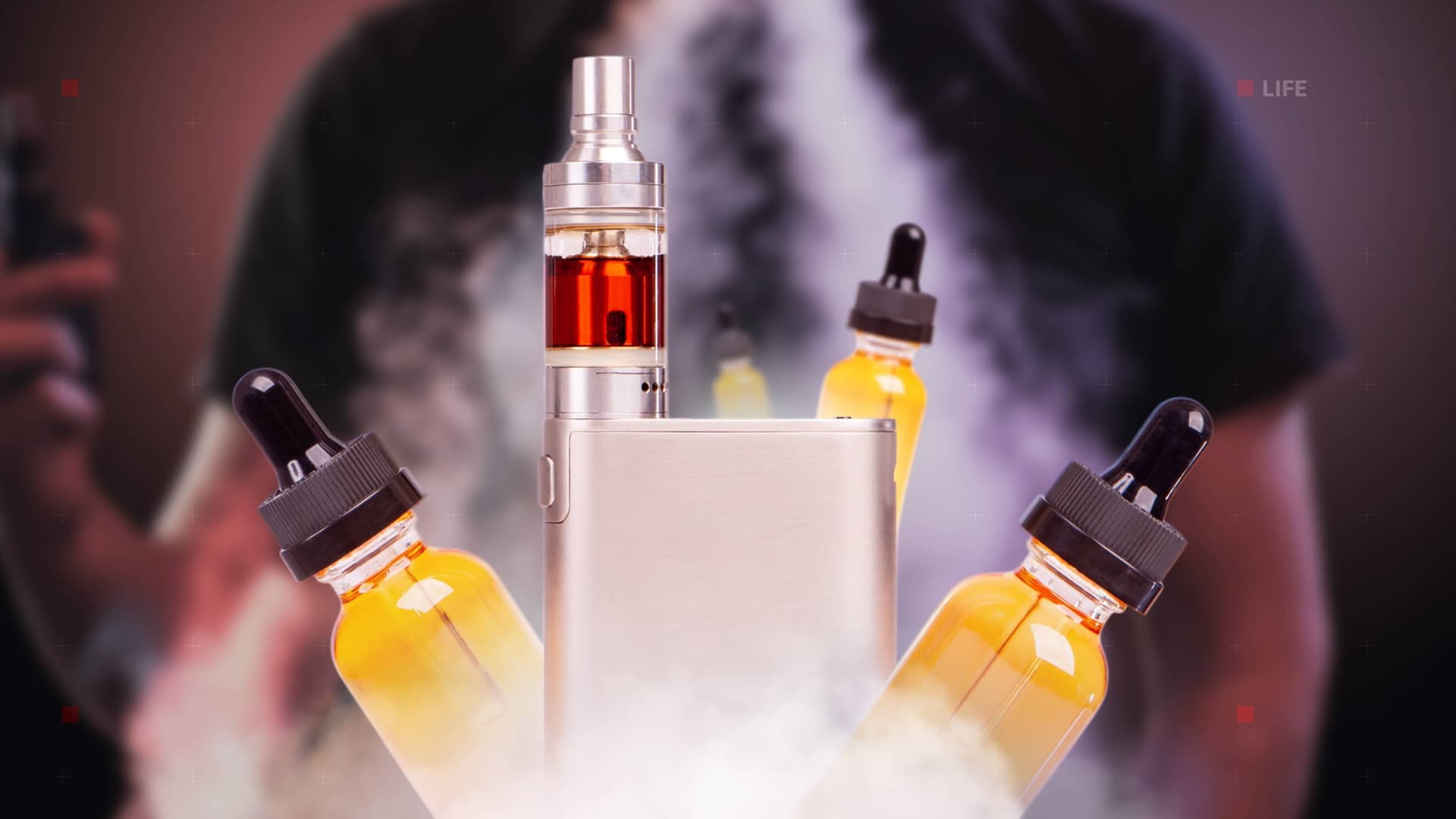
- About 1.5 thousand 'suckers' and liquids worth 2.3 million rubles were seized at a tobacco chain kiosk — a particularly large amount under the law
- The legal vape market in 2025 is 33.6 billion rubles (CRPT), and up to 103.3 billion including the illegal segment ('Center for Market Economics')
- Nicotine was found in 'nicotine-free' samples in amounts exceeding the norm; experts report severe lung damage among teenagers
Kiosk inspection and seizure of counterfeit goods
Activists of the 'Healthy Fatherland' movement used the 'Chestny Znak' app to check the permits for selling vape products at a kiosk of one of the largest tobacco chains. Scanning each package produced a warning: 'Products from this batch are banned from sale by decision of regulatory authorities; we cannot guarantee quality and safety.' After the audit began, 'managers' arrived at the store, followed by officers of the rapid response team of a local private security company who tried to interfere with the inspection; the activists called the police. The joint inspection with law enforcement and supervisory agencies took about five hours. According to the calculations of economic crimes officers, almost one and a half thousand devices ('suckers') and jars of liquid in six boxes were seized, with a total value of 2.3 million rubles — a particularly large amount under the law.
Market size estimates
According to the Center for the Development of Advanced Technologies, legal sales of vapes and liquids in 2025 amounted to 33.6 billion rubles — 64.6 million electronic devices and at least 144 thousand liters of liquids. The analytical center 'Center for Market Economics' estimates the entire market at three times higher — 103.3 billion rubles for 2025. Experts differ in their estimates of the illegal segment but agree that it may exceed legal sales by up to two times.
Health consequences
Stories of victims are being published online. Anna, who vaped for almost three years, described difficulty breathing and 'gurgling' in her lung when inhaling; her diagnosis is bronchiolitis and lung inflammation. Other cases are known: in Perm Krai, a 15-year-old girl who bought an e-cigarette through a Telegram channel suffered an epileptic seizure during a lesson; in Buryatia, a 14-year-old schoolboy was hospitalized with bloody foam, convulsions, and brain hypoxia; in Kemerovo, a 16-year-old teenager with two years of 'experience' was diagnosed with total vaping-associated lung damage.
Laboratory test results
Samples of the devices were sent to a laboratory. According to an expert, nicotine was found in the 'nicotine-free' samples, exceeding the legal level several times over; the third sample showed a discrepancy in the declared liquid volume. Evgenia Gnuchikh, Deputy Director for Research and Innovation at the Federal State Budgetary Scientific Institution All-Russian Research Institute of Tobacco, Makhorka and Tobacco Products, explained that liquid volume is an excise-taxable value, and understating the declared volume means underpaying excise duties to the state.
Production in China and Russia
A representative of a Chinese manufacturer from the city of Dongguan (Guangdong province) said he could produce products 'with zero nicotine and generally with any parameters' at a price starting from 20 yuan per e-cigarette, producing over 30 thousand devices per day. Asked about bans on electronic nicotine delivery devices in China and Vietnam, he replied: 'The emergence of new restrictions is just new opportunities for us. We have wholesale supplies to Vietnam and even within China.' Production is also being established in Russia: a manager of one such facility showed catalogs of Chinese factories and said the products are 'opened, filled, and sealed anew'; the output is 'ten thousand items per day,' and the price is from 1,140 rubles per 10 ml for federal chains. A RATK production license costs 9.5 million rubles.
Criticism of the control system
Pavel Shapkin, chairman of the National Union for Consumer Protection, stated that the license is issued without inspections or inspector visits, and a declaration of conformity can be obtained with an online payment 'without ever seeing the products.' Oversight is assigned to Rospotrebnadzor, but, according to Shapkin, 'it has a moratorium on inspections.' Raw materials from China can be brought across the border cheaper than finished products, and assembly can be done 'on one's knees' even in an apartment. Doctors are sounding the alarm: Vera Nikishina, a psychologist at City Clinical Hospital No. 1 named after N. I. Pirogov, noted that nicotine in doses allowed in e-cigarettes 'can easily cause an altered state of consciousness,' leading to 'a dysfunctional brain in the younger generation.' A specialist at the MASRC of the Pirogov University reported a 16-year-old patient with 90% lung damage who, having relatively recovered, permanently lost 40% of his lung tissue: 'Even if a person quits, the inflammation remains. Essentially, fibrosis develops.'