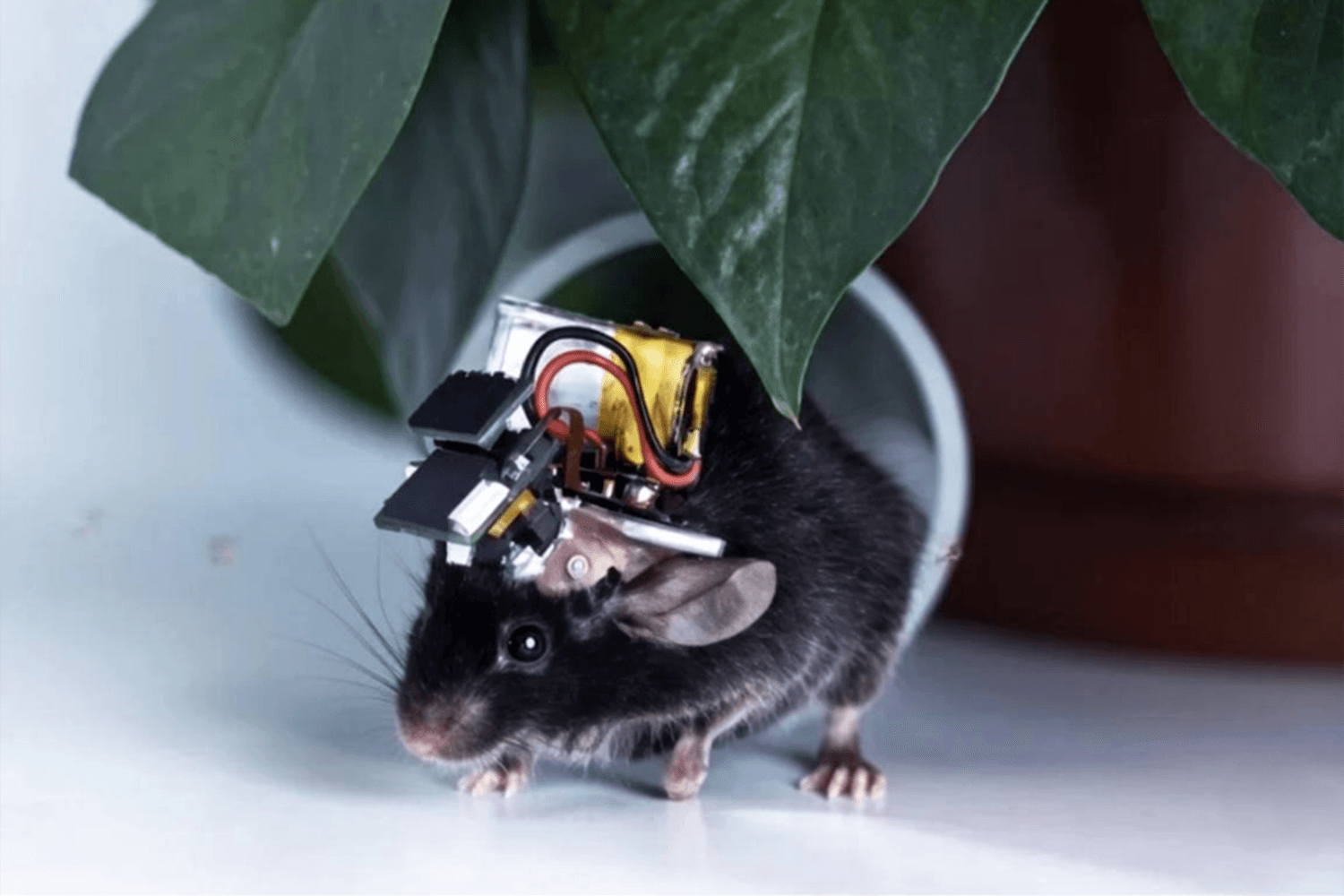
The key facts
- A team at Tsinghua University created a wireless optical mesoscope, Airscope, weighing about 1 gram
- The device made it possible to simultaneously record the activity of more than 8,500 neurons in the mouse cortex during free movement
- The system's volume has been reduced almost 100,000-fold compared with benchtop microscopes while maintaining comparable signal quality
An ultra-light device for observing the brain
Scientists at Tsinghua University in China have developed an ultra-light wireless device, Airscope, that makes it possible to simultaneously track the activity of thousands of neurons in a moving animal. This was reported by the South China Morning Post. According to the publication, the technology is intended for studying the mechanisms of brain function, and in the future it may find applications in the study of oncological and immune diseases.
Operating principle and design
Airscope is a compact optical mesoscope occupying an intermediate position between a microscope and a macroscope. The device makes it possible to observe the activity of individual cells over a relatively large area of biological tissue. At the same time, no fixation of the animal's head or connection of bulky cables that restrict movement is required. The developers managed to reduce the volume of the system almost 100,000-fold compared with conventional benchtop microscopes while maintaining comparable quality of neural signal recording. The design uses a two-megapixel image sensor and a wireless data transmission system. Artificial intelligence helped optimize the lens design, and computer vision algorithms automatically recognize and continuously track individual objects in video.
Experiments on mice and the team's plans
During the experiments, the researchers attached the device to mice and allowed them to move freely in a specially equipped environment with shelters, burrows and obstacles. Using Airscope, the scientists simultaneously recorded the activity of more than 8,500 individual neurons in the animal's cortex while it explored the space. The data obtained made it possible to study the connection between the activity of neural networks and the social behavior of mice. In the future, the team plans to study the neural mechanisms associated with emotions and social interactions, which, according to representatives, may help in studying conditions such as depression. The potential applications of the technology, as the developers note, are not limited to neuroscience: similar imaging systems can be used to monitor the development of diseases in immunology and oncology.