The key facts
- Speaking at an AI Now Institute event, Mamdani said there is a 'complete abdication of federal law' in AI and called on residents to defend control over the technology.
- He previously banned AI in elementary and middle schools and introduced a requirement to disclose AI use in real estate listing photos.
- He criticized Trump's Superintelligence Task Force for relying on company self-regulation and cited Bloomberg data on AI's role in the February strike on a school in Iran.
Speech at the 'People's AI Assembly'
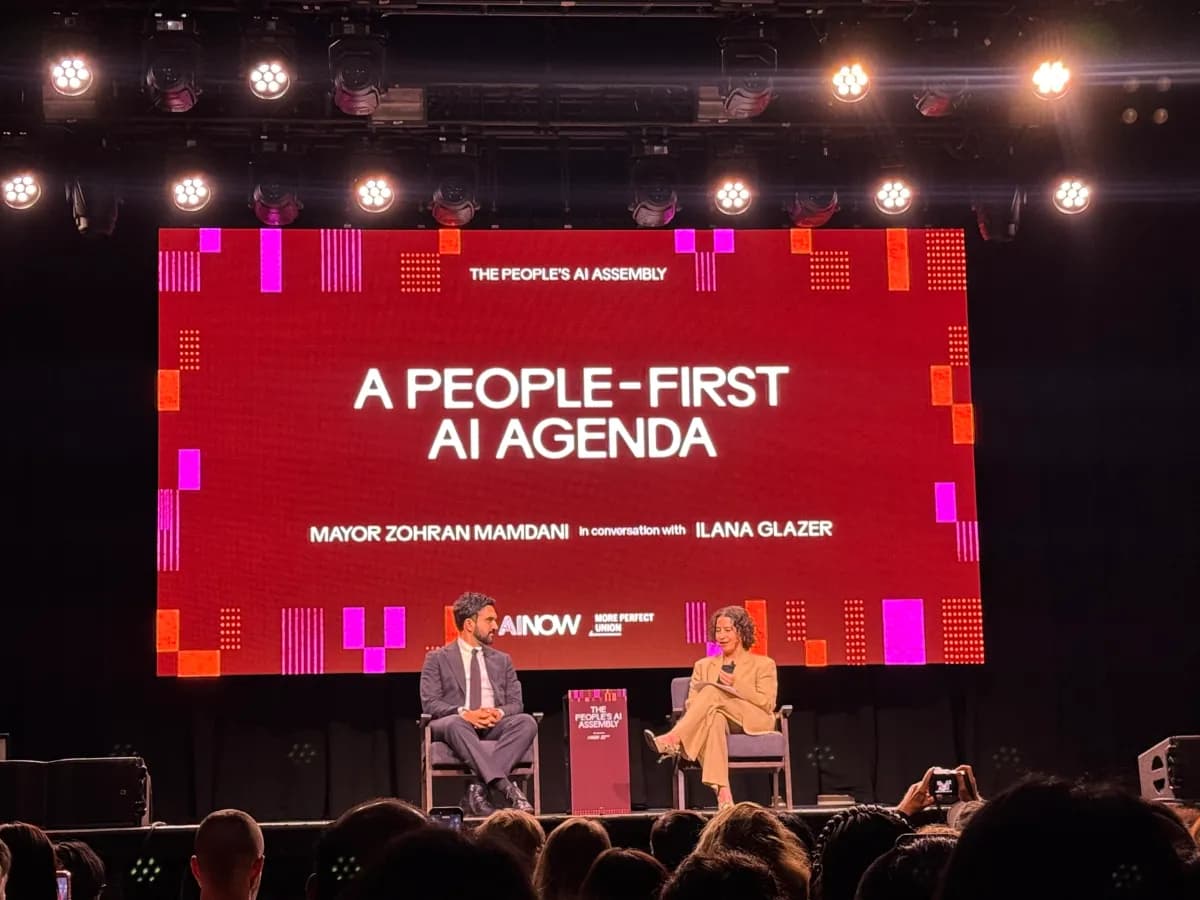
On Monday evening at Webster Hall in Manhattan, New York Mayor Zohran Mamdani and activist, actress from the series 'Broad City' Ilana Glazer discussed the future of AI at The People's AI Assembly event organized by the AI Now Institute think tank, which studies the technology's social consequences. Glazer asked the mayor questions. Mamdani urged New Yorkers to resist the feeling that AI will inevitably take their jobs, affect children's minds and dignity, and to take back control. According to him, the rapid adoption of the technology is not inevitable, and public servants must demand accountability from AI companies.
City measures against AI
The mayor recalled recent decisions by the city administration. Last month he ordered a ban on the use of AI in elementary and middle schools. Glazer, herself a parent, said the appearance of the technology in classrooms worries her: 'It made me nervous. It feels like it's imposed without consent — like it has to be in schools. Two years ago it wasn't. Why should it be in schools?' In the summer, the mayor also introduced a policy requiring landlords, brokers and real estate platforms to explicitly indicate if listing photos or videos are created with AI. The measure is designed to protect residents from 'house-phishing' — fraud through misleading listings.
Criticism of federal policy and the industry
Mamdani criticized the 'complete abdication of federal law' in the field of AI. According to him, at the national level the AI discussion is usually framed as 'an arms race with China,' while humanitarian concerns are pushed into the background for the sake of national competition. He also pointed to the 'reckless deployment of the technology without reckoning with its limitations,' citing the February US strike on a school in Iran, which killed more than 150 people, including at least 123 children. According to Bloomberg, citing participants in the Pentagon's internal investigation, one factor in the strike was excessive reliance on AI in target selection.
Corporate accountability and future regulation
'There is a desire to talk about AI as if it is infallible, as if it cannot be questioned, as if only those who are developing it now can regulate it,' Mamdani said, noting that Facebook made similar arguments in 2008. In his view, behind this is 'an attempt to escape any accountability at any level without jeopardizing a potential valuation at IPO.' TechCrunch notes that Anthropic is expected to go public this year, and OpenAI has stated plans for an IPO in 2027. The mayor also criticized the Superintelligence Task Force announced earlier this month by President Donald Trump, which, according to the outlet, is focused mainly on self-regulation of powerful AI companies rather than new federal restrictions — despite warnings from whistleblowers at Anthropic, Google DeepMind and OpenAI that AI could lead to the extinction of humanity. 'When we look at what comes after this federal administration, we need a fundamentally different approach to how we think about AI, talk about AI, and what accountability we are willing to demand,' Mamdani concluded.