The key facts
- The Bell review will be presented to parliament on Wednesday; the government is expected to accept all 27 recommendations
- Antisemitism will become a separate safeguarding risk category, rather than part of anti-racism and anti-bullying measures
- According to Community Security Trust, incidents in schools rose from 112 to 178 in the first half of 2026 (+59%)
Review will require antisemitism to be treated separately
Schools and colleges in England will be required to recognise antisemitism as a separate category of harm and take specific measures against it — according to the BBC, these are the findings of a major government review. This means hostility towards Jews will be treated as a specific risk to children's safety (safeguarding), rather than being addressed solely through general measures against racism and bullying. The review is also expected to recommend special teacher training, more consistent recording and reporting of incidents, better education about antisemitism and contemporary Jewish life, and clearer guidance on teachers' political impartiality.
Timing, author and context
The review was led by former Ofsted chief inspector Sir David Bell, now vice-chancellor of the University of Sunderland. It will be presented to parliament on Wednesday, and the government is expected to accept all 27 recommendations. The review was launched amid growing concern about antisemitism in the UK following a series of high-profile incidents, including the attack on the Heaton Park synagogue in Manchester in October 2025, in which two people died. In parallel, reviews were commissioned on antisemitism in healthcare and on public order and hate crime legislation.
Rise in incidents and conditions in Jewish schools
In August, the BBC reported that the review had documented regular harassment and abuse of Jewish schoolchildren, and that heads of some Jewish schools spend more time on security matters than on education. According to Community Security Trust, in the first half of 2026 antisemitism in schools reached its highest level on record for the first six months of a year: 178 incidents compared with 112 in the same period of 2025 — a rise of 59%. A recommendation is also expected to create a helpline for school leaders for urgent advice.
Life under guard: testimony from a Hertfordshire school
The BBC was given access to the Jewish school Yavneh College in Hertfordshire. The school's executive director, Spencer Lewis, said security is an 'innate part' of his job: high gates and fences, cameras, four in-house security guards. Pupils and staff are used to the measures; 'in-vacuation' drills (locking down in rooms during an intrusion) have become routine even for the youngest. 'Sometimes it's a bit scary, but you know you're safe,' said sixth-former Livvy. Older pupils said they feel safe at school, but reports of attacks and of harassment of pupils from other Jewish schools on the way to school and at sporting events make them feel like targets; some are reluctant to wear kippahs or Star of David pendants outside school.
The IHRA definition and reaction
The government is expected to adopt the International Holocaust Remembrance Alliance (IHRA) working definition of antisemitism, although it cannot be made mandatory. The definition is supported by major Jewish organisations, has been adopted by 47 countries, including the UK, and by most British universities, but some of its examples have been controversial. The Board of Deputies of British Jews said adopting the definition would give schools a tool 'for deepening understanding of contemporary antisemitism', and its status as a safeguarding issue would create an explicit duty for schools to respond and strengthen accountability. Bell told the BBC: 'This is not just a report for Jewish children in Jewish schools. This is for all children and young people in all schools and colleges. We know that antisemitism knows no boundaries.' The Department for Education declined to comment before the review's publication.
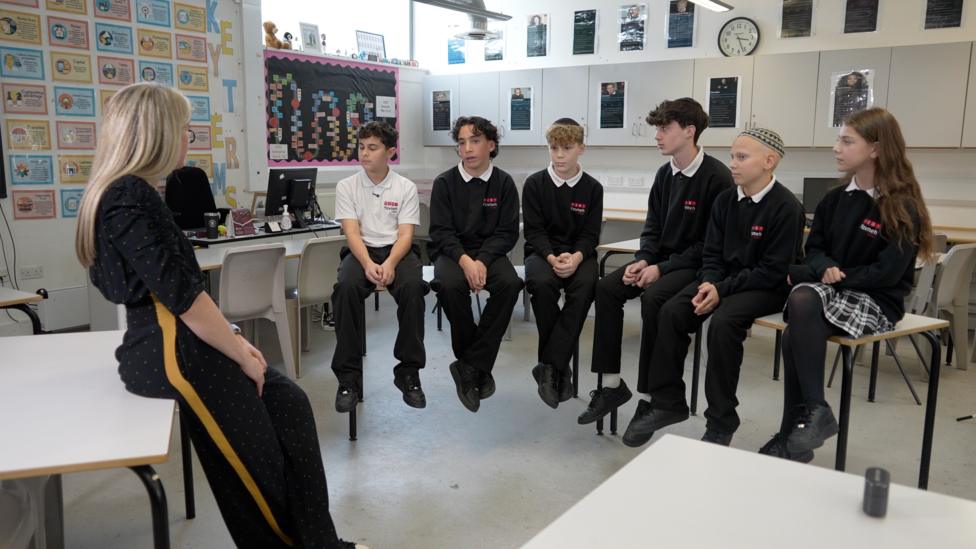
Students at Yavneh College in Hertfordshire speak to Judith Moritz about their security concerns