The key facts
- In the advisory referendum on October 19, about 76–77% of Alberta voters supported keeping the province in Canada
- The referendum is non-binding: a separatist victory would only have launched the path to a mandatory referendum on independence
- Premier Mark Carney called the result a victory for unity; separatists led by Jeffrey Rath said the movement would continue
Voting results
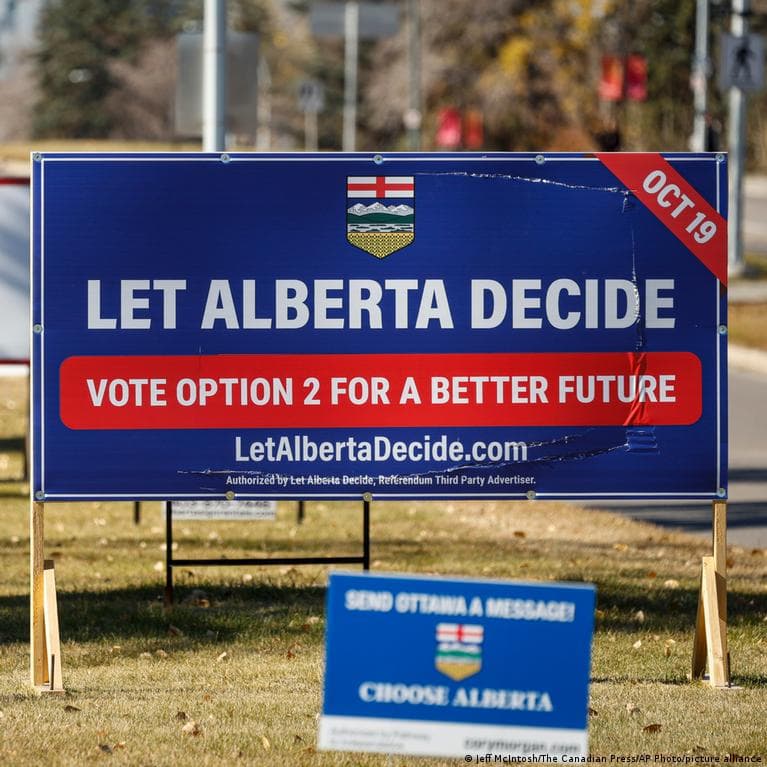
Residents of the western Canadian province of Alberta voted in a referendum on October 19 to keep the province in the federation, the Canadian broadcaster CBC News reported, citing exit poll projections. According to preliminary data from Elections Alberta, with 1,480 of 5,587 polling stations counted, 76.2% of voters (826,918 people) supported remaining in Canada, while 23.8% (257,726 people) supported starting the process of separation. According to euronews, after more than a million votes were counted, support for the federalist side reached 77%.
Referendum format
The vote was not a direct choice on independence. Voters were asked whether Alberta should remain a province of Canada or whether the provincial government should begin the legal process provided for by the Constitution of Canada to hold a binding provincial referendum on leaving the federation. Thus, a separatist victory would only have opened the path to a mandatory vote in the future. The ballot contained 10 questions: the first nine concerned immigration and constitutional matters, and the last one concerned Alberta's future within Canada. About 1.36 million residents voted in advance or by special mechanisms. Elections Alberta said ballots are counted by hand, with the separation question counted first. Unofficial results were expected within 48 hours of polls closing, with official results scheduled for October 29.
First separation referendum outside Quebec
According to Deutsche Welle, this is the first separation referendum held outside Quebec, where separatist movements were previously tied to linguistic and cultural differences. In Alberta, the campaign relied largely on economic grievances. The oil-rich province is almost twice the size of Germany by area but far more sparsely populated — about 5 million residents, nearly half of whom live in the two main cities, Edmonton and Calgary.
Politicians' reactions
Canadian Prime Minister Mark Carney, who grew up in Alberta, welcomed the result. 'On October 19, Albertans made a clear choice. They chose unity, to build together and care for one another. Above all, Albertans chose Canada,' his statement said. For Carney, this is a victory against the backdrop of a trade war with the United States: President Donald Trump has threatened to make Canada the 51st state. Alberta Premier Danielle Smith, who opposes independence, held the referendum under pressure from separatists within her United Conservative Party. 'Albertans voted for a stronger Alberta in a united Canada,' she wrote on social media. Former deputy premier Thomas Lukaszuk, who led the Forever Canadian campaign against separation, told supporters: 'We are a strong country, united from coast to coast to coast.'
Trump allies' involvement and the separatists' position
The separatist campaign drew attention from Trump allies: US Treasury Secretary Scott Bessent called Alberta a natural partner of the United States, and billionaire Elon Musk posted on X that the province should separate. Separatist leaders also met with US State Department staff. Separatists said their cause is not over: Jeffrey Rath, leader of the Alberta Prosperity Project, said the fight for independence would continue. 'We have learned a lot from this fight,' he noted. Previously, separatist parties had garnered only 1–2% of the vote, but discontent with COVID restrictions revived the movement. Alberta, a conservative stronghold with the world's fourth-largest proven oil reserves, has long been unhappy with Ottawa over the management of the oil industry: Smith accused Carney's predecessor Justin Trudeau of attempting to curb oil production for the sake of the climate agenda.