The key facts
- The 10-principle doctrine was published 9 days before the October 27 election
- Key ideas: preemptive strikes, buffer zones, military superiority, development of AI and quantum technologies
- Lapid called the document 'superficial,' Eisenkot — 'empty pages filled with slogans'
Publication of the doctrine on the eve of the election
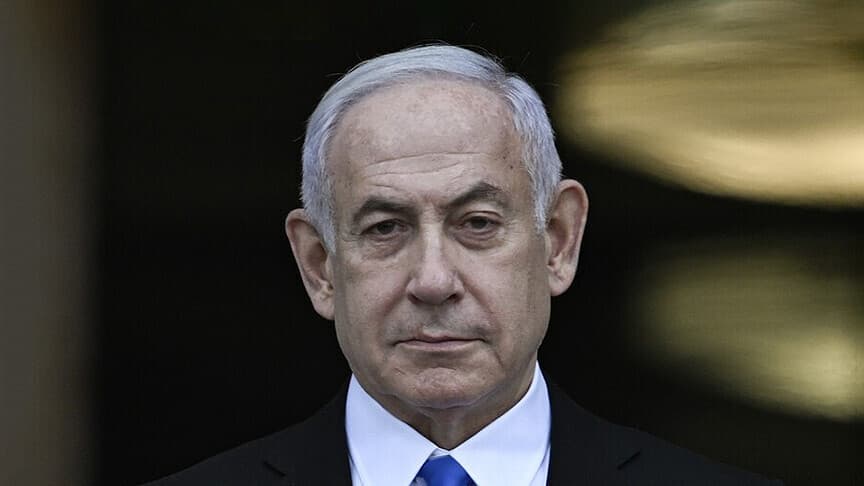
Israeli Prime Minister Benjamin Netanyahu on Sunday presented a new national security doctrine providing for preemptive strikes and the creation of buffer zones along the country's borders. The three-page document titled 'The Security Doctrine of Prime Minister Benjamin Netanyahu' was posted on the government website and prepared with the assistance of the National Security Council. It was released nine days before the parliamentary elections on October 27 and contains 10 principles of an updated security strategy.
Main provisions of the document
In the introduction, Netanyahu stated that Israel's military operations — from Gaza and Lebanon to Yemen and Iran — had, in his words, eliminated the looming threat of nuclear annihilation and dismantled the Iran-led network surrounding Israel. On this basis, he proposed shifting the priority from deterrence and defense to preemptive strikes against emerging threats, as well as strengthening military deterrence, intelligence, and early warning systems. The document allows for the creation of buffer zones along the borders 'when necessary,' without specifying their location. Among the threats named are Iran and allied groups, including Hezbollah in Lebanon and the Houthis in Yemen, as well as precision-guided missiles, drones, cyberattacks, and attempts to internationally isolate Israel. The doctrine calls for maintaining military superiority, developing domestic arms production, investing in artificial intelligence, quantum computing, and space, encouraging settlement in the 'Land of Israel,' and strengthening national unity and regional alliances. At the same time, as Anadolu notes, the document contains no detailed operational plan either for Iran or for the buffer zones.
Maps and the 'Sunni Diamond Alliance'
During the presentation, Netanyahu showed maps with geopolitical threats and regional blocs. One of the maps, bearing the logo of the German Friedrich Ebert Foundation, grouped Turkey, Saudi Arabia, Egypt, and Pakistan under the name 'Sunni Diamond Alliance.' Iran and allied groups were labeled as the 'Axis of Resistance,' and a grouping involving Israel and the UAE also appeared. The presentation did not make clear whether Netanyahu considers all the countries shown to be adversaries, and the labels did not confirm the existence of formal military alliances. Critics, according to the agency, have long accused Netanyahu of selectively using maps to exaggerate threats.
Opposition criticism
Opposition leader Yair Lapid called the document 'superficial' and 'strange,' saying it looks as if it were written by a free version of an AI chatbot. He stated that the doctrine is limited to general declarations and does not address Netanyahu's responsibility for past security failures, and also criticized the prime minister's refusal to establish a state commission of inquiry into the circumstances of the October 7, 2023 attack and its results in the area of normalizing relations with Arab countries. Lapid also pointed to contradictions between the document's principles and the government's policies — on exempting ultra-Orthodox men from military service, the deterioration of international relations, and the deepening split in society.
Eisenkot's statement
Former chief of the general staff, leader of the opposition party Yashar, Gadi Eisenkot called the document 'empty pages filled with slogans' and accused Netanyahu of leaving a 'strategic vacuum' in security policy. In his view, the publication nine days before the election is an attempt to divert attention from the government's record. Eisenkot accused the prime minister of manipulating public opinion, stoking fear, and evading responsibility, and also disputed the picture of military successes: according to him, Hamas retains armed forces in Gaza, and Hezbollah is rebuilding its capabilities in Lebanon. He promised that an opposition government would develop and adopt an official national security strategy within 150 days of taking office.
Campaign context
The publication of the doctrine came against the backdrop of Netanyahu's campaign for re-election and criticism of his government for the security failures that preceded the Hamas attack in October 2023 and the subsequent wars. The opposition accuses him of using security threats for electoral purposes and shirking responsibility. Issues of national security, military accountability, and the country's international standing have become central themes in the struggle to form Israel's next government.