The key facts
- Qatar seeks to implement previously agreed energy projects with Lebanon and called on Israel to withdraw its troops from occupied Lebanese territories.
- Lebanon advocates keeping an international force in the south after UNIFIL's mandate ends at the end of the year.
- The EU Council approved a new three-year mission to support Lebanese security institutions.
Qatari PM's visit to Beirut
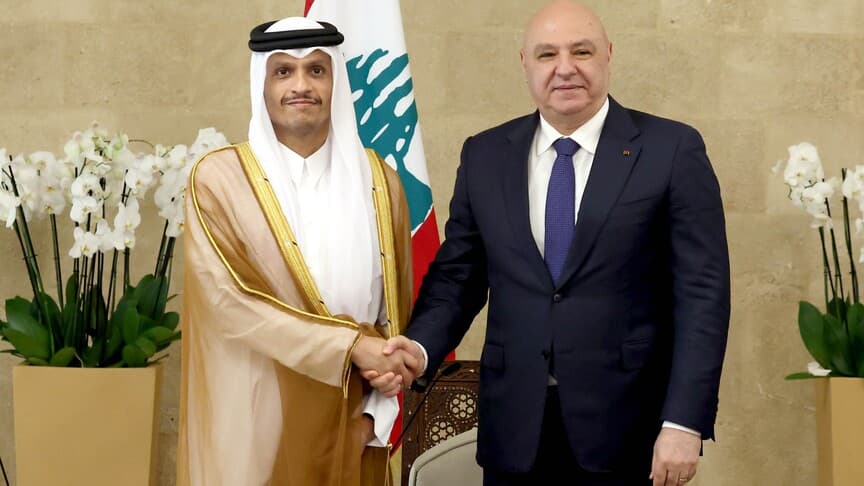
Qatar's Prime Minister and Foreign Minister Sheikh Mohammed bin Abdulrahman Al Thani said on Friday, after a meeting with Lebanese President Joseph Aoun, that Doha seeks to offer comprehensive solutions for Lebanon's energy sector and to activate projects previously agreed between the two countries. According to him, the talks concerned bilateral relations and ways to implement joint projects contributing to the security, stability and prosperity of the region. He called energy a key priority for Lebanon and added that a subsequent meeting with Prime Minister Nawaf Salam would be devoted to energizing these projects.
Southern Lebanon and the Israeli presence
Al Thani said that with Aoun he also discussed regional and international developments, in particular the situation in southern Lebanon and, as he put it, 'Israeli occupation practices' against the country. He confirmed Qatar's support for the measures taken by Lebanon and stressed the need for the Israeli army to withdraw from the Lebanese territories it holds, handing them over to the Lebanese army. Qatar, he said, will continue to support Lebanon.
The future of the international presence in the south
Lebanese Foreign Minister Youssef Raji, at a meeting with UN Under-Secretary-General for Peace Operations Jean-Pierre Lacroix, which was also attended by UNIFIL commander Diodato Abagnara, stated that Lebanon is committed to maintaining an international force in the south of the country after the mandate of the United Nations Interim Force in Lebanon (UNIFIL) ends at the end of the year. Raji thanked the peacekeepers for their contribution to the security and stability of the south. Lacroix stressed the need to prepare for the next phase and said that the UN Security Council would soon begin talks on the future of the UN presence in Lebanon, confirming the UN's readiness to play a constructive role with full respect for Lebanon's position. The parties agreed to step up efforts to overcome obstacles and ensure the continuation of the international presence in the south under the UN flag.
Context of Lacroix's visit and EU decisions
Lacroix arrived in Lebanon on Wednesday; the duration of the visit was not announced. He held meetings with President Aoun, Parliament Speaker Nabih Berri, Prime Minister Salam and army commander General Rodolphe Haykal, discussing the future of UNIFIL and the possibility of extending its mandate. On Monday, the EU Council decided to establish a new mission to support Lebanon for an initial three-year term, aimed at strengthening the capabilities of the Lebanese army and internal security forces, as well as supporting the country's sovereignty and stability. Earlier, on 7–8 October, during a visit to Lebanon, EU High Representative for Foreign Affairs Kaja Kallas stressed the need to prevent a security vacuum in the south after UNIFIL's mandate ends. UNIFIL operates in southern Lebanon on the basis of UN Security Council resolutions; its tasks include monitoring the cessation of hostilities and supporting the deployment of the Lebanese army in the area of operations. Discussions about the force's future are taking place against the backdrop of the current mandate's expiration and international consultations on the nature of the UN presence in southern Lebanon in the next period.


