The key facts
- Yesh Din recorded 377 incidents of violence over the two weeks up to October 10; the UN commission, in report A/HRC/62/22, stated that the authorities were directly involved in settler attacks.
- Ben-Gvir issued more than 240,000 weapons licences since the end of 2023; Katz ended administrative detention for Jewish settlers.
- Britain, Canada, Australia, New Zealand and Norway imposed sanctions on Smotrich and Ben-Gvir on June 10, 2025.
Accusations of official complicity
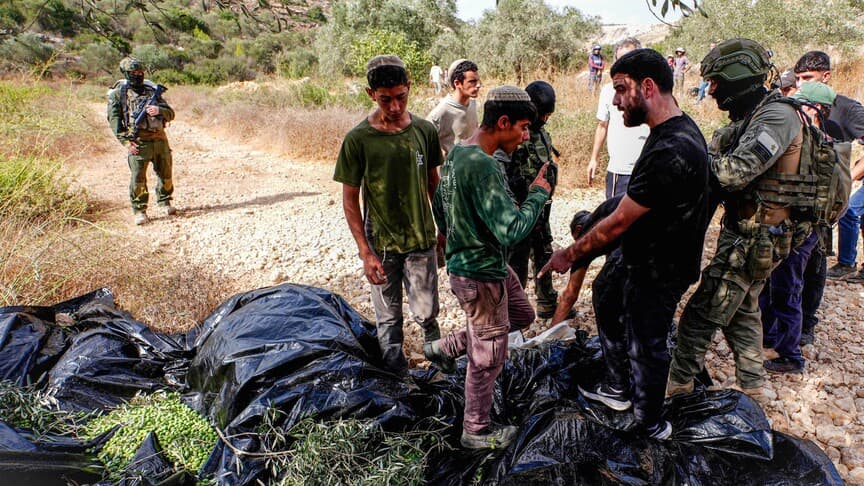
Accumulated evidence, including Israeli media reports, human rights reports, statements by politicians and former security officials, UN investigations and Western sanctions against two ministers in Benjamin Netanyahu's government, has given rise to accusations of Israel's official complicity in attacks on Palestinians, their land and property in the occupied West Bank. The accusations intensified amid an escalation of violence during the olive harvest season: the human rights group Yesh Din documented 377 incidents involving settlers and soldiers over the two weeks up to October 10.
The army and the settlers
On September 28, the Israeli newspaper Maariv reported on large-scale attacks, which it described as 'Jewish terrorism', including damage to Palestinian property, and cited accusations that soldiers helped settlers steal the olive harvest in Sinjil, north of Ramallah, and covered up the incident. On September 4, opposition Knesset member Gilad Kariv accused the army of serving groups from illegal outposts, calling it 'routine in the Palestinian territories'. In August, more than 300 reservists signed a letter to Chief of Staff Eyal Zamir, accusing the command of failing to give them the authority to prevent settler violence.
Expanded access to weapons and weakened law enforcement
On January 22, National Security Minister Itamar Ben-Gvir approved adding 18 illegal settlements to the areas whose residents may obtain weapons licences. According to his own figures, more than 240,000 licences have been issued since the end of 2023, compared with roughly 8,000 per year previously (the figure also includes Israelis outside the settlements). On November 22, 2024, Defence Minister Israel Katz announced the abolition of administrative detention for Jewish settlers suspected of attacking Palestinians, justifying it by security threats to the settlements. Channel 12 reported that the Shin Bet had warned that the move would undermine the fight against settler violence, while Ben-Gvir and Finance Minister Bezalel Smotrich welcomed it. On September 3, 2025, Smotrich announced a plan to annex 82% of the West Bank, formulating the principle as 'maximum territory and minimum Arabs'.
Sanctions and criticism from within
On June 10, 2025, Britain, Canada, Australia, New Zealand and Norway imposed sanctions on Smotrich and Ben-Gvir — asset freezes and travel restrictions — accusing them of inciting extremist violence. On June 9, 2026, France banned Smotrich from entering the country. On June 24, The Guardian published a letter from dozens of former officials, including ex-prime ministers Ehud Olmert and Ehud Barak and more than 30 heads of security services, who accused the Netanyahu government of deliberately tolerating the attacks and demanded accountability, threatening to turn to the Supreme Court. On September 29, Yair Golan, leader of the opposition Democrats party, held the government, Smotrich and Ben-Gvir responsible for the bloodshed. On October 5, Channel 13 reported on a dispute between Settlement Affairs Minister Orit Strook and Shin Bet head David Zini: in response to her objections, Zini said, 'You are detached from reality,' calling on the political leadership to condemn the attacks.
Conclusions of the UN and human rights groups
The independent UN Commission of Inquiry, in report A/HRC/62/22 dated May 8, concluded that the authorities were directly involved in settler attacks, provided the attackers with financial and military support and shielded them from accountability, describing 'settler violence' as an instrument of a policy of settlement expansion, annexation and displacement of the population. B'Tselem, as early as its 2021 report 'Settler violence = state violence', described the attacks as a means of seizing Palestinian land, and in its report 'The Deletion Project' of September 14, based on nearly 2,000 testimonies, documented cooperation between official bodies and armed settler groups.
The scale of the violence
According to Yesh Din, the 377 incidents over two weeks affected 162 Palestinian communities: 58 physical assaults on farmers, 57 cases of obstructing the harvest and 100 thefts of crops; soldiers were present in 44 incidents related to the olive harvest. The Palestinian Commission Against the Wall and Settlements recorded 219 attacks between October 1 and 12, including 42 joint attacks by the army and settlers and 136 related to the harvest, as well as 45 cases of crop theft or damage to trees. Since the beginning of October, three Palestinians have been killed. In total, the commission counted 5,561 settler attacks from the beginning of 2026 to the end of September. Israel has occupied the West Bank, including East Jerusalem, since 1967; the settlements are considered illegal under international law. Palestinians warn that settler violence, combined with settlement expansion and annexation policies, is aimed at driving them off their land and undermining the possibility of creating a Palestinian state.


