The key facts
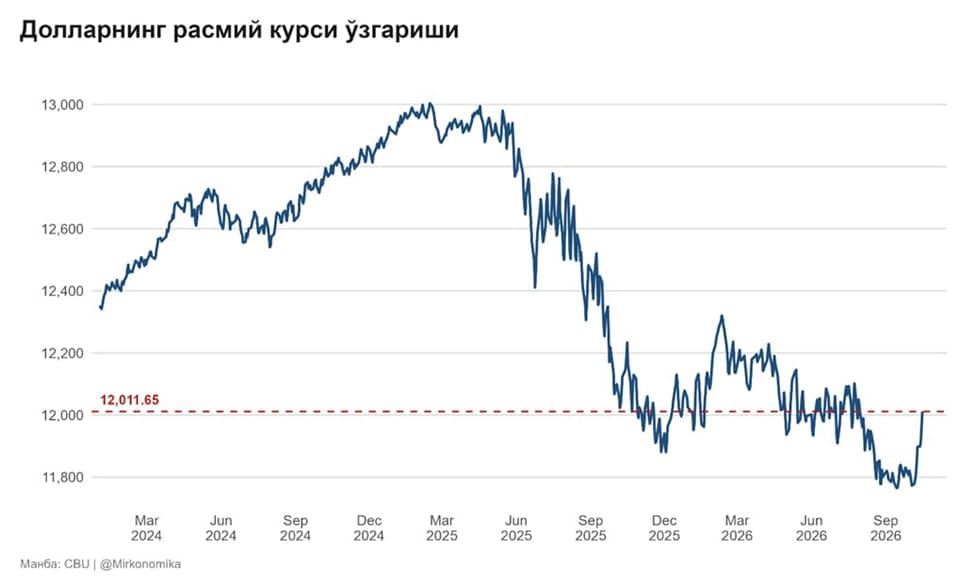
- From October 3 to 16, the soum weakened by 238.7 soums — from 11,772.95 to 12,011.65 per dollar; the official rate reached its highest level since July 31.
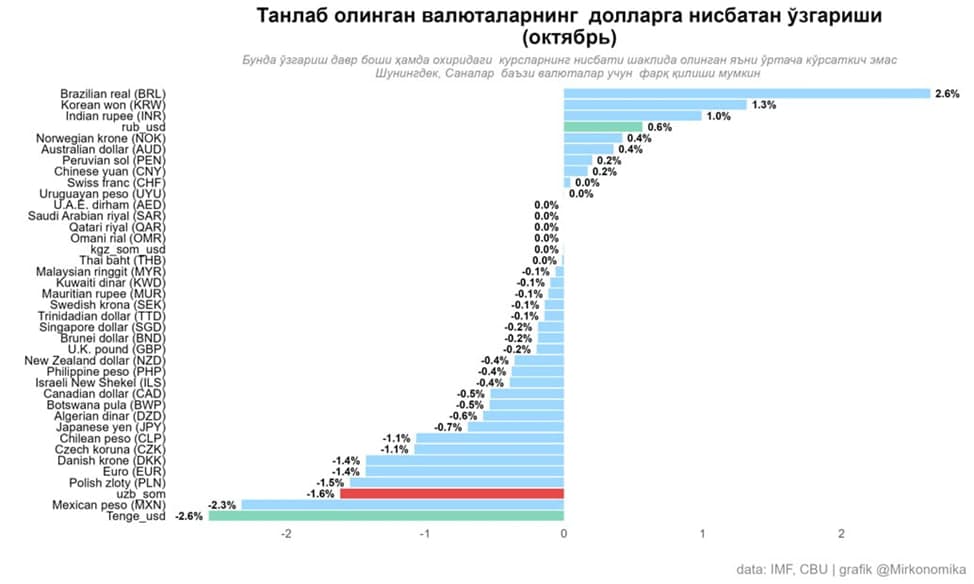
- In October, 26 of the 39 currencies reviewed depreciated against the dollar; in September, the Fed raised the rate to 3.75–4% per annum.
- The economist names possible domestic factors: one-off payments on external obligations, real exchange rate appreciation, and a seasonal decline in money transfers, but sees no grounds for a sharp prolonged weakening of the soum.
Nine sessions of weakening
The Uzbek soum has been depreciating against the dollar for nine consecutive trading sessions. Over this period, the national currency weakened by 2%, and the official dollar rate reached its highest level since July 31. From October 3 to 16, the soum depreciated by 238.7 soums — from 11,772.95 to 12,011.65 soums per dollar. Moreover, since the beginning of the year, the soum has lost all of its accumulated appreciation. The exchange rate dynamics were analyzed by economist, author of the Telegram channel Mirkonomika, Mirkomil Kholboev, a master's student in International Trade at Jeonbuk National University (South Korea).
Global strengthening of the dollar
According to Kholboev, in October most world currencies are becoming cheaper against the dollar: of the 39 currencies reviewed, 26 depreciated and only eight strengthened. The soum was among the currencies with the most noticeable decline in its rate, which, in the economist's assessment, indicates the influence of not only global but also domestic factors. He links the trend to the tightening of the US Federal Reserve's monetary policy: in September, the American regulator raised the rate by 0.25 percentage points — to a range of 3.75–4% per annum. Accelerating inflation in the US strengthened expectations of a further rate hike at the October meeting.
Possible domestic factors
Kholboev identified three possible reasons for the accelerated depreciation of the soum, emphasizing that there is no confirming data yet and these are assumptions. First, one-off payments on external obligations: after the end of the third quarter, the government or the private sector may have needed large one-off loan payments, which temporarily increased demand for foreign currency. Second, real exchange rate appreciation since May: the Central Bank may have been postponing currency interventions as part of sterilization in order to prevent producers from losing external competitiveness. At the same time, this year Uzbekistan exported noticeably less gold than in the same period last year, which, in the economist's assessment, reduces the Central Bank's capacity for sterilization through the currency market. Third, a seasonal reduction in money transfers from abroad after the end of summer.
Rate expectations
In Kholboev's opinion, a change in the national currency's rate under the influence of external and internal factors is a normal feature of the floating exchange rate regime: if the soum reacts to growing import demand, a slowdown in transfers, and other changes in the economy, this is consistent with the principles of flexible exchange rate formation. He recalled that the Central Bank of Uzbekistan does not set a target for the nominal exchange rate. At the same time, the expert does not yet see grounds to expect a sharp and prolonged depreciation of the soum: in his assessment, there are no prerequisites for a sustained weakening, since exports and investments continue to grow actively.
Reform context
At the end of August, Central Bank Chairman Timur Ishmetov announced that Uzbekistan had prepared a roadmap for the gradual liberalization of the capital account. According to him, the reforms will proceed gradually, with the strengthening of institutions, protective mechanisms, and risk management, so as not to create threats to financial stability.