The key facts
- Space Fest gathered more than 400 registered participants, up from 200 a year earlier; the number of activities doubled to eight.
- Key venues: launching water rockets from improvised materials, Build a Satellite and the Mars Transportation Challenge.
- Uzbekcosmos offers school students study abroad with a five-year employment guarantee, and university students internships in GIS and AI.
The Festival Doubled in Size
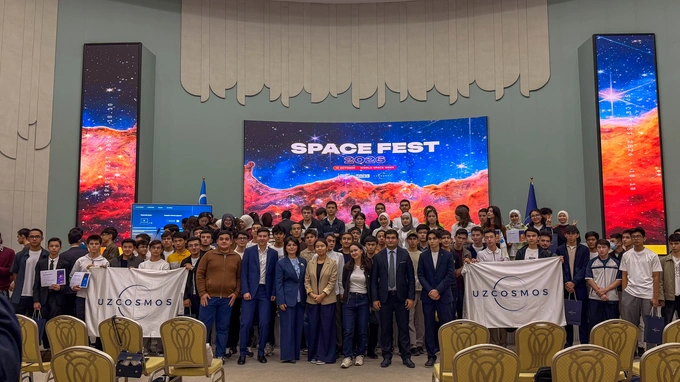
Last Saturday, the New Uzbekistan University hosted the second student festival Space Fest, timed to World Space Week. The organizers were the university's student club MUBL (Mirzo Ulugbek Legacy), together with the association of space clubs Space Alliance and the Uzbekcosmos agency, with support from ArticularUZ, Lumen Space Academy and ISEC. According to Gazeta, more than 400 people registered this year, compared with 200 last year, and the number of activities increased from four to eight. Tahir Kasimov, a lead specialist at Uzbekcosmos, explained the change in format by last year's experience: participants were more drawn to hands-on projects, so the emphasis was placed on venues where one could build something with their own hands.
Bottle Rockets in the Courtyard
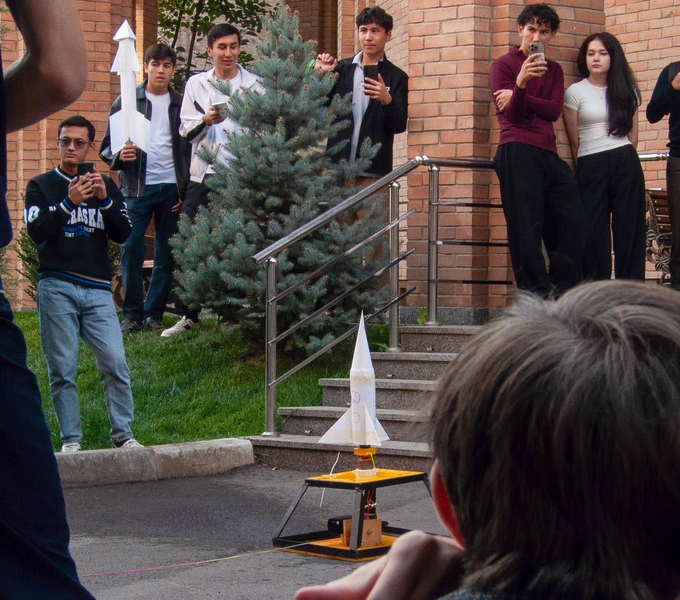
One of the main venues was the launch of homemade rockets in the university's inner courtyard. Under the rules, only materials provided by the organizers could be used: plastic bottles, thick cardboard, paper and tape. The winning team was the one whose craft stayed in the air the longest. For tenth-graders Ozodbek Azizov and Daler Tajimukhamedov from the Al-Beruni school, this was their first experience in rocketry. They noted the motivating atmosphere and the practical benefit: diplomas and participation in festivals will add to their portfolios when applying to engineering programs. During the launches, Kasimov himself joined the teams, explaining how lengthening the nozzle or adding mass to the nose affects flight stability.
Satellite Assembly and a Mission to Mars
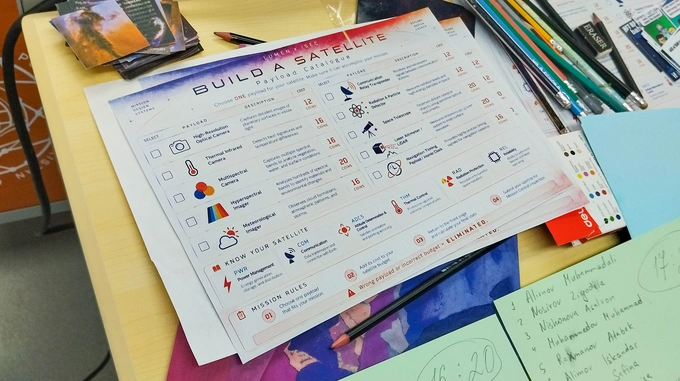
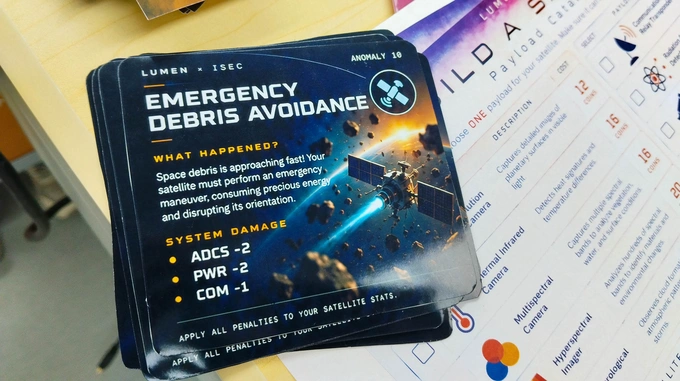
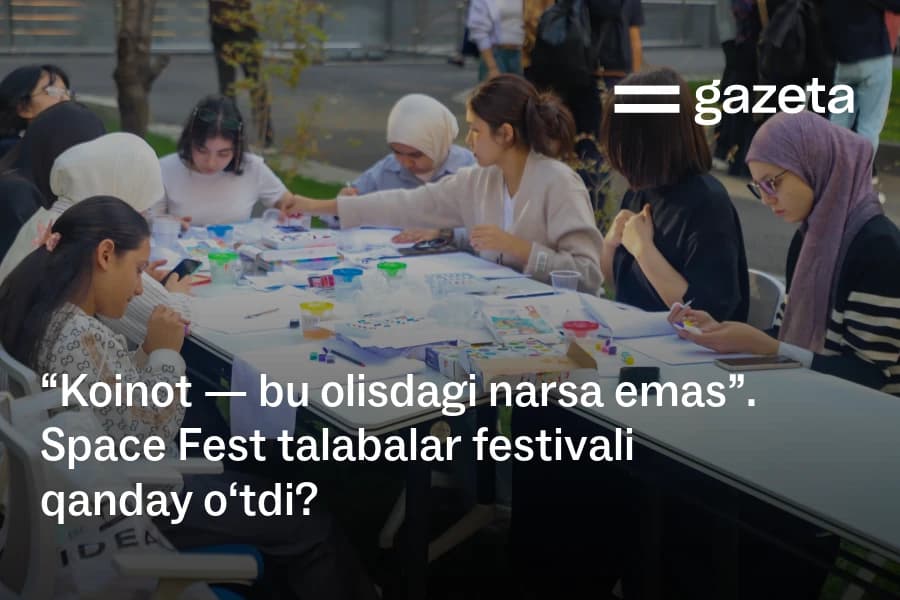
At the Build a Satellite venue, prepared by Lumen Space Academy and ISEC, teams of two received a virtual budget and a limit of 100 points, with which they had to 'buy' and balance the components of a space station: power, communications, control and orientation subsystems, plus the payload. A session lasted 20 minutes, with 15–20 participants rotating every half hour. After a project was submitted, the organizers 'injected' an anomaly — from a solar flare to a radio module failure; the winning craft was the one that completed the mission and survived the emergency. In the neighboring classroom, the Mars Transportation Challenge by ArticularUZ and Uzbekcosmos was underway: teams of up to six people planned the delivery of people and cargo to Mars over 180 conventional days with a conventionally unlimited budget, but only using existing or realistically achievable technologies. The projects were defended before university instructors.
The Experts' View
The jury of the Martian hackathon included Maxim Tyan, an associate professor of mechanical engineering at the New Uzbekistan University with 15 years of experience in the aerospace industry. In his view, the main benefit for participants is a first acquaintance with the logic of real development: to obtain funding, one must be able to write a proposal, and that is exactly how real projects are done. On the development of the industry in Uzbekistan, he said that the country, unlike Russia and the US, cannot build something enormous, so it is sensible to focus on satellites, mapping and data processing.
The MUBL Club and Paths into the Industry
One of the driving forces behind the festival was the MUBL club, led by third-year student Samira Ochilova. The club emerged two years ago from a selection process for a CanSat team building a microsatellite; the university's team won the UGCanSat competition held by Uzbekcosmos, after which the winners were offered to create a community — it started with 10 people. The club launched a six-month course in robotics and AI, and its members took third and fourth place at the Teknofest festival in Turkey. Today MUBL is part of Space Alliance, which unites the New Uzbekistan University, Inha University, Webster University, Westminster Lyceum and School No. 285. Kasimov noted that Uzbekcosmos wants to see similar clubs at every university, but the initiative must come from the students: an example is Webster University, where a female law student, after the UniSat project, proposed opening a club that gave rise to Lumen Space Academy, where students learn to design lunar rovers.
Awards and Career Paths
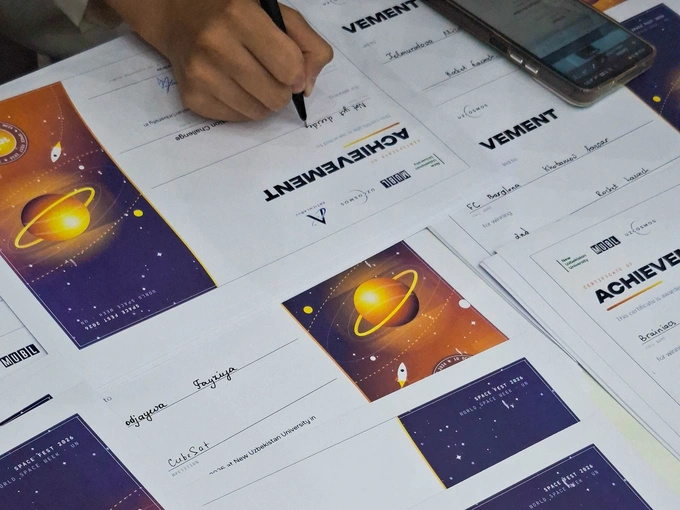
The festival concluded at 18:00 with an awards ceremony in the assembly hall: the winners received prizes and certificates from Uzbekcosmos. Kasimov emphasized that the main thing is a clear career trajectory in the industry. The agency offers eleventh-graders to pass an interview and apply through the El-yurt umidi foundation to foreign universities for aerospace programs with a guarantee letter of five-year employment at Uzbekcosmos. Senior students have access to internships in geographic information systems and artificial intelligence, and starting next year they will be taught to write scientific papers and submit abstracts to the International Astronautical Congress. 'Curiosity precedes learning,' Kasimov concluded.