The key facts
- October 27 election; per a Madad poll of October 14, the opposition has 50 seats and Netanyahu's coalition 47, with 61 needed
- Likud (18), Yashar Eisenkot (20), Bennett and Lapid's 'Together' (12), Ben-Gvir's 'Jewish Power' (8), Lieberman's 'Israel Our Home' (9)
- Palestinian parties — the Joint List (9) and Raam (6) — are rejected as coalition partners by both Netanyahu and the opposition
Election context
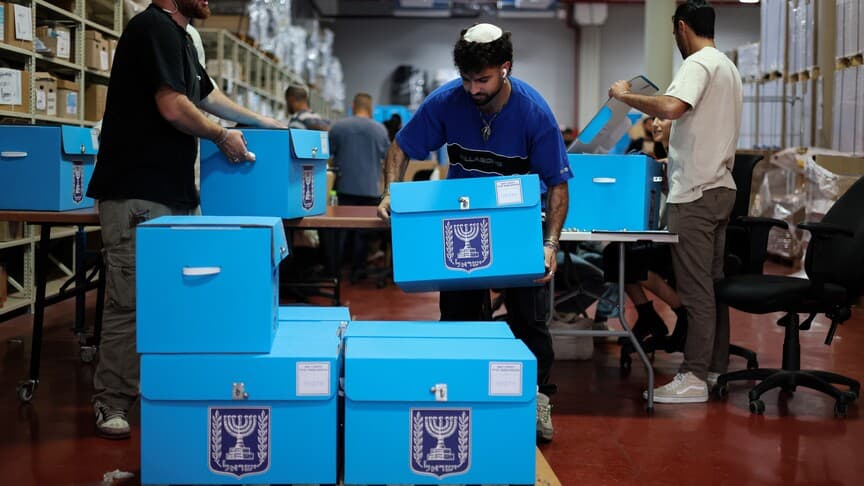
According to Anadolu, growing international recognition of Palestinian statehood and the UN investigation's finding of genocide in Gaza did not stop the leading candidates in the October 27 election from opposing Palestinian independence and promising further military action. Prime Minister Benjamin Netanyahu and his right-wing coalition promise to continue the policy in Gaza and the occupied West Bank, but key opposition figures also reject Palestinian statehood, criticizing Netanyahu more for failing to eliminate Hamas than for the destruction of Gaza. Seat projections are taken from the Madad poll of October 14: four coordinated opposition lists — 50 seats, the parties of the current coalition — 47; both sides fall short of the 61-seat majority.
The ruling coalition
Netanyahu's Likud (18 projected seats) has led the government since December 2022, under which the military campaign has destroyed Gaza and claimed, according to the outlet, nearly 75,000 lives. Netanyahu is subject to an International Criminal Court warrant on suspicion of war crimes, including starvation as a method of warfare. He insists that Hamas must fully disarm before the end of the Israeli occupation, and the party portrays Palestinian statehood as a security threat. The government has accelerated settlement expansion in the West Bank; in September at the UN, Netanyahu called reports of record settler violence 'a handful of juvenile delinquents.' Finance Minister Bezalel Smotrich (Religious Zionism, 6 seats) said in September on the Ynet podcast that the Palestinian Authority should be dissolved, the war extended to the West Bank ('do there what we did in Gaza'), and the Israeli-occupied areas of Gaza and about 82% of the West Bank annexed under the September 2025 plan. National Security Minister Itamar Ben-Gvir (Jewish Power, 8 seats) presented a plan to relocate 1.86 million Palestinians from Gaza over seven years under the name 'voluntary emigration,' advocates restoring Israeli settlements in Gaza, and in August 2026 called for killing '30–40' people in Gaza every night, stating that 'all of Gaza' belongs to Israel.
The opposition
The 'Yashar' list of former chief of staff Gadi Eisenkot leads with 20 seats. Eisenkot promised to end Hamas rule within 18 months of becoming prime minister — either through Donald Trump's framework plan or by military means. On October 11, on the Channel 7 podcast, he called the 'principle of two states for two peoples a mistake' and opposed incorporating millions of Palestinians into Israel. The 'Together' alliance of former prime ministers Naftali Bennett and Yair Lapid received 12 seats: Bennett rejects Palestinian statehood and demands the operation continue until Hamas is disarmed, and supports settlement expansion; Lapid in the long term supports two states but has not committed to halting settlement expansion. Avigdor Lieberman's 'Israel Our Home' (9 seats) proposes dissolving the Palestinian Authority, scrapping the Oslo Accords, transferring zones A and B of the West Bank to Jordanian administration while keeping zone C (about 60% of the territory) for Israel, and, regarding Gaza, cutting off water, electricity and fuel.
Other parties and Palestinian lists
The new list 'Amha Israel' of Ofer Winter (4 seats) opposes Palestinian statehood, supports relocating Palestinians from Gaza and drafting the ultra-Orthodox, which could cause friction with Netanyahu's religious allies — 'Torah and Shabbat' (8 seats) and Shas (7 seats), focused on religious institutions and army service exemptions. Shas supports the demilitarization of Gaza but opposes indefinite Israeli control; according to the Jerusalem Post, 'Torah and Shabbat' has no comparably detailed policy on Gaza. Another 4 seats go to the reservists' list of Yoaz Hendel and Yaron Zelucha. The Joint List (9 seats) and Raam (6 seats) could be decisive, but Netanyahu and leading opposition figures reject cooperation with Arab parties. Raam leader Mansour Abbas demands recognition of an independent Palestinian state and an end to the occupation; his party was part of the Bennett–Lapid government in 2021. Joint List leader Youssef Jabareen makes progress toward Palestinian statehood a condition for talks on supporting a new government. The outlet also recalls the International Court of Justice advisory opinion of July 2024, which declared Israel's presence on Palestinian territory unlawful and demanded an end to new settlement construction and the withdrawal of settlers.


