The key facts
- More than 600 actions across France; authorities estimate attendance at nearly 200,000 people, 40,000 of them in Paris
- Trade unions and 'yellow vests' join the students; Prime Minister Lecornu has set up a crisis cell
- Paris police banned marches in the city centre and near key government buildings; Nuñez allowed for the use of stun grenades
Mass protests ahead of the elections
After several weeks of student protests, France is preparing for nationwide demonstrations on Saturday over the cost of living. Organisers have created a website listing more than 600 planned actions across the country, as well as hundreds of other protest activities, including blockades of motorways and petrol stations. The actions are organised by the 'yellow vests' movement, which took to the streets against Macron and his government eight years ago; it called on teachers, students, workers, pensioners and farmers to take part via a social media appeal.
Attendance estimates and the authorities' preparations
Interior Minister Laurent Nuñez told the France 2 TV channel that 'fairly massive participation' is expected. According to a police source cited by AFP, the authorities estimate the number of participants at nearly 200,000 people, 40,000 of them in Paris. Prime Minister Sébastien Lecornu ordered the creation of a crisis cell to monitor the demonstrations. On Thursday he said he feared clashes after what he called 'urban violence' during the student protests, and described the situation in the country as a 'moment of fatigue' in 'an atmosphere of permanent crisis: war, inflation and cost-of-living problems'.
Restrictions in Paris and police readiness
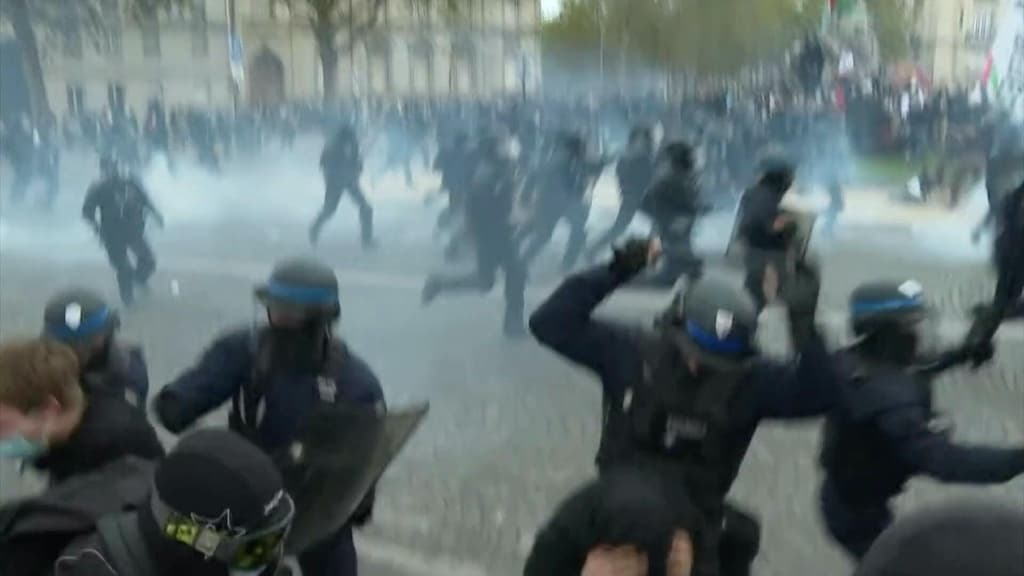
Paris police have banned a large march through the tourist and business centre of the capital and are negotiating an alternative route with the organisers. According to AFP, the main demonstration in Paris was due to begin at 14:00 (12:00 GMT) at the Place de la Bastille; Deutsche Welle reported that it would start at the Place de la République and head towards the north of the city. Paris police prefect Patrice Faure banned demonstrations around the Élysée Palace, the prime minister's residence and the Champs-Élysées. Nuñez said police may use stun grenades in the event of 'extremely serious urban violence'; he had previously suspended their use after a grenade tore off the hand of a 15-year-old teenager. A source in the interior ministry, speaking anonymously to AFP, said that 'riots are expected, especially at demonstrations in Paris and other major cities', citing the risk of violence from the 'ultra-left movement', and that the blocking of roads and key facilities 'will not be tolerated'. The protesters, for their part, have created a smartphone app showing in real time the location of police, tear gas and helicopters.
Demands and the context of the student protests
The protesters demand greater protection from inflation and increased spending on public services, above all education. The student protests began last month over conditions in schools: pupils complained about the absence of teachers and dilapidated buildings. Lecornu is trying to push a budget with spending cuts through parliament. According to DW, several demonstrators and more than 900 police officers were injured during the school protests; the internal police oversight body is investigating at least two dozen cases of alleged police violence. According to AFP, several teenage protesters suffered serious injuries and thousands were arrested. There is also public discontent over the perceived brutality of the police.
Political reactions
President Emmanuel Macron on Friday called for 'calm and respect', adding that the right to protest is inseparable from 'respect for people and property'. According to the government spokesperson, Macron said this week that the students' 'legitimate' demands 'are being used for political purposes'. The leader of the left-radical party La France Insoumise, Jean-Luc Mélenchon, supported the student protests and marched at the demonstrations on Tuesday; the government had accused the party of fomenting discontent, which it denies. Far-right candidate Marine Le Pen, whom polls name as the favourite in the elections, positions her party, the National Rally, on the side of the police. Party leader Jordan Bardella, according to DW, said at the Paris Motor Show: 'I am extremely worried. This will be a day of chaos for France.' Activist Benjamin Ball, who is working on the website for Saturday's demonstrations, told AFP: 'This is not just the yellow vest movement, not just a student movement — it is the whole people rising up, and that is why those in power are afraid.' Marie-Lou, an 18-year-old student from Lille, told AFP that she expects workers and 'yellow vests' to join the protesters, expressing the hope that 'all these different struggles can converge'.
Political background
The unrest is weighing on the final months of Macron's presidency ahead of the election of his successor in April and May. According to DW, the 'yellow vests' previously held mass weekly protests from November 2018 to June 2020, initially against rising fuel prices and later against the cost of living and economic inequality in general. Opposition parties and their candidates have seized on the instability ahead of the campaign.


