The key facts
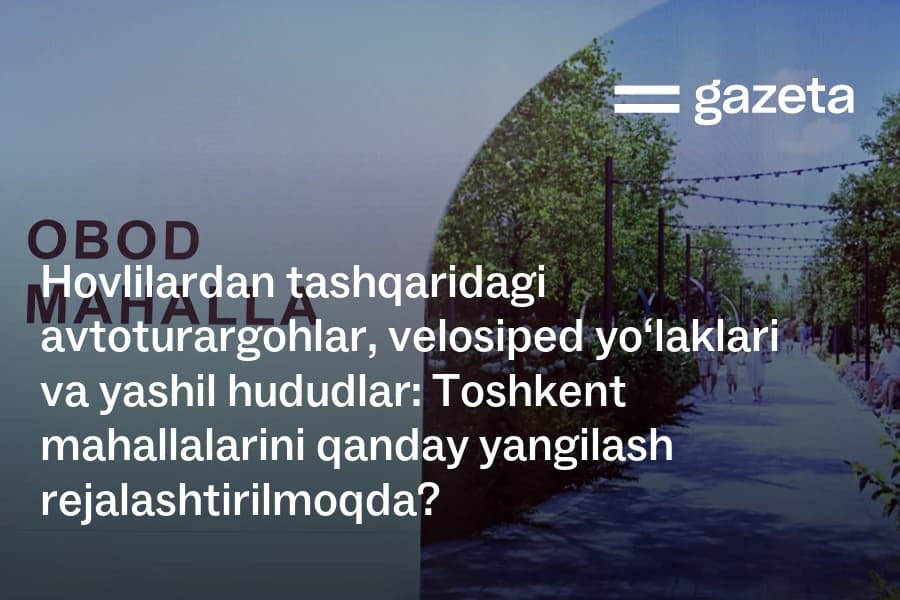
- The project to renew four mahallas of the Yashnabad district ('Vatandosh', 'Mokhinur', 'Al-Bukhari', 'Tong') covering 75 hectares with 18,386 residents is based on the '15-minute mahalla' principle
- By 2027, 100 mahallas of Tashkent are planned to be renewed, and 400 by 2030, creating 130,000 jobs
- The plan includes 2,000 new student places, four kindergartens with 540 places, three clinics, and moving parking outside residential courtyards
Presentation of Mahalla Renewal Projects
President of Uzbekistan Shavkat Mirziyoyev reviewed a presentation of projects for the improvement of mahallas, the construction of new schools and kindergartens, and the development of Tashkent's urban environment. Kun.uz dated the event October 14, while the press service of the head of state, according to Gazeta.uz, reported it on October 15. In particular, a project for the comprehensive renewal of four mahallas of the Yashnabad district was presented — 'Vatandosh', 'Mokhinur', 'Al-Bukhari' and 'Tong'. Their total area is 75 hectares, and 18,386 people live there.
The '15-Minute Mahalla' Principle
The project is based on the '15-minute mahalla' principle, which involves placing retail, household services, educational and medical institutions, recreation and sports areas within a convenient distance for residents. Tashkent khokim Shavkat Umirzakov, in an interview with the Uzbekistan 24 TV channel, said the concept was developed on the president's instructions given at a meeting in the Almazar district. According to him, special attention will be paid to five areas: social infrastructure, leisure, sports and health, retail, and ecology. Residents should be able to meet their basic daily needs within a 5–15 minute walk from home: sports grounds and essential stores within five minutes, household services within 10–15 minutes. 'We are completely changing the approach to the repair and improvement of mahallas, [introducing] the concept of a 15-minute comfortable environment,' the khokim said.
What Is Planned for the Four Mahallas of the Yashnabad District
In the territory of the four mahallas, green areas are planned to be expanded, a three-kilometer walking alley created, children's and sports playgrounds renewed, and a multifunctional sports facility built. By expanding existing schools, 2,000 additional student places are planned, and four kindergartens with 540 places and three clinics are also to be organized. The project provides for moving car parking outside residential courtyards, renewing public transport stops, creating safe pedestrian and bicycle paths, repairing the facades of 76 residential buildings and utility networks, improving street lighting, increasing the number of waste collection points, as well as creating new shops, cafes, household service enterprises and public spaces.
Program Scale and Jobs
Following the same principle, 100 mahallas of Tashkent are planned to be comprehensively renewed in 2027, and 400 by 2030. The program provides for the modernization of all infrastructure, including heating, drinking water supply, sewage, electricity and gas supply systems, repair of facades of apartment buildings, roads and sidewalks, and renewal of children's and sports playgrounds. The number of trees and shrubs per resident is expected to be brought in line with international standards. By 2030, 130,000 new jobs are expected to be created in the 400 mahallas, including 22,000 in 2027 in the first 100 mahallas. To this end, banks must establish a system for developing and implementing entrepreneurial projects on a 'conveyor belt' principle.
School Place Shortage in Tashkent
According to Kun.uz, with the growth of Tashkent's population, the shortage of student places is increasing: in the 2025–2026 academic year it amounted to 141,000. Over the next five years, the number of schoolchildren may grow by 71,000 (14%), reaching 212,000 by the 2030–2031 academic year. In this regard, by 2030 it is planned to create 48,000 new student places funded by the republican budget and 78,000 funded by the local budget. As a result, the school workload coefficient, according to the publication, will decrease from the current 1.4 to 1.2 by 2030.