The key facts
- Kenya has confirmed the first two Ebola cases in the country's history: the second patient is a 39-year-old relative of the first patient, who was already in quarantine.
- In the DRC, more than 9,000 cases and over 4,000 deaths have been confirmed since May; the worst-hit province is Ituri — 6,734 cases, 3,177 deaths.
- The outbreak is caused by the Bundibugyo virus, for which there are no licensed vaccines; healthcare workers are being vaccinated with Ervebo, whose effectiveness against this strain is unknown.
Second Case in Kenya
Kenya's Ministry of Health has reported the second Ebola case in the country's history. The patient is a 39-year-old man — a close relative of the first victim; according to the ministry, he was already in quarantine and under observation when the virus was detected. The patient was isolated as soon as he developed fever, weakness and joint pain, after which the test came back positive. The Ministry of Health stressed that early detection reduces the risk of virus transmission and that there is 'no evidence' of the infection spreading among the wider population. Of the patient's 128 close contacts, 113 have been traced.
The First Victim
The first victim was a Kenyan citizen who fell ill about a month ago. According to Health Minister Aden Duale, the 40-year-old man was treated in the DRC, then travelled overland to Kampala and flew to Nairobi on October 3 (according to DW, on a flight from Entebbe). He was hospitalised in Nairobi and died on October 5. The epicentre of the outbreak is in the Congolese province of Ituri; cases have also been recorded in Uganda and Kenya.
The Situation in the DRC
Since the outbreak was declared in May, more than 4,000 people have died in Congo (DW cites a figure of 4,400). As of October 13, more than 9,000 cases have been confirmed, and 899 patients are in isolation wards. The province of Ituri has recorded 6,734 cases, including 3,177 deaths. The ECDC warns that the outbreak remains a public health emergency of international concern, and response efforts are particularly hampered in remote areas. The WHO noted that contact tracing is a 'serious operational burden' and in recent weeks has fallen short of targets.
Vaccines and the Risk to Europe
The outbreak is caused by the Bundibugyo virus, for which there are as yet no licensed vaccines or specific treatments. Frontline healthcare workers in Congo are being vaccinated with Ervebo — the only licensed Ebola vaccine, developed against other strains. According to the UN, it has shown high effectiveness against the Zaire ebolavirus, but it is unknown whether it provides 'substantial protection' against the disease caused by the Bundibugyo virus. According to the ECDC, the risk of the infection being introduced into Europe remains very low: isolated imported cases cannot be ruled out, but the probability of numerous independent introductions is small even under a pessimistic scenario.
Criticism of Kenya's Preparedness
The authorities' response has been criticised by opposition figures and medical trade unions. Former Chief Justice David Maraga, a candidate for president in the 2027 elections, asked how a virus carrier passed screening at Jomo Kenyatta International Airport. Former Vice President Kalonzo Musyoka noted that the danger was detected by doctors at a Nairobi hospital, not by border services. Dennis Miskellah of the doctors' union believes Kenya's health system is not prepared for a pandemic and 'has not learned the lessons of COVID-19'; according to him, the country had enough time since May, when Uganda recorded nearly 20 cases. He also pointed to a lack of coordination between the Ministry of Health and the 47 semi-autonomous counties, limited isolation capacity, shortages of protective equipment in rural facilities, and a shortage of healthcare workers due to a freeze on public-sector hiring.
Government Measures and Public Sentiment
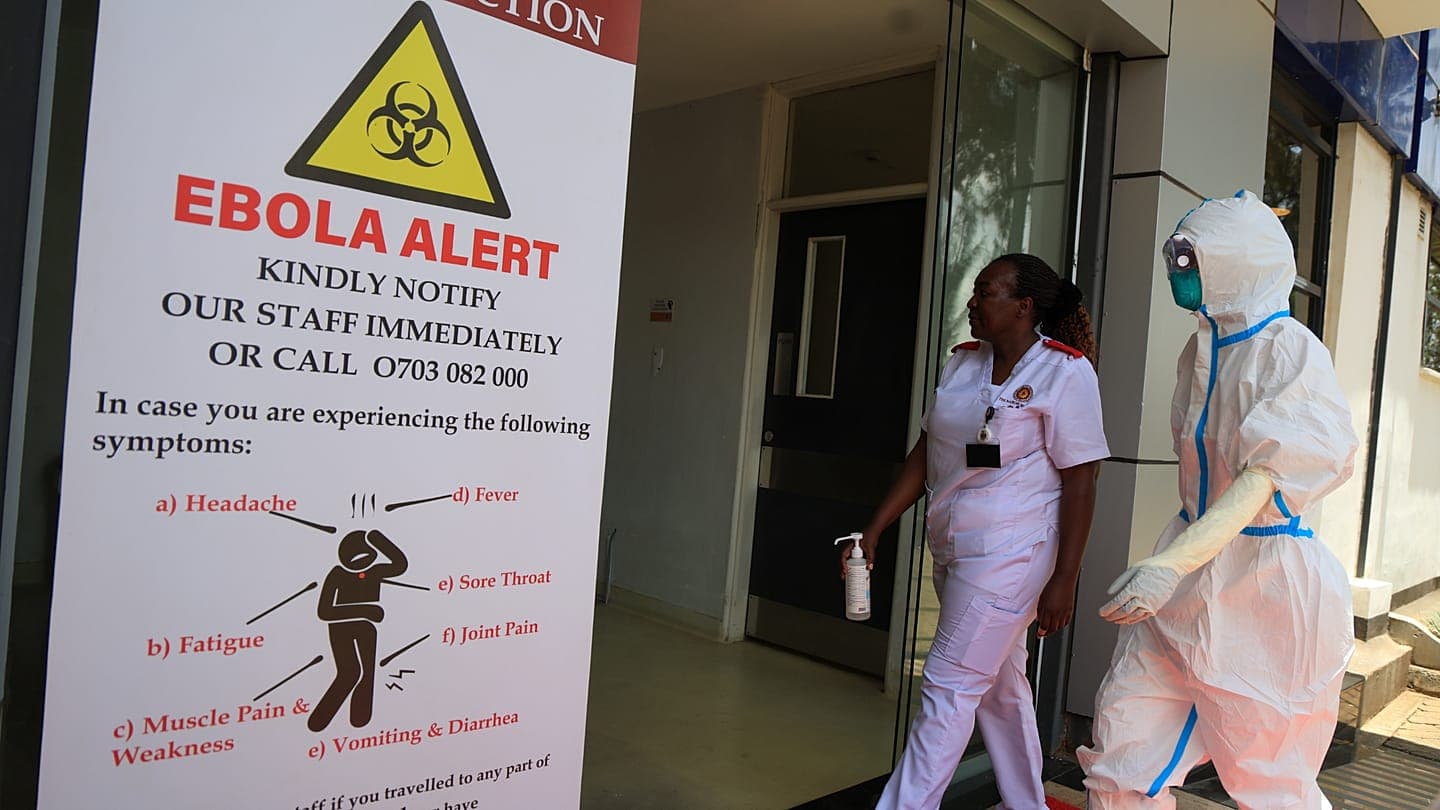
Kenya declared heightened readiness after the outbreak was declared in the DRC in May: isolation hospitals have been designated, screening at airports and borders has been intensified, mobile laboratories have been deployed, and flights from a number of African countries are directed to special terminals for checks. Arrivals from Congo, Uganda, Tanzania, Ethiopia, Angola, Zambia, Rwanda, Burundi, the Central African Republic and South Sudan are required to fill out a health declaration. Anxiety and scepticism about the authorities' preparedness are growing in society; the health ministry, through Aden Duale, is urging citizens to remain vigilant and seek medical care if symptoms appear. According to the WHO, symptoms develop 2–21 days after infection and in the early stages resemble malaria or typhoid fever.