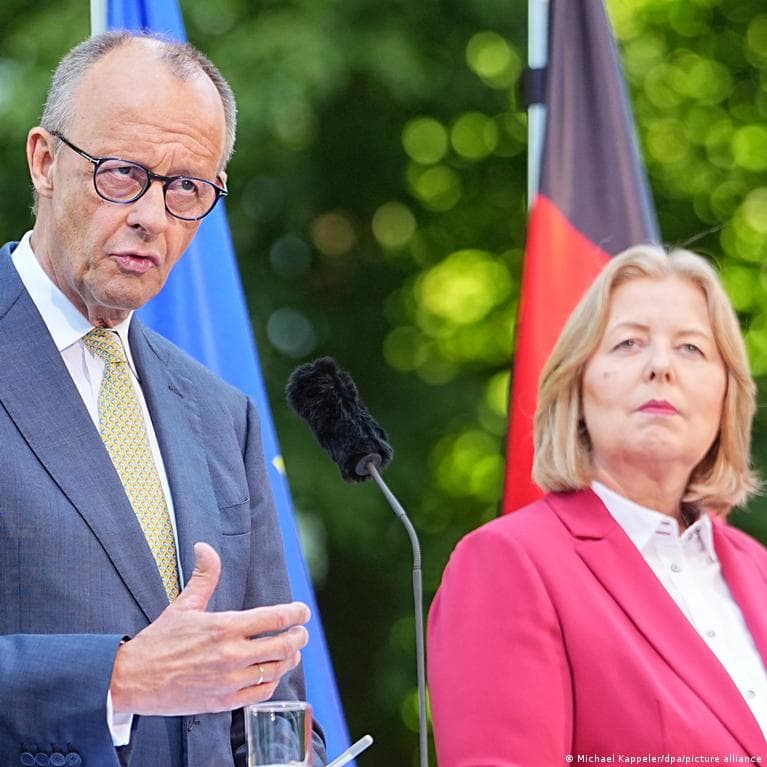
The key facts
- Bärbel Bas (58), Minister of Labour and SPD co-leader, resigned from all posts after the death of her stepdaughter.
- She also cited intensified public attacks, including from the CDU/CSU, as a reason.
- According to Süddeutsche Zeitung, Merz criticized her at a closed briefing; his spokesperson refused to confirm or deny this.
Resignation amid personal tragedy
On Monday, Germany's Minister of Labour Bärbel Bas, who also serves as co-leader of the Social Democratic Party (SPD), announced her departure from all government and party positions. The 58-year-old politician explained the decision by a personal tragedy: 'After the death of my stepdaughter, I realized that I need time to grieve,' her statement said.
Criticism from the coalition partner
Bas also wrote that the decision was influenced by ongoing criticism from the conservative governing parties CDU and CSU: according to her, 'public attacks on me, unfortunately including from the ranks of our coalition partner, continued to intensify' during this difficult period for her. As Minister of Labour, she was responsible for the complex pension system reform, including raising the retirement age, and some conservative politicians demanded in harsh terms that the project not be delayed.
The Chancellor's remark
According to the newspaper Süddeutsche Zeitung, Bas took one remark especially hard: at a briefing closed to publication with journalists, Chancellor Friedrich Merz (CDU) reportedly criticized her work pace while knowing about her personal tragedy. According to the outlet, Merz said that Bas was 'barely visible publicly' and did not put forward her own proposals. The Chancellor's press secretary refused to confirm or deny the report. Merz publicly expressed regret over the resignation and wished her all the best.
Reactions and assessments
Green Party co-leader Felix Banaszak, who knows Bas from their native Duisburg, told DW that harshness in politics is nothing new, but 'we need to find a different way of working if we do not want to keep burning people out.' He added that the SPD bears partial responsibility: no one in the party came to Bas's defense, and that 'it is naive to pretend that attacks on a man would have unfolded the same way.' Free University of Berlin researcher Mirko Liefke noted the growing escalation and speed of public debate due to social media, as well as the fact that women politicians are subjected to 'an exceptional level of misogynistic and sexualized abuse.' Mecklenburg-Western Pomerania Premier Manuela Schwesig (SPD) called the CDU/CSU attacks 'inhumane,' which drew sharp criticism from conservatives. Liefke interpreted the waves of public sympathy after resignations as a 'facade of care' linked to the general emotionalization of politics.
Context: hardening political climate
Bas's resignation became another example of the tightening tone of political debate in Germany. The number of official reprimands in the Bundestag has risen sharply, especially after the Alternative for Germany (AfD) entered parliament in 2017. Former SPD general secretary Kevin Kühnert, who resigned in 2024, told the newspaper Die Zeit in April 2025 that he constantly received threats from the far right and noted 'growing disrespect for dissenting views.' Liefke also recalled that politicians of earlier generations, such as Chancellor Helmut Schmidt (1974–1982), kept the public sphere separate from the private one and did not openly display emotions, whereas today personal stories make politicians 'more visible and more vulnerable.'
What comes next
Bas, who served as President of the Bundestag from 2021 to 2025, intends to keep her parliamentary mandate.


