The key facts
- The EU's trade deficit with China reached €360 billion last year and is expected to exceed it this year
- Merz demands 'significantly reducing' the EU budget compared to the European Commission's proposal; Kristersson calls the proposals 'simply unacceptable'
- Zelensky arrived at the summit on Friday and called for increased pressure on Russia and defense support for Ukraine
Economic challenges at the center of the agenda
Leaders of European Union countries gathered in Brussels for a two-day summit devoted to the bloc's main economic challenges, including competition from China. According to Deutsche Welle, on Friday the participants' attention will shift to support for Ukraine, with Ukrainian President Volodymyr Zelensky joining the discussion.
Trade deficit with China
The leaders are expected to discuss ways to eliminate the EU's large trade deficit with China, which reached €360 billion ($400.4 billion) last year and is forecast to exceed that level in the current year. The summit comes less than a week after the European Commission agreed with Beijing to limit imports of hybrid cars from China. In a joint statement, the leaders called on the European Commission to 'urgently expand the EU's toolkit with new mechanisms to better counter these imbalances.' The EU accuses China of unfair economic practices, arguing that state subsidies to Chinese industry create unequal conditions. Industry associations say that growing imports from China are leading to a rising number of factory closures in the bloc. Ahead of the meeting, German Chancellor Friedrich Merz and French President Emmanuel Macron jointly called for new EU measures against market-distorting practices. The leaders will also consider rising energy prices within the bloc as another factor reducing competitiveness.
The contentious 2028–2034 budget
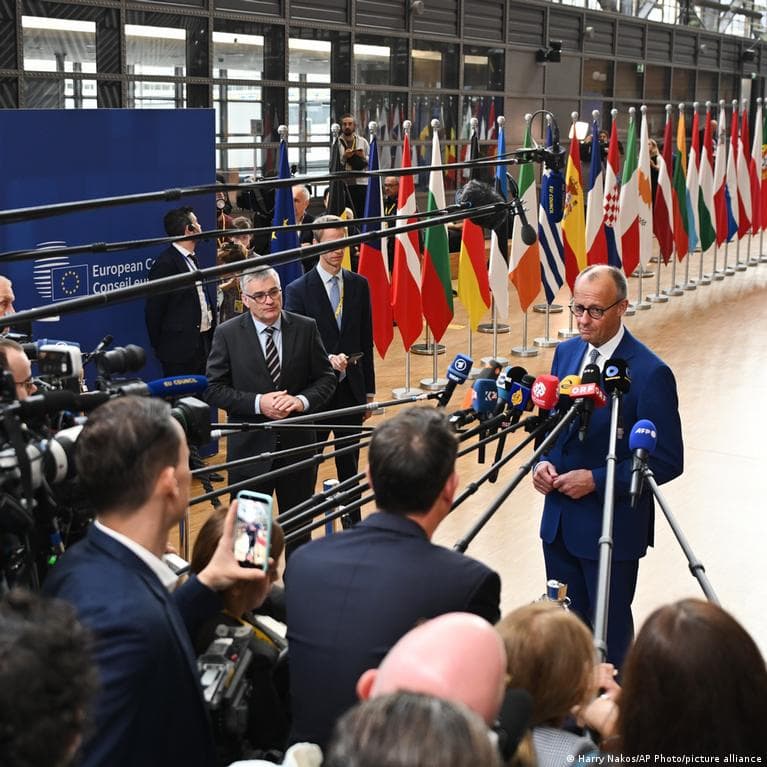
The bloc's seven-year budget for 2028–2034 is another contentious item on the agenda ahead of a special summit in November, where an attempt will be made to reach an agreement. The budget requires unanimous approval, and negotiations traditionally divide wealthier states from countries dependent on cohesion funds. Merz, who leads calls for a leaner budget, said upon arrival in Brussels: 'We are in very, very difficult negotiations about the future finances of the European Union. We must substantially reduce the overall budget compared to the commission's proposals. No EU member state can afford this.' Swedish Prime Minister Ulf Kristersson also called the proposals on the table 'simply unacceptable.' Italian Prime Minister Giorgia Meloni is among the most active defenders of traditional funds, including cohesion payments; on Wednesday she told parliament that she sees no 'contradiction between old policies and new priorities.' No breakthrough is expected at the current summit, but leaders hope for a compromise by the end of the year. Pressure is mounting due to elections next year in a number of countries, which could make an agreement acceptable to all harder to achieve.
Support for Ukraine
On Friday, EU leaders will turn to the situation in Ukraine, to which Zelensky has been invited. 'All of us in Europe want the end of this war. And for that, strong signals are needed — more real pressure on Russia and more defense support for Ukraine,' he wrote after arriving. He is expected to urge the bloc to step up support for Kyiv amid intensified Russian strikes ahead of winter, which have killed dozens of civilians. The importance of European aid is growing as the administration of US President Donald Trump continues its ambivalent line on the conflict, reflected, in particular, in a recent deal to import Russian diesel fuel despite international sanctions. Trump has also called for replacing Zelensky as Ukraine's leader.