The key facts
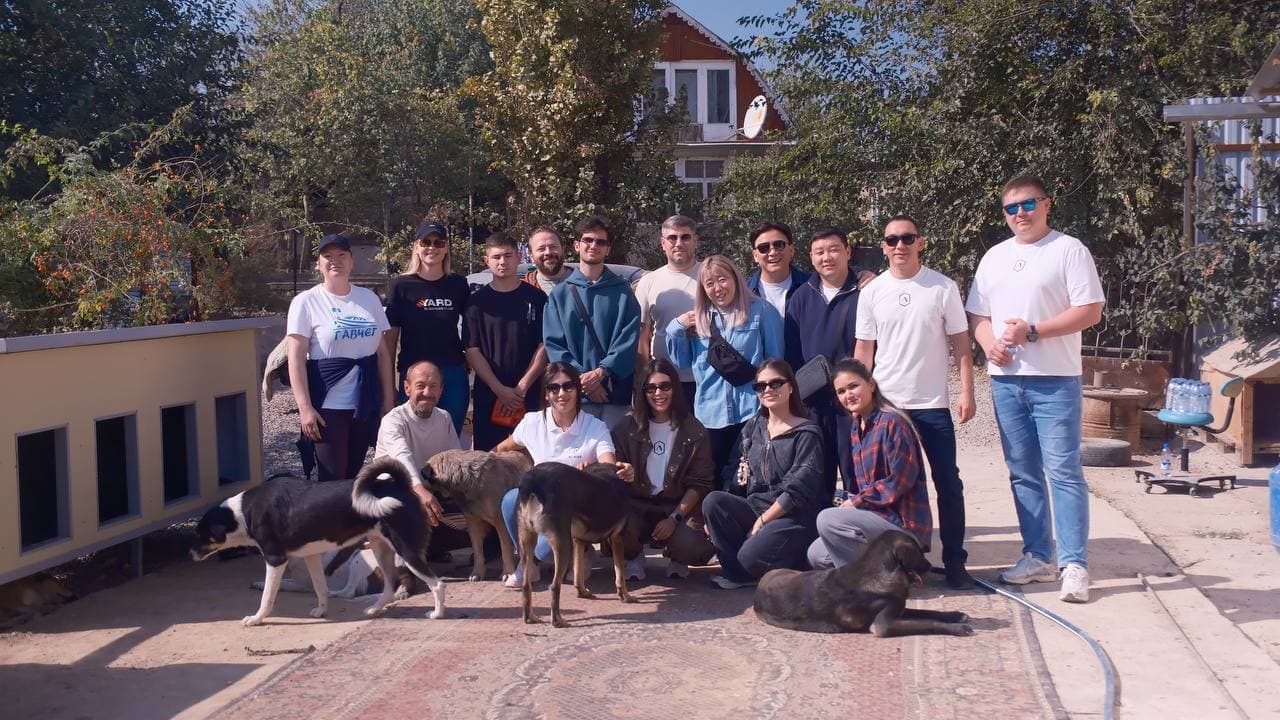
- AL-BINA and partners are helping the Gavcheg shelter, which houses more than 800 dogs, by solving infrastructure problems rather than providing one-off aid.
- The support includes drilling the shelter's own well for constant access to water and 50 kennels from TERLEPLAST designed for 200 dogs.
- Basic shelter expenses amount to about 20–25 million soums per week; the initiative is part of the AL-BINA FRIENDS partner ecosystem.
AL-BINA, together with partners SEKTA, YARD Business Club, PLOV & LOUNGE, TARLEPLAST, YAMAGUCHI, PEKHAR, IPOTEKA BANK, DOMIO, SHAKHIN GROUP and ELECTRIX, decided to support Gavcheg not with one-off aid, but by taking on the solution of several of its basic infrastructure problems.
The UzNews article about the Gavcheg shelter showed not just the story of a man who has been rescuing animals for many years. Behind it lies an enormous amount of daily work: more than 800 dogs, constant expenses for food, treatment, vaccination and sterilization, as well as the constant need to find funds for keeping the animals. According to Gavcheg itself, basic shelter expenses alone amount to about 20–25 million soums per week.
For the shelter's founder Sergei Rusnak, the problem has long been not simply taking in another animal. He speaks of the need to create conditions in which the dogs already rescued can live with dignity. At Gavcheg, the animals move freely around the territory most of the time, rather than being kept in individual enclosures or on chains.
It was precisely this aspect of the story that caught the attention of the development company AL-BINA.
From publication to concrete help
After the article was published in the media, the AL-BINA team learned more about Gavcheg's story and decided not to limit itself to an emotional reaction or a one-time delivery of food.
The company says that one thing especially struck them: part of the shelter's problems is related not to daily expenses, which cannot be covered once and for all, but to basic infrastructure.
For example, the shelter lacks even elementary conditions for organizing its territory. One such issue is water. To provide the animals with water, shelter workers have to arrange its delivery, and the source is located at a considerable distance.
When it comes to hundreds of dogs, such a task becomes constant and very costly.
Therefore, AL-BINA, together with partners SEKTA, YARD Business Club, PLOV & LOUNGE, TARLEPLAST, YAMAGUCHI, PEKHAR, IPOTEKA BANK, DOMIO, SHAKHIN GROUP and ELECTRIX, went straight to the root cause of the problem: supporting the drilling of the shelter's own well on its territory.
This will significantly simplify Gavcheg's daily work and provide the animals with constant access to water.
The second task the team identified after getting to know the shelter was the lack of a sufficient number of shelters for the animals.
In addition, AL-BINA's partner company TERLEPLAST prepared 50 kennels designed for 200 dogs.
Thus, we are talking not simply about gifts for the animals, but about creating additional places where they can take cover and rest.
For AL-BINA, the approach itself matters here: to see the problem, understand what the shelter really needs, and help precisely at the point where assistance can change the daily conditions in which the animals are kept.
Why AL-BINA involves partners. AL-BINA FRIENDS: uniting business around shared values
AL-BINA FRIENDS is AL-BINA's partner ecosystem, which brings together companies from different fields to create additional value for clients and society.
Initially, this direction developed as a benefits program for AL-BINA clients. The company began bringing together partners from various fields, and thanks to this, the company's clients receive special offers, discounts and privileged terms from the partners.
But over time, the company saw that the potential of AL-BINA FRIENDS is much broader. If companies unite not only for commercial interests but also around shared values, they can jointly implement initiatives whose scale would be difficult for each of them to achieve individually.
Thus appeared the second important component of AL-BINA FRIENDS — uniting businesses to implement social and environmental projects.
Now the direction also works with initiatives aimed at helping people, supporting social institutions, protecting animals and improving the urban environment.
For the company, it is fundamentally important that AL-BINA FRIENDS remains not just a database of companies offering discounts.
“We want to build a community of like-minded people, where partnership benefits not only the business and its clients, but also the city in which we live and work,” — shared the commercial director of the development company AL-BINA.
The mission of AL-BINA FRIENDS is to unite business capabilities to create more value for people.
Why AL-BINA engages in social projects
For the company, this is a continuation of a broader philosophy.
AL-BINA operates in development and creates residential environments. Therefore, the company believes that a developer’s responsibility does not end at the boundaries of its own project.
It is about the city, its people, the environment, and the communities that exist alongside.
That is why the company consistently develops several social areas: AL-BINA ECO, projects supporting children and rehabilitation centers, years of work with the “House of Mothers,” and now support for the Gavcheg shelter.
These stories have different audiences and different tasks, but the common principle is the same: “If a problem exists near us and we can genuinely help — we should not walk past it.”
At the same time, the company strives, wherever possible, not merely to meet an immediate need, but to find a solution that will have a longer-term effect.
That is exactly why, in the case of Gavcheg, the choice fell on a water well and infrastructure for the animals.
What’s next?
Support for the shelter should not end with a single handover of aid.
For AL-BINA FRIENDS, it is important to continue developing a model in which more and more partners join social initiatives.
In this sense, the story of Gavcheg became another example: sometimes a single article is enough for thousands of people to learn about a problem, and then those ready to move from attention to action are found.
And this, perhaps, is the main continuation of the story after the UzNews publication: the problem was not just reported — people appeared who decided to take on part of it.
Advertising