The key facts
- YouTube Music introduces three categories for labeling AI tracks: Fully Gen AI, Partly Gen AI, and No Gen AI
- Labels will appear on the player page and in the main YouTube app; AI origin does not disqualify a track from monetization
- Other services are taking stricter measures: Deezer receives about 90,000 fully AI-generated tracks per day and excludes them from recommendations
New Labeling System
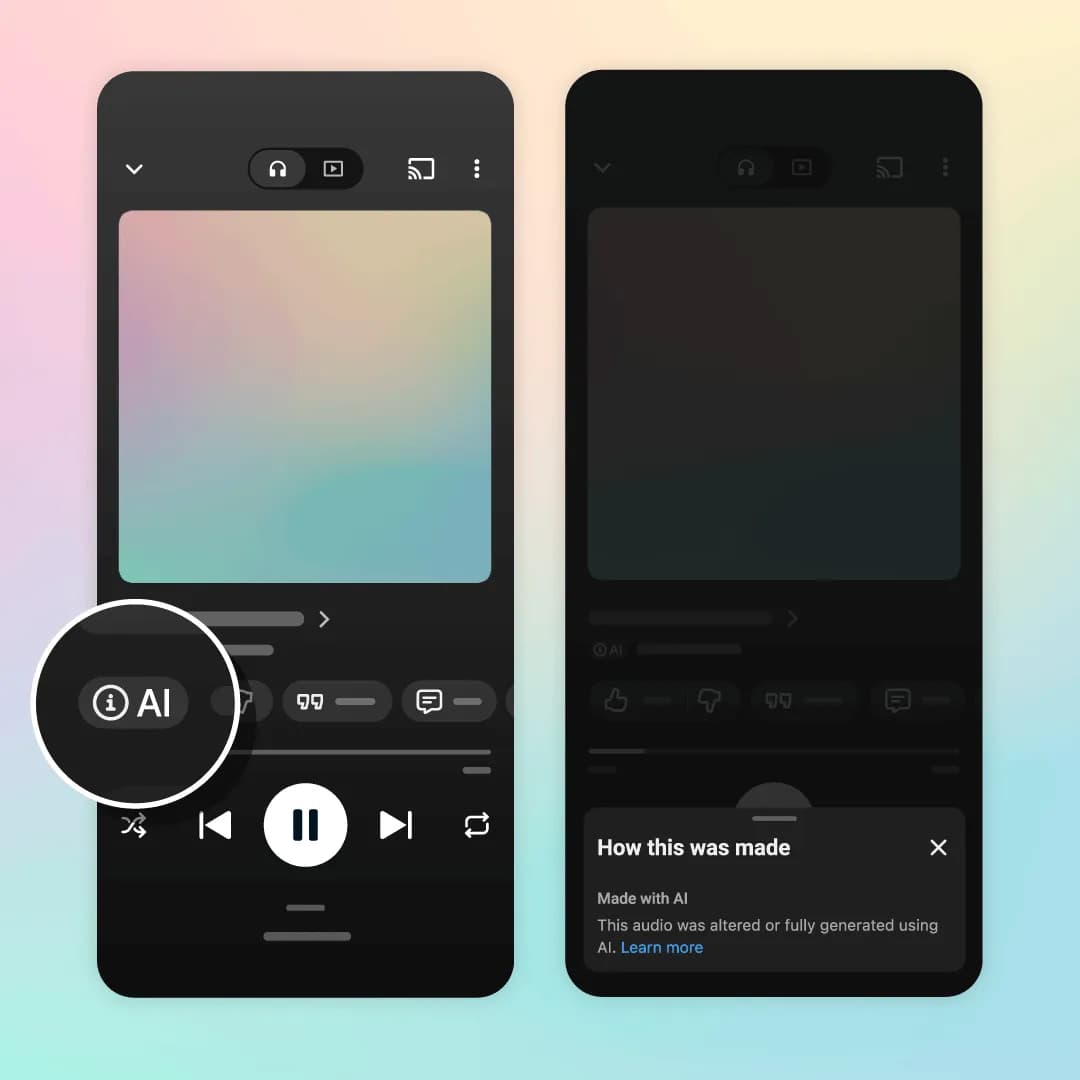
YouTube Music has announced the launch of a labeling system designed to increase transparency regarding songs created with generative AI. Listeners will be able to see whether AI was used in creating a composition, including songwriting and vocals. The label is displayed on the player page, and clicking on it reveals additional information about the specific role of AI in creating the track. According to TechCrunch, the labels will also apply in the main YouTube app.
Three Label Categories
YouTube said it worked with music partners and used its own detection tools to identify AI music. According to the service's help page, partners can indicate the use of generative AI in one of three categories: Fully Gen AI (entirely created by AI), Partly Gen AI (AI components combined with live elements from the artist), or No Gen AI. The latter category includes, in particular, tracks processed with pitch-correction tools like Auto-Tune.
Industry Context
The launch comes amid the rapid spread of AI music on streaming platforms, each of which is developing its own approach. Apple Music plans to introduce 'Made With AI' labels as part of its AI Transparency Tags later this year. Spotify already has AI labels and a spam filter for music. Deezer has taken a stricter stance: in July, the company reported receiving nearly 90,000 fully AI-generated tracks daily. Deezer labels detected AI music, excludes it from algorithmic recommendations and editorial playlists, and withholds royalties for fraudulent streams; the service is also working on an option for users to filter AI tracks. TIDAL labels recordings identified as fully AI-generated, allows listeners to turn them off, and excludes such recordings from royalty distribution.
YouTube's Approach
Unlike a number of services, YouTube is betting on disclosure rather than restrictions. The new labels are intended to inform listeners about the role of AI, but AI involvement itself does not make a track ineligible for monetization. YouTube is also experimenting with creating music using AI, including the Dream Track tool, which allows select creators to generate soundtracks with AI versions of participating artists' voices.


