The key facts
- The camp in Puerta del Sol emerged on 26 September after the eviction of a pensioner due to a sharp rent increase; the pensioner Maricarmen Abascal died in early October
- Sánchez's government failed to pass two urgent housing laws, leading to the scheduling of early elections for 29 November
- The government has ruled out clearing the camp, which irritates the Madrid authorities led by Isabel Díaz Ayuso
One month of the tent camp in central Madrid
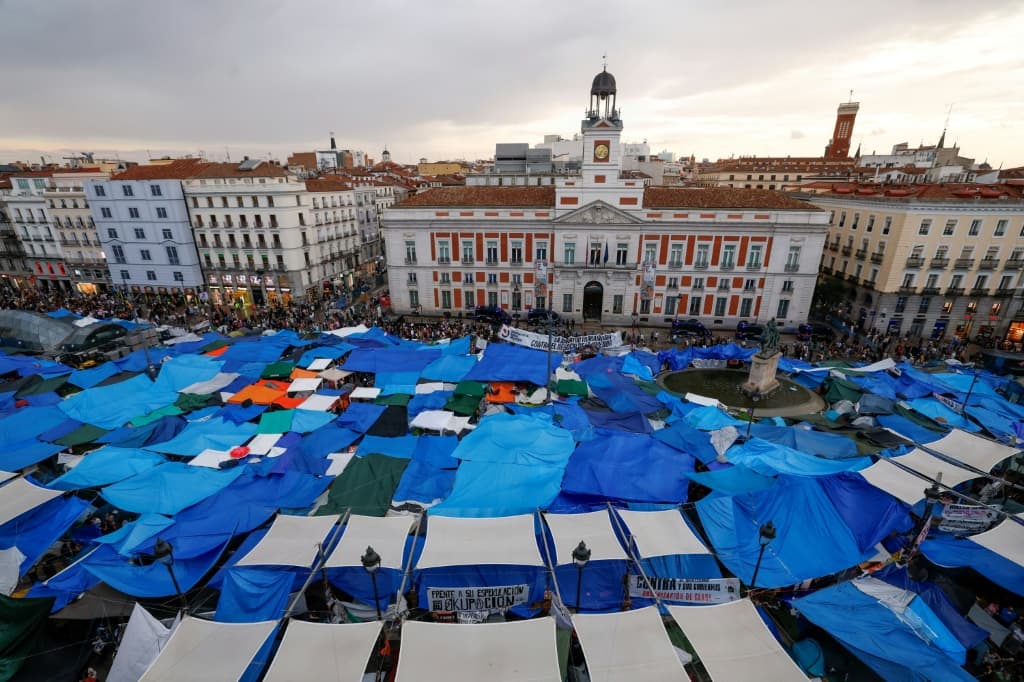
A month after the action began, the tent camp on Madrid's Puerta del Sol square has grown into a 'mini-city' with a dining hall, clinic, library and meeting space, where hundreds of people live. The camp has become the center of nationwide protests against the housing crisis — a topic key to the November elections. The camp arose on 26 September after the police eviction of an 87-year-old pensioner from the apartment where she had lived her whole life: the company that owned the property sharply raised the rent. This sparked protests across the country involving tens of thousands of people; tent camps also appeared in other Spanish cities.
Political consequences
The government of socialist Pedro Sánchez responded by presenting two urgent housing laws with restrictions on evictions and open-ended rental contracts, but the minority government failed to pass them through parliament. After that, Sánchez called early general elections for 29 November. 'We have achieved a lot; we managed to bring the elections closer,' said 22-year-old lab technician Marcos Navarro, who has been living in the camp since 27 September. He promised that activists would remain on the square 'until they kick us out or until everything truly changes.' The pensioner Maricarmen Abascal died in early October; an altar with candles and flowers has been dedicated to her in the camp.
How the camp is organized
Rows of tents under a canopy form 'streets' and 'squares' named after different themes: 'Rage,' 'Tear down the walls,' Gaza and Maricarmen Abascal. Anthropologist and dancer Soufiane Ben called the camp 'a modern dystopian micropolis.' In the camp clinic, nurses, doctors, psychologists and social workers work in shifts; according to 42-year-old health worker Orlando Santander, first aid is mostly provided for injuries from police batons, while other doctors nearby run private practices for oncology patients.
Reaction of the authorities and residents
The government has ruled out clearing the camp — unlike the police clearing of similar housing protests in neighboring Portugal — which irritates the conservative city and regional authorities. 'They are killing all business in central Madrid. But not only that — it is also an image of Spain before the world,' said Madrid regional head Isabel Díaz Ayuso, a fierce critic of Sánchez. Her government unsuccessfully tried to remove the camp through the courts, and police blocked far-right groups that tried to clash with activists and tear down tents. Leather workshop owner Pedro Mora says he has lost a third of his income because of the protest, while Alba Varela, owner of the feminist bookshop 'Mujeres,' supports the activists, allowing them to use the toilet, charge their phones and rest.
Context of the movement
In Madrid, housing costs often consume half of the average salary in Spain. Activists draw inspiration from the movement's spread across the country and from protests in other European countries — in France, Italy and Albania. 'We inspire many, definitely in Europe, and I think Spain is a country that has always had a lot of fighting spirit,' said 26-year-old anthropologist Ayla Herrero.