The key facts
- The wedding consists of betrothal and crowning and usually lasts 40–60 minutes
- Baptism of both spouses, confession and communion are required; a civil registry certificate is often requested
- The sacrament is not performed during multi-day fasts and on the eve of strict fasting days
The Meaning of the Sacrament
A wedding in the Orthodox Church is a sacrament in which God blesses the union of a man and a woman. Unlike a civil registry office registration, which records the marriage from the state's point of view, a wedding gives the union a spiritual dimension: the spouses make vows before God. According to the publication's explanation, the sacrament symbolizes the union of Christ with the Church, where the husband becomes the head of the family and the wife the helper and support of her husband.
How the Ceremony Proceeds
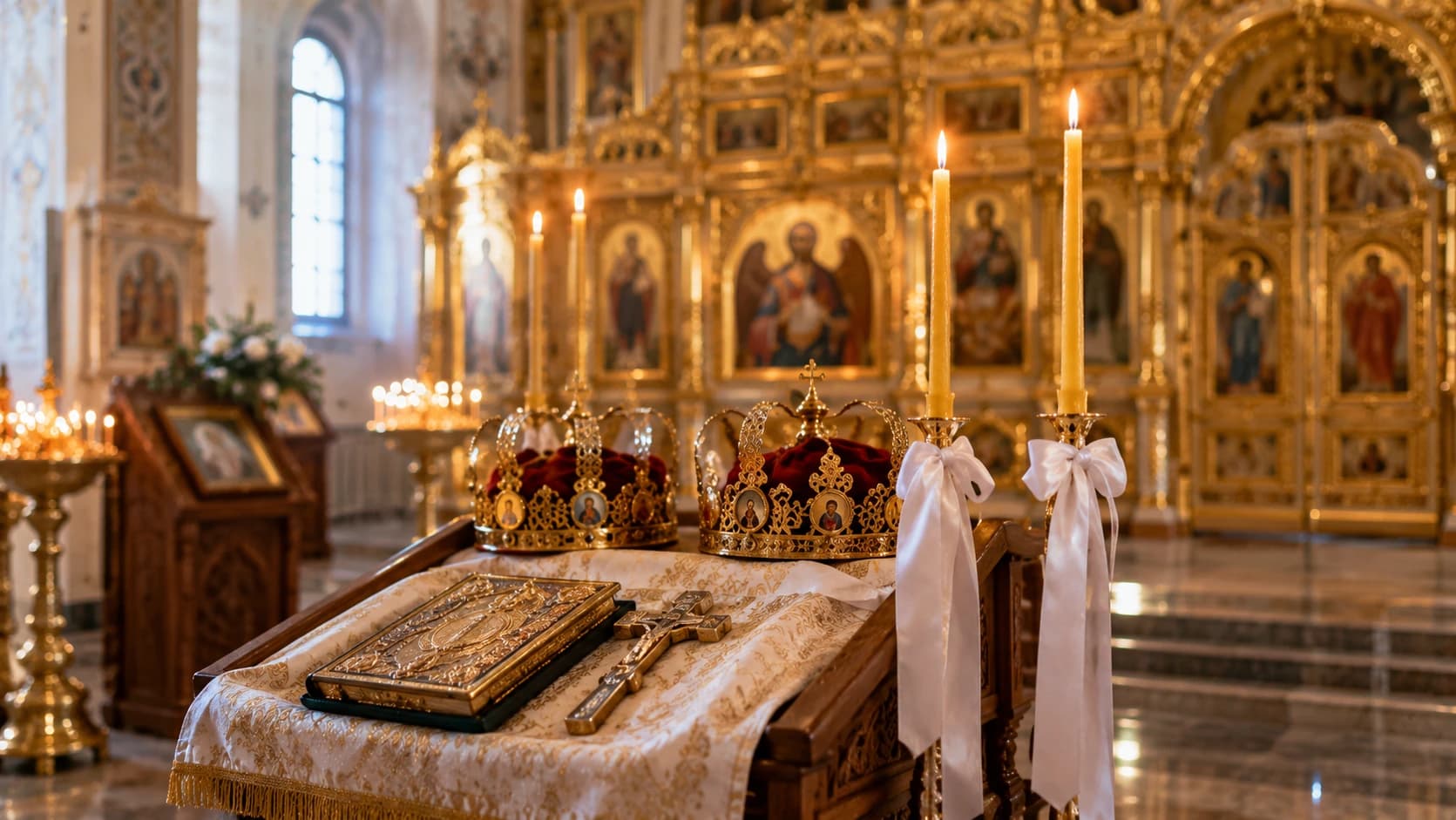
The sacrament consists of two parts: betrothal and the wedding itself. The priest blesses the bride and groom and puts rings on them — a sign of fidelity. The couple is given wedding candles symbolizing the purity of their intentions. Then prayers for peace, love and patience are read, and crowns are placed on the spouses' heads — an image of glory and a reminder of the feat of family life. The spouses drink three times from a common cup of wine and walk around the analogion three times while troparia are sung. The priest asks questions about the voluntary nature of the union, removes the crowns and says the concluding prayers. Details may vary from church to church, but the general sequence remains the same.
Conditions and Preparation
Both spouses must be baptized; if in doubt, their status should be clarified with a priest. Before the sacrament, it is customary to confess and receive communion. In most churches, a certificate of marriage registration at the civil registry office is requested. Among the items needed are rings; wedding candles, a towel (rushnyk) and icons of the Savior and the Mother of God are often brought; it is best to clarify the exact list at the chosen church. The ceremony usually takes 40–60 minutes. During the service, attendees are asked to keep silence, not to use phones and not to take photos or videos without a blessing. Clothing should be modest, and women's heads must be covered.
Choosing a Church and Preparatory Conversations
There are no strict rules when choosing a church: the publication advises relying on one's inner feelings, learning the history of the church and meeting the rector. It is important to take into account the rules of the particular church: in some places weddings are performed only after catechetical conversations, in others — by prior appointment. It is recommended to agree on the date and time several weeks or months in advance. In many churches, one or two conversations about the meaning of the sacrament are held before the wedding.
Wedding Dates
Weddings are not performed during the days of multi-day fasts — Great Lent, the Apostles' Fast (Petrov), the Dormition Fast and the Nativity Fast — nor on the eves of strict fasting days or before major feasts. Popular periods: Krasnaya Gorka (the first Sunday after Easter), the time between the Petrov and Dormition fasts, the period from Epiphany to the beginning of Great Lent (excluding Christmastide and Maslenitsa), as well as the time after the Protection (October 14) — but this is a tradition of individual parishes, not a general rule.
Remarriage and Attire
If the marriage has already been registered at the civil registry office, this is not an obstacle to a wedding — on the contrary, the certificate is often required as proof of the legality of the union. Remarriage is more complicated: a wedding is possible, but only with the blessing of a bishop and after consideration of the circumstances, with a personal appeal to a priest and the collection of documents. As for the dress: usually the same dress is worn for the wedding and the registry office; a floor-length dress with long sleeves made of flowing fabric will do. Tight-fitting or revealing clothing is not recommended. There are no strict rules about color; light shades are usually preferred, and white symbolizes purity and innocence.