The key facts
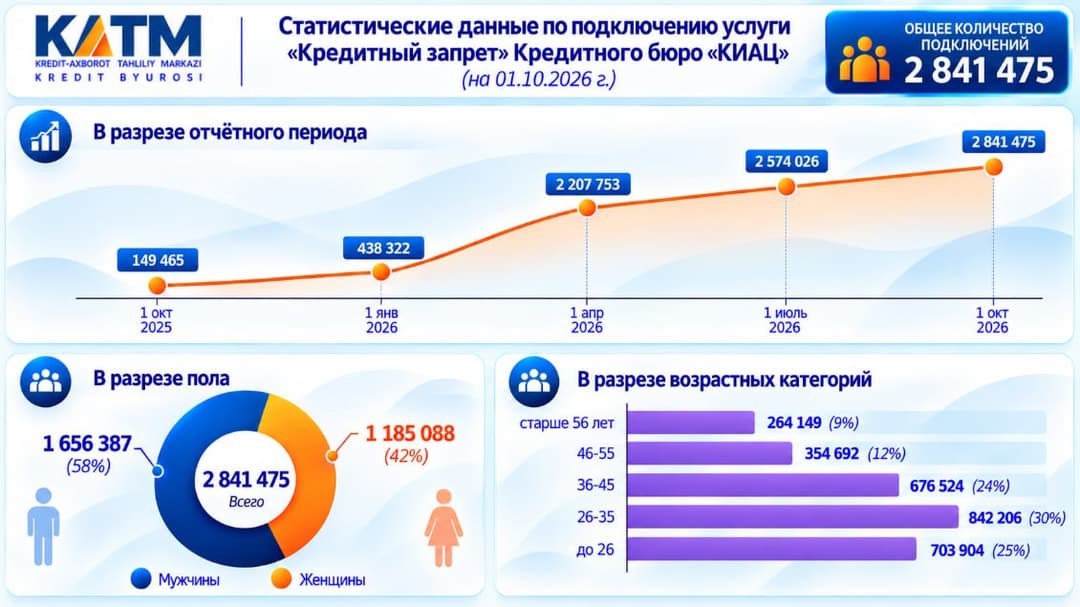
- As of October 1, 2026, 2,841,475 people had set a self-ban on loans: 1,656,387 men (58%) and 1,185,088 women (42%)
- Over three months the number of users grew by 267,449 people (10.4%), year over year — 19-fold
- The service is free, there are no restrictions on setting or lifting the ban; it was launched on June 6 to protect against loans taken out by fraudsters
Growth in the number of service users
According to the Credit Information Analytical Center (CIAC), as of October 1, 2026, 2,841,475 individuals had subscribed to the 'Credit Ban' service. As of July 1, 2026, there were 2,574,026 — thus, over three months the number of users increased by 267,449 people, or 10.4%. According to CIAC data cited by Kun.uz, compared with the same period last year the figure grew 19-fold, and since the beginning of the year — 6.5-fold.
Who sets the ban
Of the total number of users, 1,656,387 are men (58%) and 1,185,088 are women (42%). By age groups, the largest share falls on citizens aged 26–35 — 842,206 people (30%). Under 26 — 703,904 people (25%), 36–45 — 676,524 (24%), 46–55 — 354,692 (12%), older than 56 — 264,149 (9%).
The essence of the service
A self-ban on issuing loans is a voluntary decision to temporarily or indefinitely forgo the possibility of obtaining loans, microloans and credit cards. The service of entering personal data into the register of persons prohibited from concluding loan agreements has been available to individuals since June 6. It allows citizens to block the conclusion of a loan agreement in their name without their participation or knowledge. The service is provided free of charge and without restrictions — the ban can be set and lifted an unlimited number of times.
How to enable or disable it
The service can be enabled or disabled in several ways: via the CIAC mobile app ('Popular Services' section, 'Credit Ban' option — Android, iOS and Huawei AppGallery); on the credit bureau's website via a personal account or the call center (+998 71 203-47-47); on the Unified Portal of Interactive Public Services (my.gov.uz) via the 'Setting or lifting a ban on concluding a loan agreement' service; as well as through Public Services Centers.
Why the service was introduced and anti-fraud measures
The self-ban option was launched to prevent fraud related to concluding loan agreements without the citizen's participation or knowledge. According to data cited by Daryo.uz, over five years cyber fraudsters stole more than 1.9 trillion soums in Uzbekistan, of which 4% came from online loans taken out in someone else's name. Under a resolution of the Board of the Central Bank, which comes into force on April 22, for citizens in whose name fraudsters took out an online loan, the accrual and collection of interest, penalties and fines is suspended. If a credit organization withheld from the victim amounts under the online loan or related payments, they are returned to his or her bank card or specified account on the basis of a court decision or ruling.