The key facts
- Spain spends about €34.287 billion a year on defense — more than six times Morocco's amount (€5.645 billion), but Morocco has more military personnel (195,000–200,000 vs 116,700) and rocket artillery, which Spain has lacked since 2011
- Morocco's first F-16 Block 72 made its maiden flight on October 6 in Greenville; the US approved the delivery of 25 such aircraft and signed a 2026–2036 cooperation roadmap with Rabat
- Spain dominates at sea: five F-100 frigates, the LHD Juan Carlos I and submarines, whereas a submarine fleet has historically been Morocco's weakness
Morocco's rearmament under Madrid's watch
The first F-16 Block 72 fighter of the Royal Moroccan Air Force made its maiden flight on October 6 in Greenville (South Carolina), Lockheed Martin reported. The aircraft is undergoing testing before delivery to the customer after program delays. This is the most visible detail of a rearmament that is being closely watched in Spain. According to Euronews, Madrid retains the budget advantage and controls the sea, while Rabat has a larger army and rocket artillery, which the Spanish Army has not had for 15 years.
Spending: a gap of more than six to one
According to Sipri, Spain allocated about €34.287 billion to defense in 2025 — 50% more than a year earlier, raising the share of military spending to 2.1% of GDP. Morocco spent €5.645 billion versus €4.920 billion in 2024, remaining Africa's second military investor after Algeria (€22.660 billion). The gap is explained by the size of the economies: Morocco's GDP for 2025 amounted to €138.668 billion, Spain's about €1.69 trillion, i.e. 12 times larger (World Bank).
Contested figures on Moroccan spending
The frequently cited claim that Morocco spends 10% of GDP on defense does not match Sipri data: the institute estimates the country's military spending in 2025 at 3.54% of GDP. The 10% figure more likely refers to the share of defense in government spending, which Sipri estimates at 10.28%. Morocco's 2026 finance law authorized multi-year commitments of the defense ministry totaling 157.170 billion dirhams (about €14.7 billion) — this line is often presented as a single year's spending. In reality, 55.300 billion dirhams (€5.157 billion) will be paid out in 2026. Spain reached 2% of GDP in 2025 and expects to consolidate that level, remaining the only ally to reject the 5% target by 2035.
Personnel: Rabat's advantage
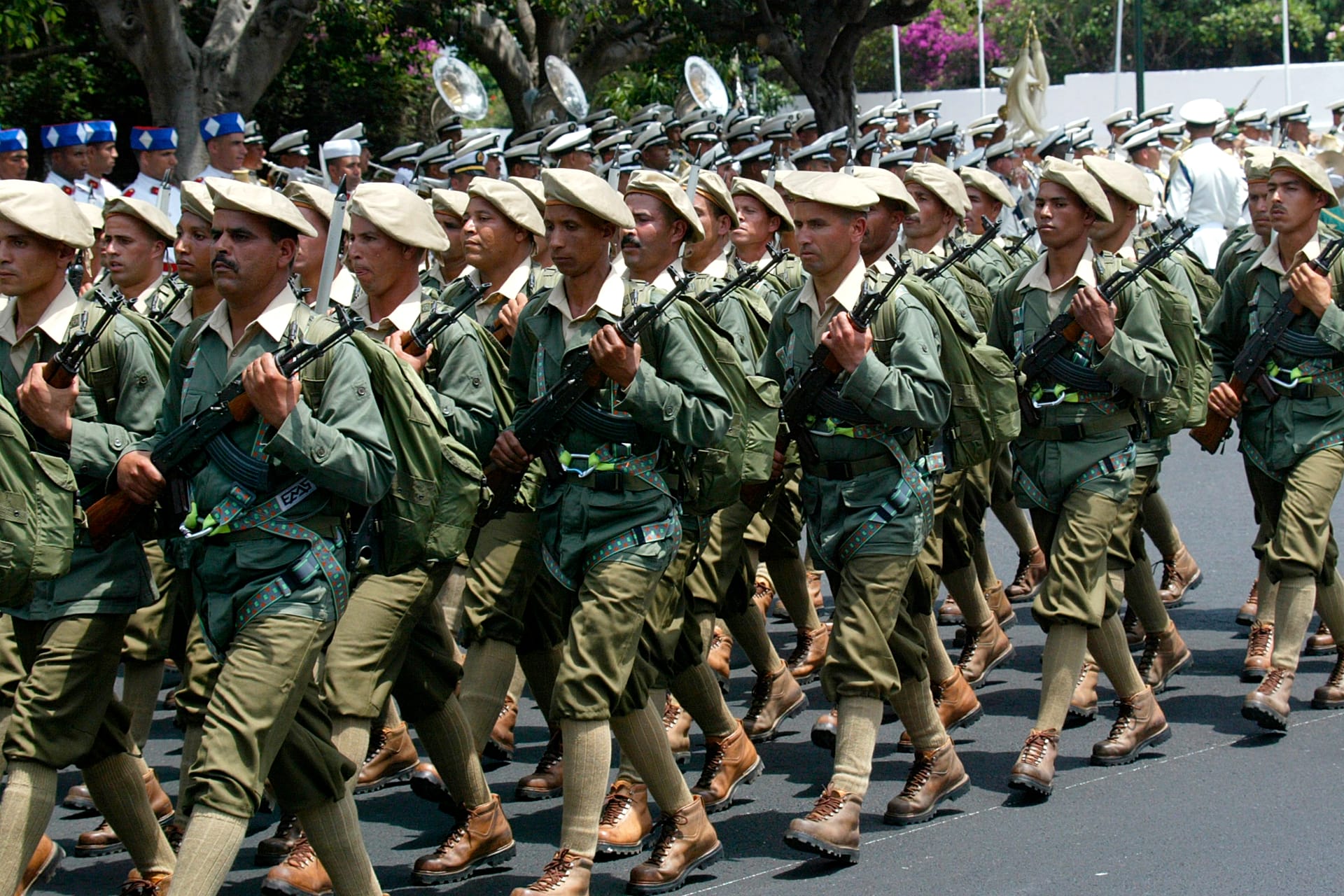
According to several matching estimates, Morocco has between 195,000 and 200,000 active-duty troops and about 150,000 reservists, and it retains compulsory military service, reinstated in 2019. Euronews urges caution about the figure of 400,000 that has spread through the media: it comes from the Global Firepower card updated on January 21, 2026, and at the time of writing had not been confirmed by independent databases. Spain has a personnel problem: as of January 1, 2025, there were 116,739 troops on active duty — below the legally established minimum of 130,000 — and the year ended with a further reduction of 832 service members. In reserve, at the start of 2024, there were 3,091 volunteer reservists.
Air power: Eurofighter vs F-16 Viper
According to the World Air Forces 2026 directory (FlightGlobal), Spain has 81 EF-18 Hornet fighters and 67 Eurofighters, with 45 more on order; the first two-seat Halcón left the factory in Getafe on June 1, with the second batch to arrive from 2030. The long-term outlook is uncertain: Spain postponed the F-35 purchase in August 2025 in favor of European projects, and in June 2026 the FCAS program effectively collapsed due to disagreements between France and Germany — Paris intends to develop its own aircraft alone. Morocco in 2019 received US approval to buy 25 F-16 Block 72 for about €3.380 billion plus 23 upgrade kits for its existing F-16s. Talks on F-35s for Rabat, according to specialized outlets, have advanced (32 aircraft, about €13.5 billion over 45 years with maintenance), but there is no official confirmation — the deal would require approval from the US administration and Congress. As for helicopters, Morocco has received 12 of the 24 ordered AH-64E Apaches (the rest in 2026–2027), while Spain is upgrading 18 Tigers to the MKIII standard. Morocco has also completed acceptance of the Israeli Barak MX air defense system: three batteries and 225 interceptors with a range of up to 70 km (per the SIPRI database).
Ground forces and rocket artillery
On land, the potentials are closest. Morocco operates American M1A2 Abrams tanks — an estimated 200 vehicles in service with 150 more ordered (exact figures are closed). Spain has 220 Leopard 2E and about fifty Leopard 2A4s, which are planned to be upgraded to the 2A8 standard. The most visible asymmetry is in MLRS: Global Firepower attributes 185 systems to Morocco and none to Spain — the capability was lost after the Teruel system was withdrawn in 2011. Morocco combines Chinese systems with the Israeli PULS and awaits HIMARS deliveries (Washington approved the sale of 18 launchers). There is a paradox: the Spanish Silam program was supposed to rely on the PULS, but the contract was cancelled due to the government's embargo on Israeli military technology; on December 30, 2025, Escribano and Rheinmetall Expal presented a national alternative to the Defense Ministry. Meanwhile, the Moroccan army is receiving 8x8 WhAP armored vehicles assembled within the country.