The key facts
- More than 600 demonstrations across France; the Interior Ministry reported 272 detained by midday, more than 130 in Paris
- In Marseille and Lille protesters stormed city halls, in Lyon the tourist office was set on fire, windows of CNews and Europe 1 were smashed
- The actions united student protests, trade unions and the 'yellow vests' against the backdrop of the 2027 presidential election
Scale of the actions and detentions
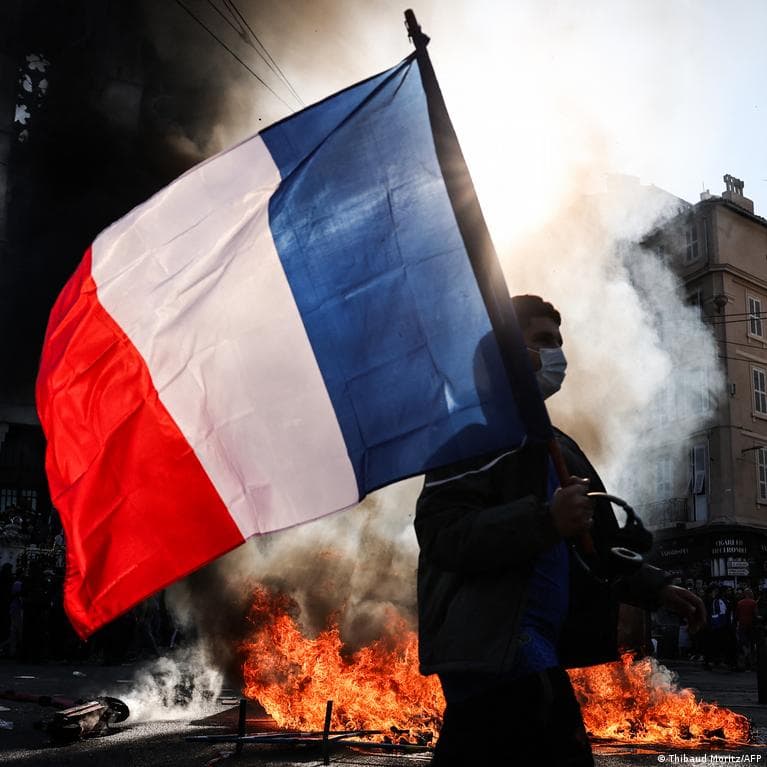
On October 17, 2026, mass protests against high prices, social inequality and the state of the education system took place in France. According to the organizers, more than 600 demonstrations were planned across the country. The Interior Ministry reported that by midday about 272 people had been detained after incidents in Paris, Marseille, Rennes, Toulouse and Angers; in the capital alone, according to police, more than 130 people were detained. A police source estimated the expected turnout at almost 200,000 people, including about 40,000 in Paris. The ministry blamed the riots on the 'ultra-left' and listed episodes: attempted looting, clashes with police, arson of street furniture and attacks on buildings of authorities and media.
Clashes and riots in the cities
In Paris and Marseille police used tear gas; in the capital a water cannon was also deployed. The main Parisian demonstration began at 14:00 (12:00 GMT) at the Place de la République; the authorities banned actions around the Élysée Palace, the prime minister's residence, the Champs-Élysées and the train stations, as well as a march through the city center. Already in the morning there were reports of scuffles in Saint-Denis and near the Gare du Nord. According to AFP, protesters smashed the windows of the offices of the TV channel CNews and the radio station Europe 1 in western Paris, and several parked cars were set on fire. In Marseille, demonstrators broke into the city hall, toppled a bust and smashed furniture before being pushed out by police; the mayor requested reinforcements, and a police station there was also damaged. In Lyon, the city's tourist office was set on fire; in Lille, protesters entered the city hall and ransacked the premises before leaving the building.
Who is protesting and why
The actions united several waves of discontent. In the autumn, student protests over the situation in schools continued — complaints about the lack of teachers and worn-out infrastructure; in recent weeks several demonstrators and more than 900 police officers were injured, and in one incident a teenager lost a hand due to a stun grenade. Internal police oversight is investigating at least two dozen cases of alleged police violence. Students were joined by trade unions and activists of the 'yellow vests' movement, which had earlier announced 'yellow-youth' demonstrations. Many protesters complained about inflation exceeding three percent against the backdrop of the war in the Middle East, and about police violence. According to a poll of 2,000 people, the cost of living worries about 45% of the French; purchasing power has been declining since 2024, and fuel has become more expensive since the start of the American-Iranian war. The country's public debt is forecast to exceed 120% of GDP next year — twice the EU limit of 60%.
Political context and reactions
The protests are taking place against the backdrop of preparations for the presidential election, which will replace Emmanuel Macron and will be held in about six months. The president on the eve called for 'calm and respect', emphasizing that the right to protest is linked to 'respect for people and property'. Prime Minister Sébastien Lecornu said on Thursday that the authorities fear violence: 'This is a moment of fatigue in the country. We are in an atmosphere of permanent crisis: wars, inflation, purchasing power problems.' The leader of the National Rally, Jordan Bardella, said he was 'extremely concerned' and expected 'a day of chaos for France'. Marine Le Pen wrote on X that 'looting, marauding, attacks on the police — the rioters have once again disgraced the October 17 demonstrations', and stated that the protesters' demands had been 'hijacked by the ultra-left'. Jean-Luc Mélenchon, who supported the student protests and took part in one of them on Tuesday, on the contrary, claimed that 'everything is proceeding peacefully' in most demonstrations, accusing TV news of 'flooding us with images of violence from dozens of cities'. The government blamed his party 'La France Insoumise' (Left France) for fomenting discontent, which the party denies.
Voices of participants
Demonstrators in Paris chanted 'Everyone hates the police' and 'Macron, resign'. 50-year-old actress Agnès told AFP: 'For years we have had problems with the climate, the economy and equality, but the government does nothing about it.' 18-year-old schoolboy Camille Alakhyan named the reasons: 'the 2027 elections, politicians who lie, the super-rich who have been taking more and more wealth for the last 10 years.' The head of the high school students' representation LSU, Riad Rani, said in Paris: 'The government is trembling, and rightly so, because when the French people are angry, they do not back down.' In Marseille, during the storming of the city hall, people shouted 'This is a revolution — we are taking the Bastille!', in La Rochelle they marched behind a placard reading 'Revolution or death', in Montpellier they unfurled a banner reading 'The people will win'. An official from Guéret named Franck said: 'At the end of the month I have nothing left. Prices are rising, but wages are not. We can no longer endure it, we are suffocating.'